
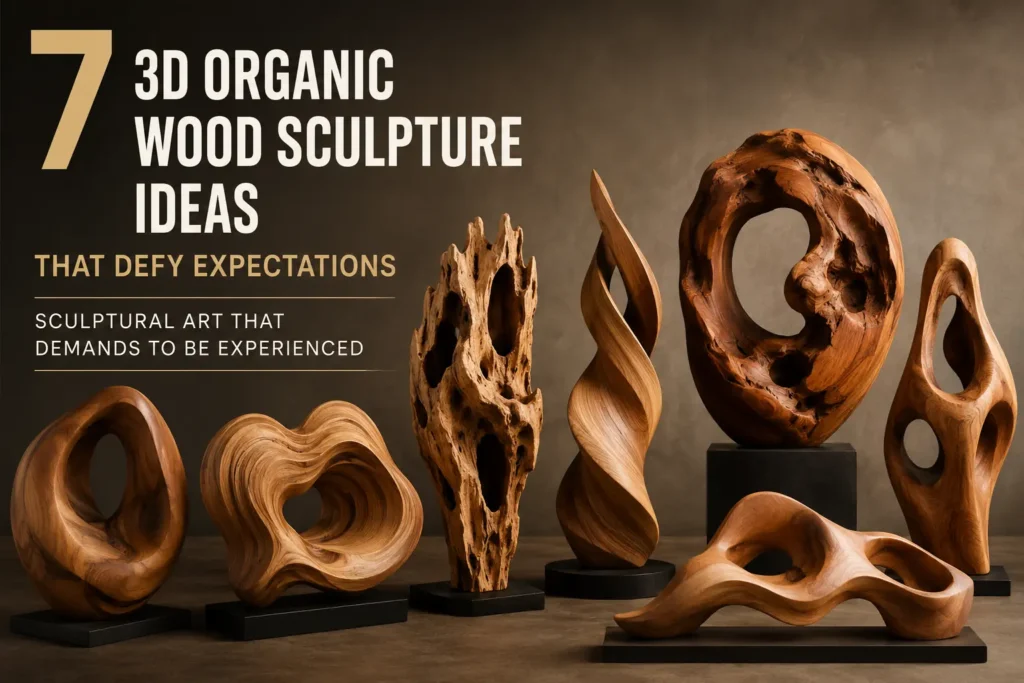
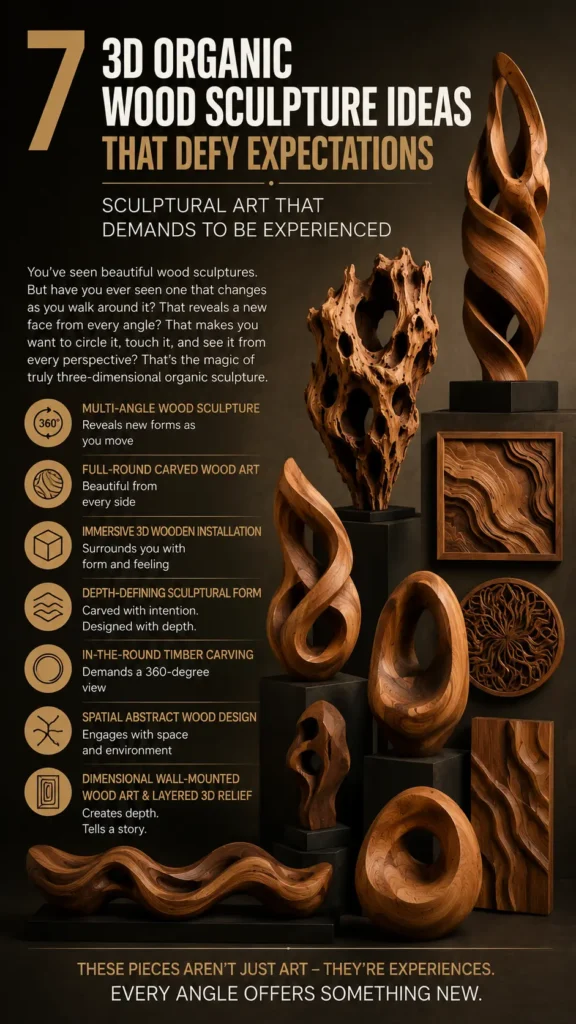
You’ve seen beautiful wood sculptures. But have you ever seen one that changes as you walk around it? That reveals a new face from every angle? That makes you want to circle it, touch it, and see it from every perspective? That’s the magic of truly three-dimensional organic sculpture.
Let me introduce you to 3D organic wood sculpture ideas that defy expectations. In this guide, you’ll explore multi-angle wood sculpture that reveals new forms as you move, discover full-round carved wood art that’s beautiful from every side, experience immersive 3D wooden installation that surrounds you, master depth-defining sculptural form, appreciate in-the-round timber carving that demands a 360-degree view, embrace spatial abstract wood design that engages with its environment, and incorporate dimensional wall-mounted wood art and layered three-dimensional wood relief that create depth on flat surfaces.
These pieces aren’t just art – they’re experiences. Every angle offers something new.
1. Multi-Angle Wood Sculpture – Revealing New Forms as You Move
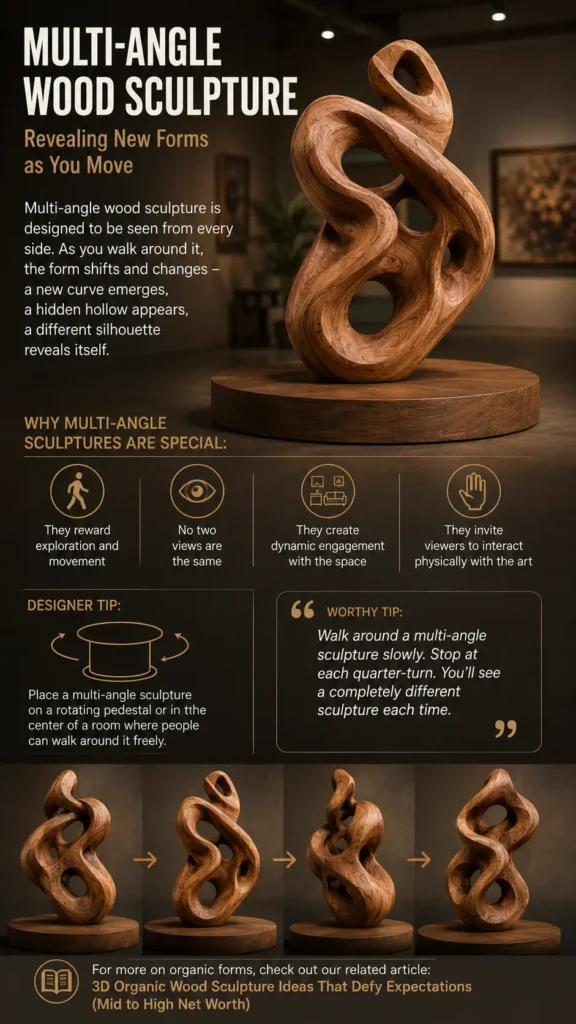
Multi-angle wood sculpture is designed to be seen from every side. As you walk around it, the form shifts and changes – a new curve emerges, a hidden hollow appears, a different silhouette reveals itself.
Why multi-angle sculptures are special:
- They reward exploration and movement
- No two views are the same
- They create dynamic engagement with the space
- They invite viewers to interact physically with the art
Designer tip:
Place a multi-angle sculpture on a rotating pedestal or in the center of a room where people can walk around it freely.
Worthy tip: “Walk around a multi-angle sculpture slowly. Stop at each quarter-turn. You’ll see a completely different sculpture each time.”
For more on organic forms, check out our related article: 3D Organic Wood Sculpture Ideas That Defy Expectations (Mid to High Net Worth)
2. Full-Round Carved Wood Art – Beauty Without a Bad Side

Full-round carved wood art is sculpted completely in the round – finished on all sides, with no flat back or hidden surfaces. It’s designed to be placed anywhere, seen from any angle, and admired from every perspective.
Characteristics of full-round carving:
- No flat or unfinished surfaces
- Every side is carved, sanded, and finished to the same standard
- The form is complete and self-contained
- Often placed on a pedestal or plinth
Best woods:
Cherry, walnut, or butternut – woods that carve cleanly and finish beautifully on all sides.
Where to place:
- On a pedestal in an entryway
- In the center of a large room
- In a gallery or museum setting
Worthy tip: “Full-round carving is the ultimate test of a sculptor’s skill. Every angle must be perfect – there’s nowhere to hide.”
You Might Like : The Elowen Live-Edge Floating Vanity: A Sculptural Masterpiece for the Modern Bathroom
3. Immersive 3D Wooden Installation – Art That Surrounds You
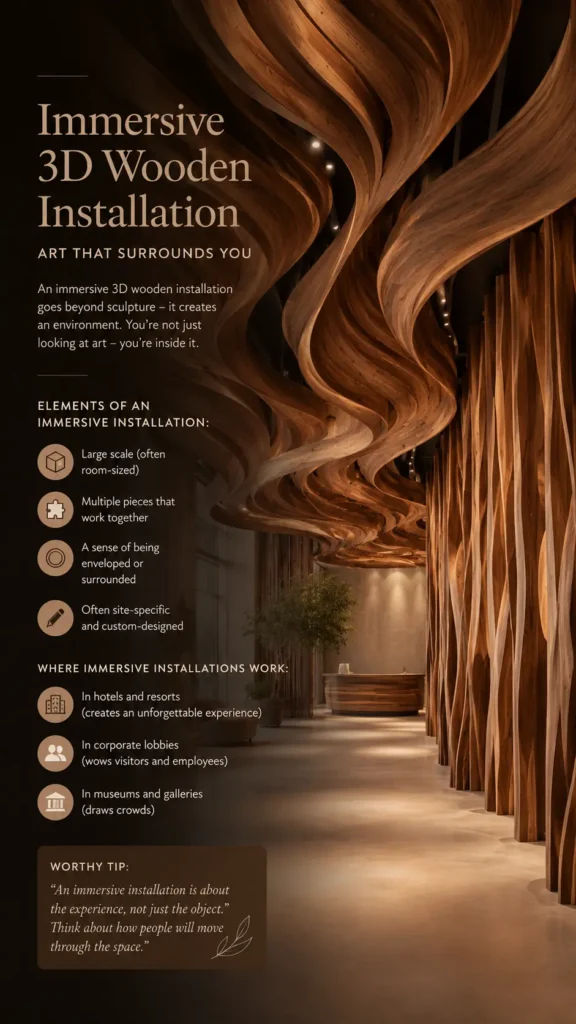
An immersive 3D wooden installation goes beyond sculpture – it creates an environment. Imagine walking into a room where wood flows around you, overhead, underfoot, and on all sides. You’re not just looking at art – you’re inside it.
Elements of an immersive installation:
- Large scale (often room-sized)
- Multiple pieces that work together
- A sense of being enveloped or surrounded
- Often site-specific and custom-designed
Where immersive installations work:
- In hotels and resorts (creates an unforgettable experience)
- In corporate lobbies (wows visitors and employees)
- In museums and galleries (draws crowds)
Worthy tip: “An immersive installation is about the experience, not just the object. Think about how people will move through the space.”
4. Depth-Defining Sculptural Form – The Power of Shadows

Depth-defining sculptural form creates visual depth through carving, layering, and strategic shadowing. The piece appears to have multiple layers, with some elements pushed forward and others receded into the background.
How depth is achieved:
- Extreme undercutting (carving behind the surface)
- Layered elements (foreground, midground, background)
- Strategic lighting that creates shadows
- Contrast between raised and lowered areas
Best woods:
Maple or basswood (for intricate detail) or walnut (for dramatic contrast).
Where to place:
- Where raking light can emphasize the depth (near a window or spotlight)
- In a space with variable lighting (the piece changes throughout the day)
Worthy tip: “The shadows are as important as the wood. A depth-defining piece changes throughout the day as the light shifts.”
5. In-the-Round Timber Carving – Sculpting All Sides

In-the-round timber carving is the traditional approach to sculpture – you work the entire piece, turning it constantly to ensure every side is finished. It’s the most demanding form of carving, but the results are breathtaking.
Techniques for in-the-round carving:
- Constant rotation of the piece (on a carving stand)
- Repeated checking from every angle
- Building the form in layers, not all at once
- Leaving no side until last (everything develops together)
Designer tip:
When commissioning an in-the-round piece, give the artist photos of the space from multiple angles. They need to understand how the piece will be seen from every side.
Worthy tip: “An in-the-round piece should look good from the top, the bottom, the sides, and everything in between. It should be beautiful when the lights are on and when they’re off.”
6. Spatial Abstract Wood Design – Engaging With Its Environment
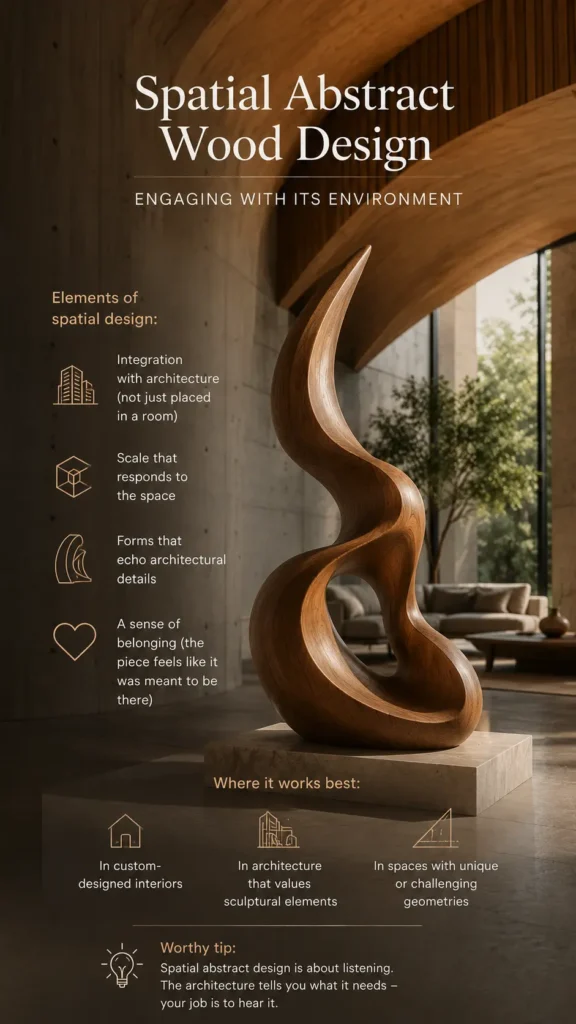
Spatial abstract wood design doesn’t exist in isolation – it responds to the architecture around it. The curves echo the angles of the room, the scale matches the volume of the space, and the placement creates a dialogue with the environment.
Elements of spatial design:
- Integration with architecture (not just placed in a room)
- Scale that responds to the space
- Forms that echo architectural details
- A sense of belonging (the piece feels like it was meant to be there)
Where it works best:
- In custom-designed interiors
- In architecture that values sculptural elements
- In spaces with unique or challenging geometries
Worthy tip: “Spatial abstract design is about listening. The architecture tells you what it needs – your job is to hear it.”
7. Dimensional Wall-Mounted Wood Art – Depth on Flat Surfaces
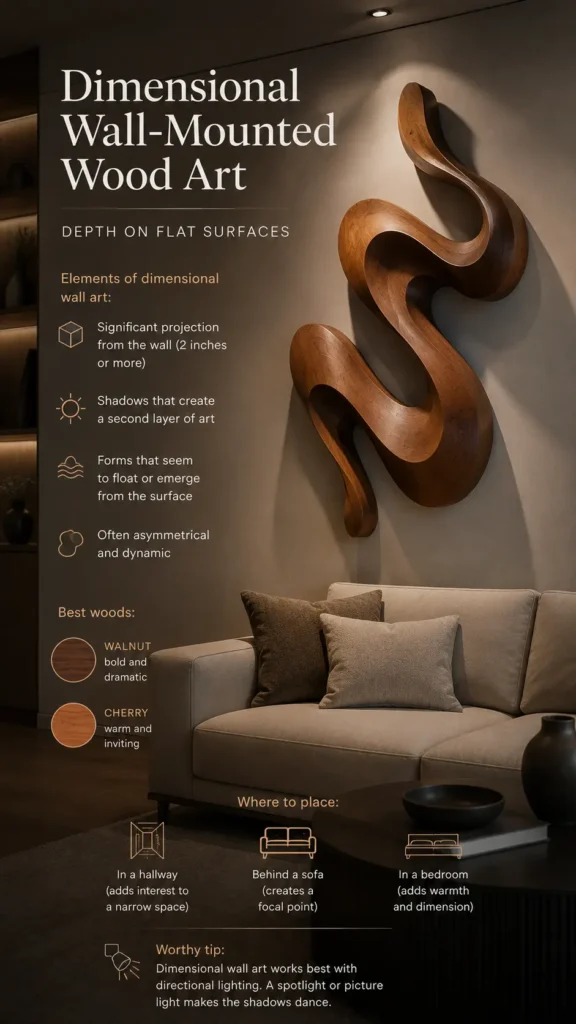
Dimensional wall-mounted wood art brings 3D organic forms to walls. Unlike flat relief, these pieces project significantly from the surface – inches or even feet – creating drama and depth in a space that doesn’t have room for a freestanding sculpture.
Elements of dimensional wall art:
- Significant projection from the wall (2 inches or more)
- Shadows that create a second layer of art
- Forms that seem to float or emerge from the surface
- Often asymmetrical and dynamic
Best woods:
Walnut (bold and dramatic) or cherry (warm and inviting).
Where to place:
- In a hallway (adds interest to a narrow space)
- Behind a sofa (creates a focal point)
- In a bedroom (adds warmth and dimension)
Worthy tip: “Dimensional wall art works best with directional lighting. A spotlight or picture light makes the shadows dance.”
8. Layered Three-Dimensional Wood Relief – Complexity and Depth

Layered three-dimensional wood relief creates depth through overlapping layers. Instead of carving one surface, the artist carves multiple layers that sit at different depths, creating a sense of complexity and richness.
How layering works:
- The background is carved deepest
- Each layer sits slightly forward
- The foreground elements are closest to the viewer
- The result is depth without heavy projection
Why layering is special:
- It creates visual complexity without bulk
- It works beautifully in a variety of lighting conditions
- It rewards close inspection (you see more with each look)
Worthy tip: “A layered relief is like reading a book – each layer reveals more of the story. The more you look, the more you see.”
From Flat to Form – Elevating Your Space with 3D Organic Wood Sculpture
You now have a complete guide to 3D organic wood sculpture ideas that defy expectations – from multi-angle wood sculpture and full-round carved wood art to immersive 3D wooden installation, depth-defining sculptural form, in-the-round timber carving, spatial abstract wood design, dimensional wall-mounted wood art, and layered three-dimensional wood relief.
These pieces aren’t just decorations – they’re experiences. They reward exploration, engage the viewer, and transform the spaces they occupy.
Table of Contents
Call to Action (CTA)
Ready to bring a 3D organic masterpiece into your next project? Email me at admin@woodzaa.com with “3D Organic” in the subject line. Tell me about your space – the room, the light, the feeling you want to create. I’ll sketch a custom concept that defies expectations and creates a truly immersive experience.
Let’s create something that rewards every angle.
– Sheila


Pingback: 7 Unique Spiral Wood Sculpture Designs That Stop the Scroll – Mesmerizing Art for Modern Interiors - Woodzaa