
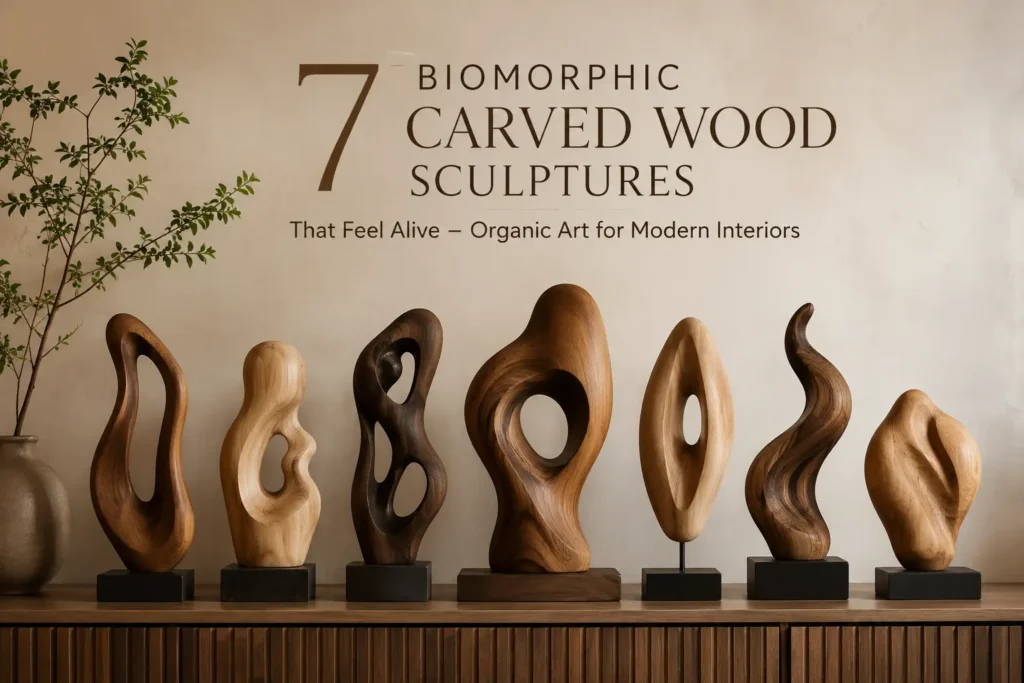
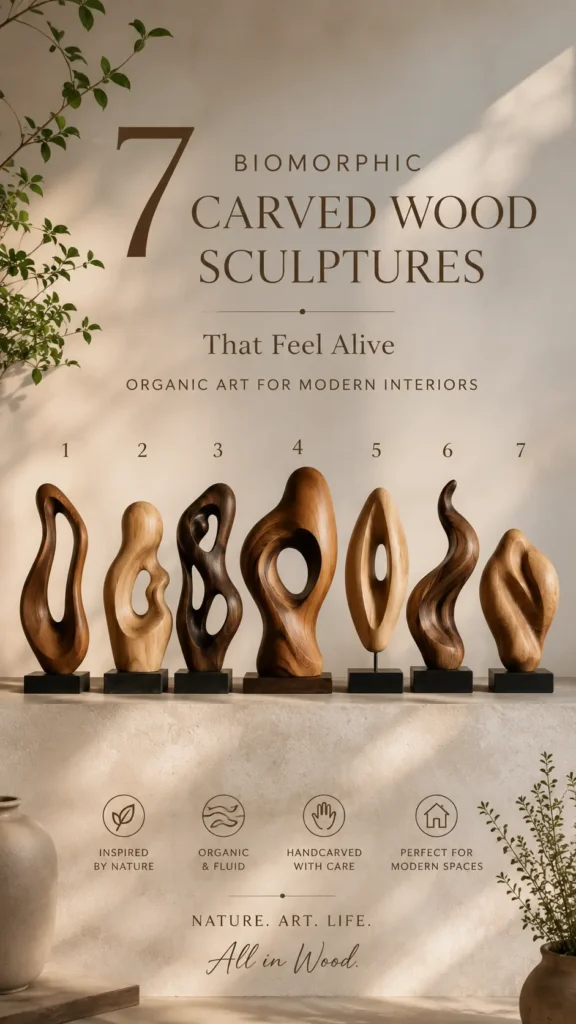
You’ve seen beautiful wood sculptures. But have you ever seen one that seems to breathe? That looks like it’s growing, stretching, or twisting of its own accord? That’s the magic of biomorphic art – sculpture that mimics the living forms of nature, capturing the essence of growth, movement, and life itself.
Let me introduce you to biomorphic carved wood sculptures that feel alive. In this guide, you’ll explore organic fluid wood art that flows like water, discover surreal carved wooden forms that challenge perception, appreciate curvilinear abstract sculpture that feels soft to the eye, find nature-mimicking wood statues that bring the outdoors in, explore cellular or botanical wood carving on a microscopic scale, understand morphological wood design that evolves as you look at it, and experience whimsical flowing wood shapes, amorphous wooden art pieces, and dynamic tension in wood that keeps your eye moving.
These pieces aren’t just art – they’re alive with energy, movement, and organic beauty.
1. Organic Fluid Wood Art – Flowing Like Nature Itself
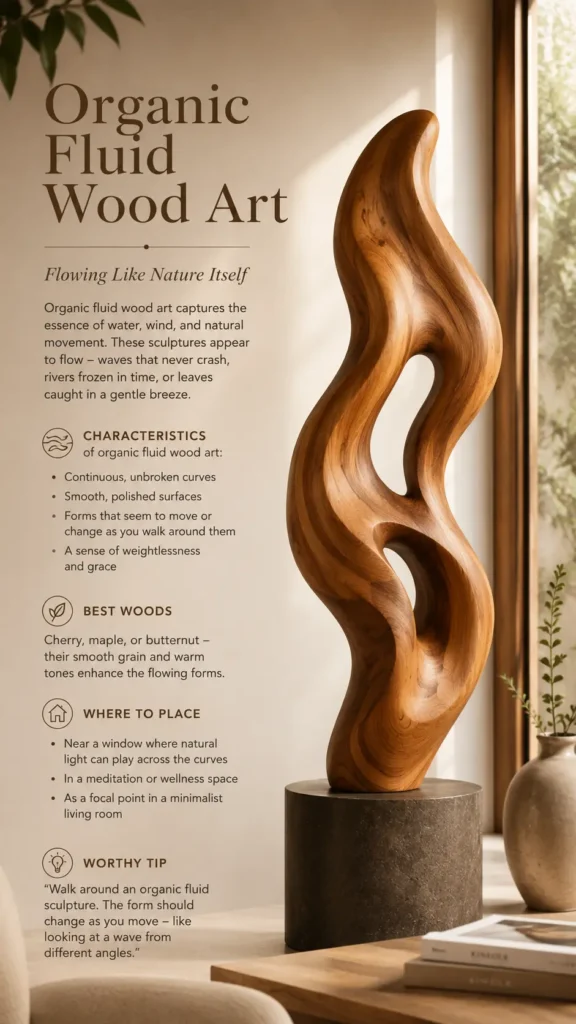
Organic fluid wood art captures the essence of water, wind, and natural movement. These sculptures appear to flow – waves that never crash, rivers frozen in time, or leaves caught in a gentle breeze.
Characteristics of organic fluid wood art:
- Continuous, unbroken curves
- Smooth, polished surfaces
- Forms that seem to move or change as you walk around them
- A sense of weightlessness and grace
Best woods:
Cherry, maple, or butternut – their smooth grain and warm tones enhance the flowing forms.
Where to place:
- Near a window where natural light can play across the curves
- In a meditation or wellness space
- As a focal point in a minimalist living room
Worthy tip: “Walk around an organic fluid sculpture. The form should change as you move – like looking at a wave from different angles.”
For more on organic forms, check out our related article: Biomorphic Carved Wood Sculptures That Feel Alive (Mid to High Net Worth)
2. Surreal Carved Wooden Forms – Where Dreams Meet Wood

Surreal carved wooden forms blend the familiar with the impossible. A leaf that’s also a face. A branch that becomes a hand. A figure that’s simultaneously human and tree. These pieces feel like they came from a dream.
Elements of surreal forms:
- Juxtaposition of unexpected elements
- Uncomfortable but beautiful proportions
- Details that reveal themselves slowly
- A sense of mystery or otherworldliness
Why surrealism works in interiors:
Surreal pieces are endlessly fascinating. Your clients will find something new every time they look – and that engagement makes the piece priceless.
Worthy tip: “Commission a surreal piece that incorporates a personal symbol – a favorite animal, a childhood memory, or a family inside joke. The hidden meaning makes it even more special.”
You Might Like : Do You Want Custom Wood Sculpture Click This…
3. Curvilinear Abstract Sculpture – The Softness of Curves
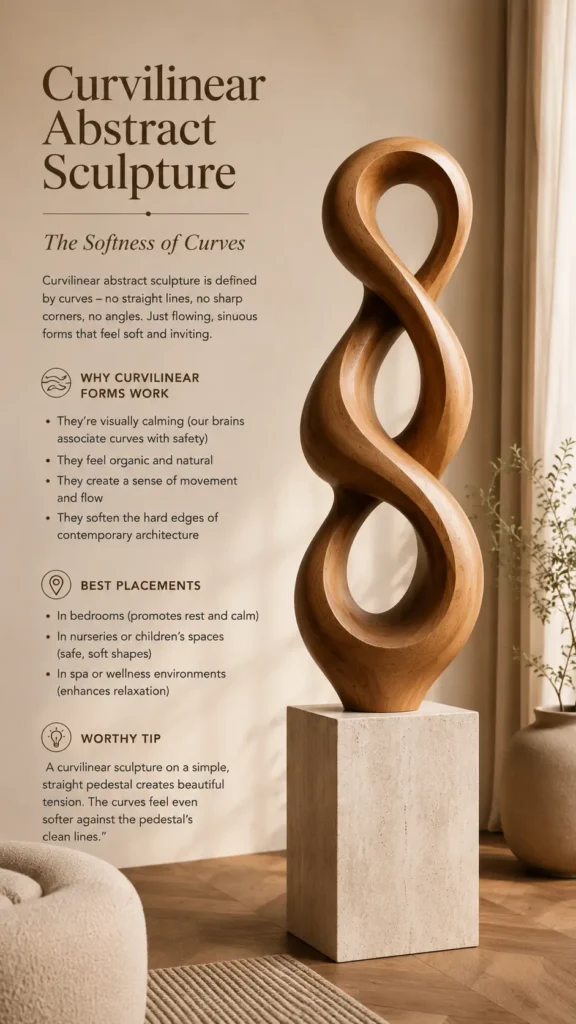
Curvilinear abstract sculpture is defined by curves – no straight lines, no sharp corners, no angles. Just flowing, sinuous forms that feel soft and inviting.
Why curvilinear forms work:
- They’re visually calming (our brains associate curves with safety)
- They feel organic and natural
- They create a sense of movement and flow
- They soften the hard edges of contemporary architecture
Best placements:
- In bedrooms (promotes rest and calm)
- In nurseries or children’s spaces (safe, soft shapes)
- In spa or wellness environments (enhances relaxation)
Worthy tip: “A curvilinear sculpture on a simple, straight pedestal creates beautiful tension. The curves feel even softer against the pedestal’s clean lines.”
4. Nature-Mimicking Wood Statues – Bringing the Outdoors In
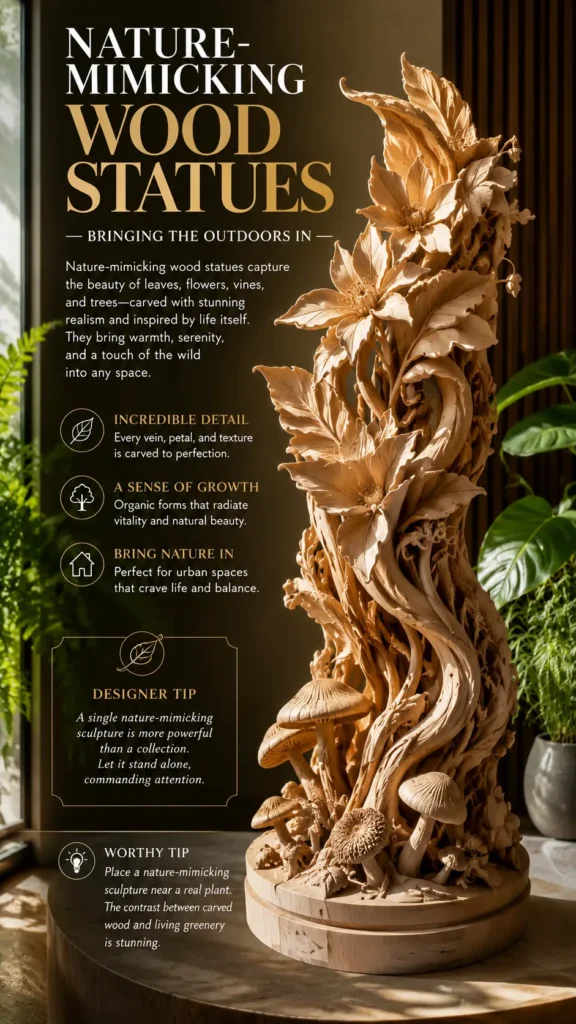
Nature-mimicking wood statues are the most literal form of biomorphic art. Leaves, flowers, vines, mushrooms, and trees – carved so realistically they almost seem alive.
What makes them special:
- Incredible detail (veins, textures, organic imperfections)
- A sense of growth and vitality
- The ability to bring nature indoors (perfect for urban spaces)
Best woods:
Basswood (holds fine detail beautifully), butternut (warm, organic tone), or maple (pale, clean look).
Designer tip:
A single nature-mimicking statue is more powerful than a collection. Let it stand alone, commanding attention.
Worthy tip: “Place a nature-mimicking sculpture near a real plant. The contrast between carved wood and living greenery is stunning.”
5. Cellular or Botanical Wood Carving – The Microscopic Made Monumental
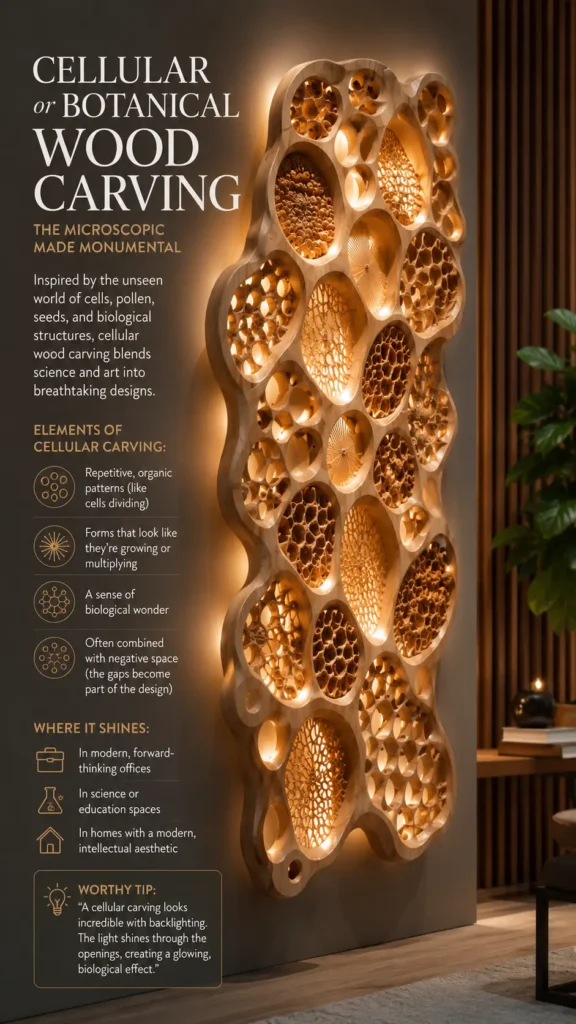
Cellular or botanical wood carving takes inspiration from the microscopic world – cells, pollen, seeds, and biological structures. These pieces feel scientific and artistic at the same time.
Elements of cellular carving:
- Repetitive, organic patterns (like cells dividing)
- Forms that look like they’re growing or multiplying
- A sense of biological wonder
- Often combined with negative space (the gaps become part of the design)
Where it shines:
- In modern, forward-thinking offices
- In science or education spaces
- In homes with a modern, intellectual aesthetic
Worthy tip: “A cellular carving looks incredible with backlighting. The light shines through the openings, creating a glowing, biological effect.”
6. Morphological Wood Design – Forms That Evolve
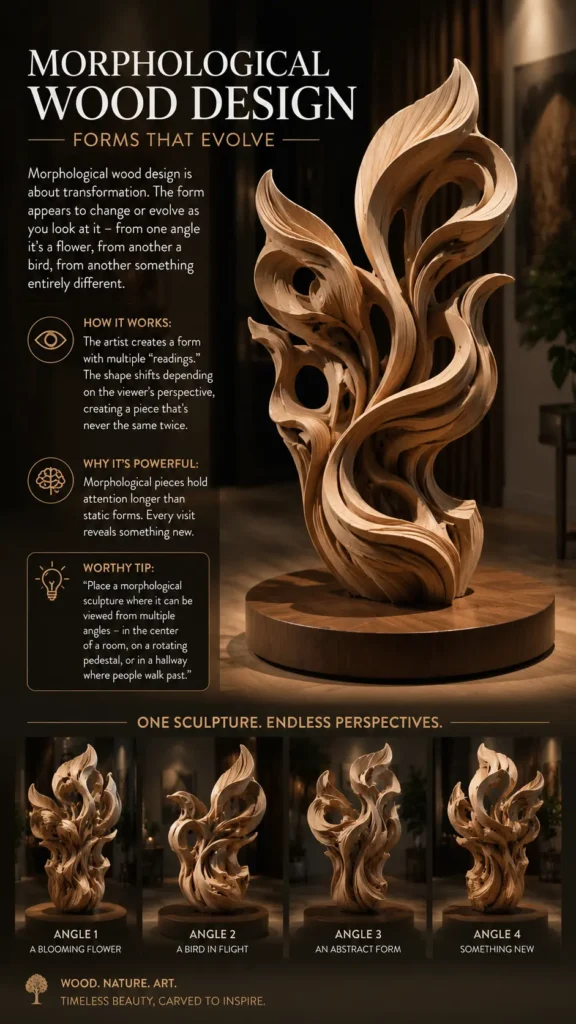
Morphological wood design is about transformation. The form appears to change or evolve as you look at it – from one angle it’s a flower, from another a bird, from another something entirely different.
How it works:
The artist creates a form with multiple “readings.” The shape shifts depending on the viewer’s perspective, creating a piece that’s never the same twice.
Why it’s powerful:
Morphological pieces hold attention longer than static forms. Every visit reveals something new.
Worthy tip: “Place a morphological sculpture where it can be viewed from multiple angles – in the center of a room, on a rotating pedestal, or in a hallway where people walk past.”
7. Whimsical Flowing Wood Shapes – Playful and Unpredictable

Whimsical, flowing wood shapes are playful, unpredictable, and full of personality. They twist, loop, and spiral in ways that feel joyful and unconstrained.
Elements of whimsical forms:
- Unexpected twists and turns
- A sense of joy and lightness
- Forms that feel like they’re dancing
- Often asymmetrical and surprising
Where to place:
- In a child’s room or nursery
- In a creative studio or office
- In a room that needs energy and playfulness
Worthy tip: “A whimsical sculpture is a mood-lifter. Place one where you’ll see it first thing in the morning – it’ll set a joyful tone for the day.”
8. Amorphous Wooden Art Pieces – Shape Without Definition
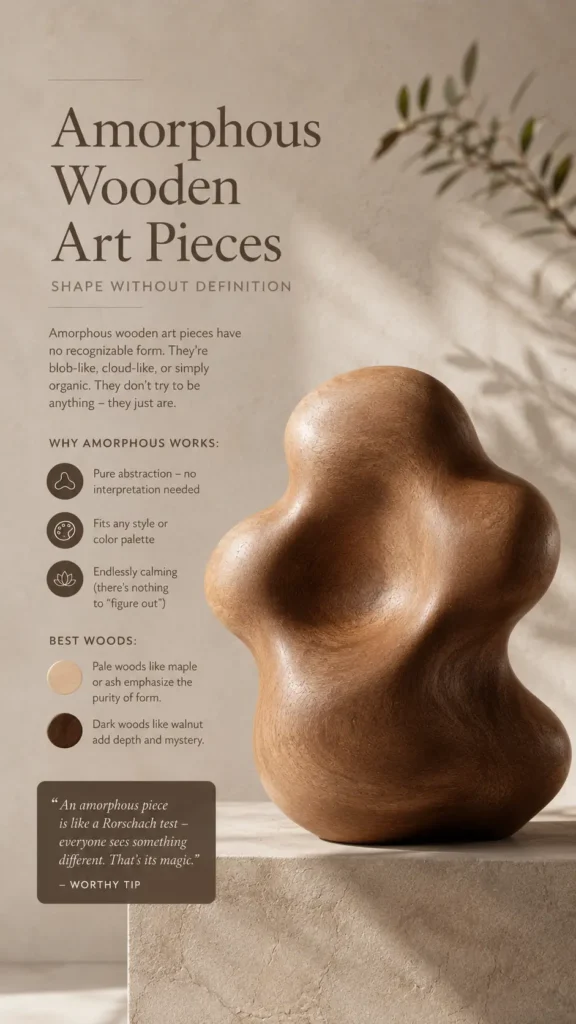
Amorphous wooden art pieces have no recognizable form. They’re blob-like, cloud-like, or simply organic. They don’t try to be anything – they just are.
Why amorphous works:
- Pure abstraction – no interpretation needed
- Fits any style or color palette
- Endlessly calming (there’s nothing to “figure out”)
Best woods:
Pale woods like maple or ash emphasize the purity of form. Dark woods like walnut add depth and mystery.
Worthy tip: “An amorphous piece is like a Rorschach test – everyone sees something different. That’s its magic.”
9. Dynamic Tension in Wood – Energy That Holds Your Eye
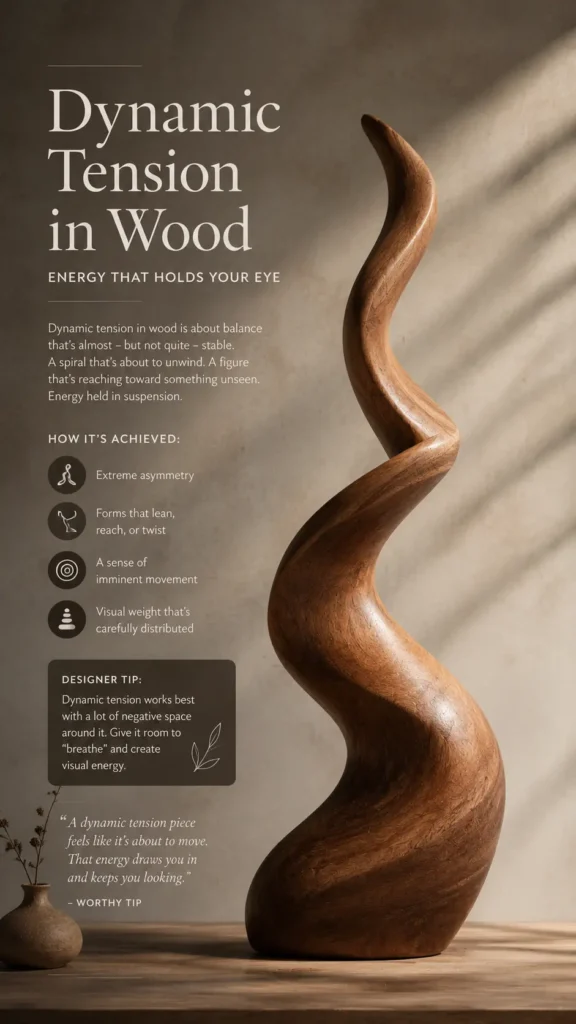
Dynamic tension in wood is about balance that’s almost – but not quite – stable. A spiral that’s about to unwind. A figure that’s reaching toward something unseen. Energy held in suspension.
How it’s achieved:
- Extreme asymmetry
- Forms that lean, reach, or twist
- A sense of imminent movement
- Visual weight that’s carefully distributed
Designer tip:
Dynamic tension works best with a lot of negative space around it. Give it room to “breathe” and create visual energy.
Worthy tip: “A dynamic tension piece feels like it’s about to move. That energy draws you in and keeps you looking.”
From Biomimicry to Masterpiece – Curating Living Art
You now have a complete guide to biomorphic carved wood sculptures that feel alive – from organic fluid wood art and surreal carved wooden forms to curvilinear abstract sculpture, nature-mimicking wood statues, cellular or botanical wood carving, morphological wood design, whimsical flowing wood shapes, amorphous wooden art pieces, and dynamic tension in wood.
These pieces aren’t just decorations – they’re living, breathing expressions of nature’s beauty, translated into wood. They bring warmth, wonder, and a touch of the organic to any contemporary space.
Table of Contents
Call to Action (CTA)
Ready to bring a biomorphic masterpiece into your next project? Email me at admin@woodzaa.com with “Biomorphic” in the subject line. Tell me about your space and the feeling you want to create. I’ll sketch a custom concept that captures the organic, living energy of nature in wood.
Let’s create something that breathes.
– Sheila


Pingback: 7 Brutalist Wood Wall Sculpture — Bold, Raw, Unforgettable – The Ultimate Statement Piece for Modern Interiors - Woodzaa