
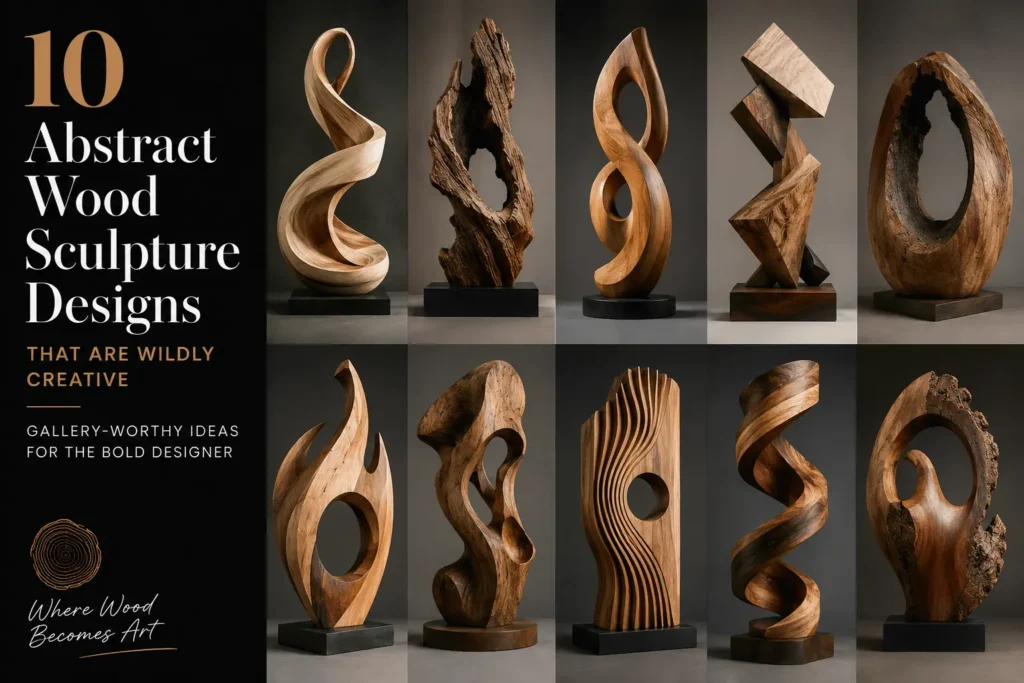
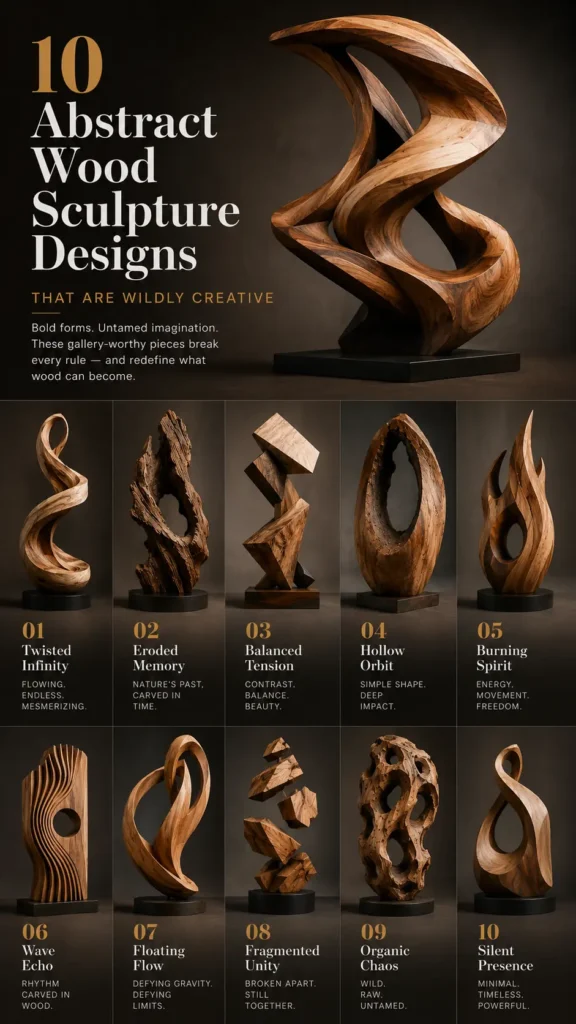
You’ve seen the predictable wood art – a carved eagle, a live‑edge shelf, a simple bowl. Beautiful, but safe. What if you could offer your clients something that stops them mid‑step and makes them say, “I’ve never seen anything like that”? That’s the power of abstract wood sculpture.
Let me introduce you to abstract wood sculpture designs that are wildly creative. In this guide, you’ll explore unconventional wood sculpture forms that break every rule, discover futuristic abstract wood designs that feel ahead of their time, experiment with surreal carved wood shapes, create explosive, dynamic wood compositions, master twisted and distorted wood forms, design floating, gravity‑defying wood art, embrace fragmented and deconstructed sculptures, channel organic chaos in carved wood, and achieve minimalist abstract with maximum impact.
These aren’t just decorations – they’re experiences. They challenge perception, reward repeated viewing, and turn any room into a gallery.
1. Unconventional Wood Sculpture Forms – Breaking Every Rule
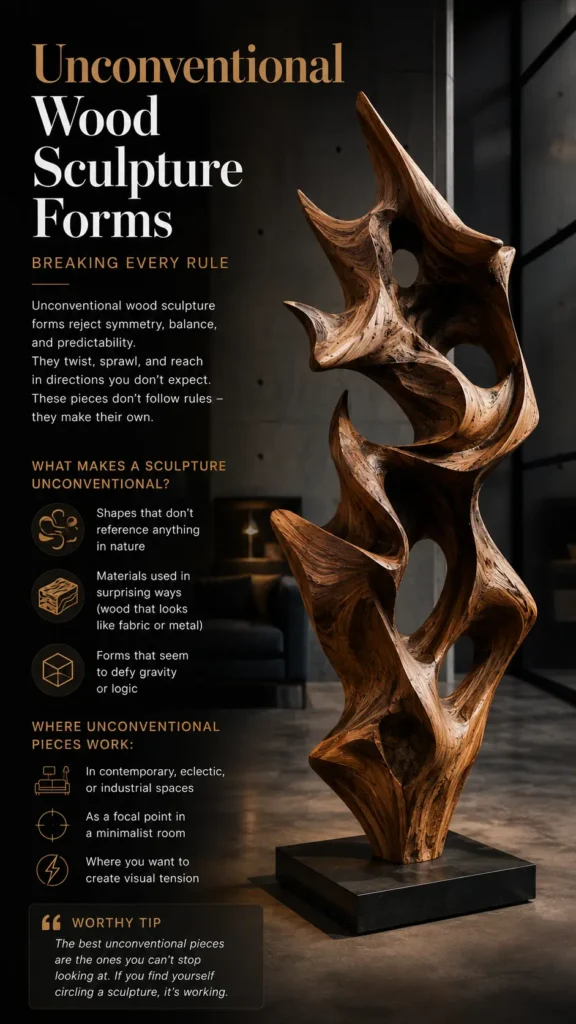
Unconventional wood sculpture forms reject symmetry, balance, and predictability. They twist, sprawl, and reach in directions you don’t expect. These pieces don’t follow rules – they make their own.
What makes a sculpture unconventional?
- Shapes that don’t reference anything in nature
- Materials used in surprising ways (wood that looks like fabric or metal)
- Forms that seem to defy gravity or logic
Where unconventional pieces work:
- In contemporary, eclectic, or industrial spaces
- As a focal point in a minimalist room
- Where do you want to create visual tension
Worthy tip: “The best unconventional pieces are the ones you can’t stop looking at. If you find yourself circling a sculpture, it’s working.”
For more on creative wood art, check out our related article: Abstract Wood Sculpture Designs That Are Wildly Creative (Mid to High Net Worth)
2. Futuristic Abstract Wood Designs – Carved for Tomorrow

Futuristic abstract wood designs feel like they belong in a spaceship or a sci‑fi film. Think sleek, streamlined, and otherworldly. These pieces use wood’s natural warmth but push it into a geometric, almost digital aesthetic.
Elements of futuristic design:
- Sharp, precise angles
- Smooth, polished surfaces that reflect light
- Asymmetrical shapes that suggest motion or speed
- Integration of metal or resin accents (optional)
Best woods:
Maple (for a pale, clean look), mahogany (for deep, rich contrast), or black walnut (for dramatic, dark elegance).
Worthy tip: “Pair a futuristic wood sculpture with metallic furniture – brass, chrome, or copper. The contrast creates a stunning visual tension.”
You Might Like : Do You Want Custom Wood Sculpture Click This…
3. Surreal Carved Wood Shapes – Dreams Made Solid

Surreal carved wood shapes bring the subconscious to life. Melting forms, impossible angles, creatures that don’t exist – these pieces are playful, unsettling, and unforgettable. They challenge the viewer to question reality.
Surrealist ideas to try:
- A clock that drips like melting wax
- A hand with too many fingers
- A tree growing upside down
- A face that’s also a landscape
Why surrealism works in interiors:
Surrealist pieces are instant conversation starters. Guests will gather around them, trying to figure out “what it means.” That engagement makes the piece more valuable.
Worthy tip: “Commission a surrealist piece that incorporates a personal symbol for your client – a favorite animal, a childhood memory, or a family inside joke.”
4. Explosive, Dynamic Wood Compositions – Energy in Solid Form
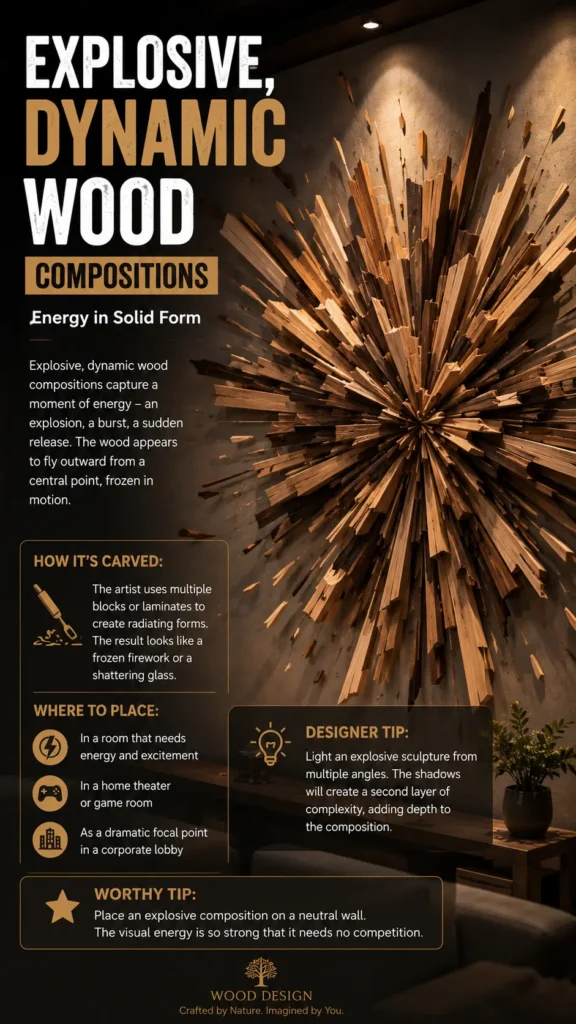
Explosive, dynamic wood compositions capture a moment of energy – an explosion, a burst, a sudden release. The wood appears to fly outward from a central point, frozen in motion.
How it’s carved:
The artist uses multiple blocks or laminates to create radiating forms. The result looks like a frozen firework or a shattering glass.
Where to place:
- In a room that needs energy and excitement
- In a home theater or game room
- As a dramatic focal point in a corporate lobby
Designer tip:
Light an explosive sculpture from multiple angles. The shadows will create a second layer of complexity, adding depth to the composition.
Worthy tip: “Place an explosive composition on a neutral wall. The visual energy is so strong that it needs no competition.”
5. Twisted and Distorted Wood Forms – Wood That Fights Back
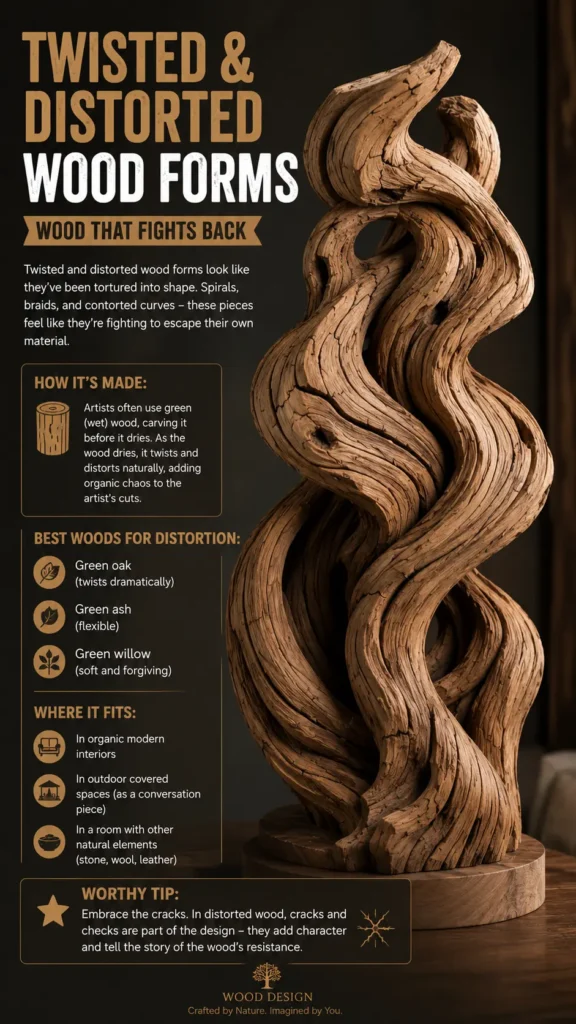
Twisted and distorted wood forms look like they’ve been tortured into shape. Spirals, braids, and contorted curves – these pieces feel like they’re fighting to escape their own material.
How it’s made:
Artists often use green (wet) wood, carving it before it dries. As the wood dries, it twists and distorts naturally, adding organic chaos to the artist’s cuts.
Best woods for distortion:
Green oak (twists dramatically), green ash (flexible), or green willow (soft and forgiving).
Where it fits:
- In organic modern interiors
- In outdoor covered spaces (as a conversation piece)
- In a room with other natural elements (stone, wool, leather)
Worthy tip: “Embrace the cracks. In distorted wood, cracks and checks are part of the design – they add character and tell the story of the wood’s resistance.”
6. Floating, Gravity‑Defying Wood Art – Defying Physics

Floating, gravity‑defying wood art looks like it should fall – but it doesn’t. A sculpture that balances impossibly, a cantilever that seems to float, or a piece suspended from a single point – these works challenge our understanding of weight and balance.
Techniques for floating effects:
- Hidden internal armatures (metal supports)
- Wall‑mounted pieces with invisible brackets
- Ceiling suspensions with thin, nearly invisible wires
Where it shines:
- In a grand entryway (it welcomes with wonder)
- Above a dining table (it becomes a focal point)
- In a stairwell (as a sculptural interruption)
Worthy tip: “Backlight a floating sculpture with an LED strip. The glowing gaps will make the piece feel even more impossible.”
7. Fragmented and Deconstructed Sculptures – Parts That Make a Whole
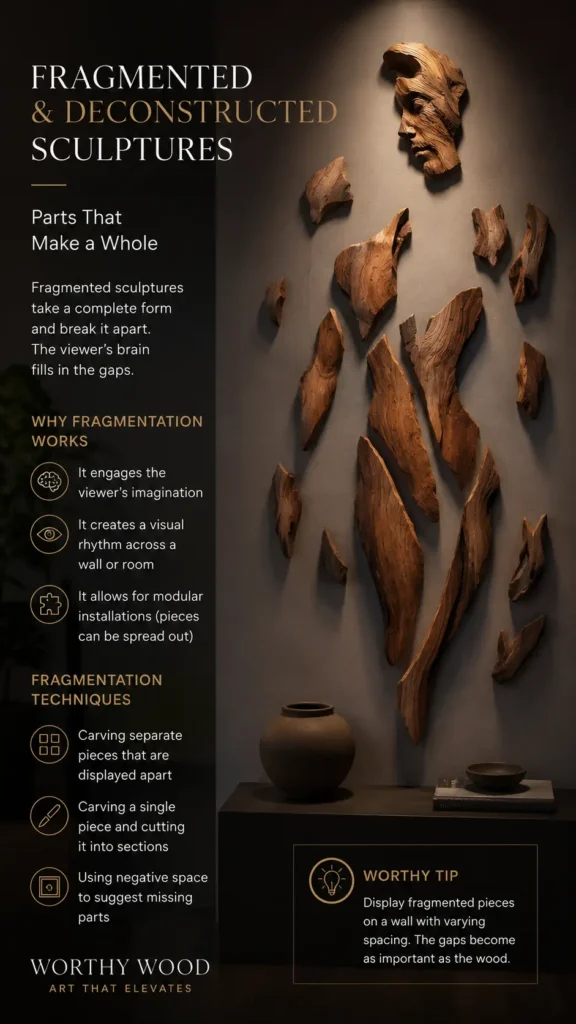
Fragmented and deconstructed sculptures take a complete form and break it apart. A figure might have a missing torso, or a tree might be represented by a single branch and a root. The viewer’s brain fills in the gaps.
Why fragmentation works:
- It engages the viewer’s imagination
- It creates a visual rhythm across a wall or room
- It allows for modular installations (pieces can be spread out)
Fragmentation techniques:
- Carving separate pieces that are displayed apart
- Carving a single piece and cutting it into sections
- Using negative space to suggest missing parts
Worthy tip: “Display fragmented pieces on a wall with varying spacing. The gaps become as important as the wood.”
8. Organic Chaos in Carved Wood – Controlled Wildness

Organic chaos in carved wood looks wild, messy, and uncontrollable – but it’s actually carefully planned. The artist channels the energy of nature’s chaos: tangled branches, crawling vines, or wave‑tossed driftwood.
Elements of organic chaos:
- Uneven, jagged edges
- Textures that mimic bark, moss, or water erosion
- Forms that seem to grow or sprawl
Best woods:
Reclaimed wood (adds character and age), driftwood (already shaped by water), or burl wood (wild, swirling grain).
Designer tip:
Organic chaos pieces work best in maximalist rooms, where they have room to breathe. Pair with smooth, clean surfaces (glass, marble) for contrast.
Worthy tip: “An organic chaos sculpture looks incredible in a polished, ultra‑modern room. The contrast between clean lines and wild wood is pure visual electricity.”
9. Minimalist Abstract with Maximum Impact – The Power of Simplicity
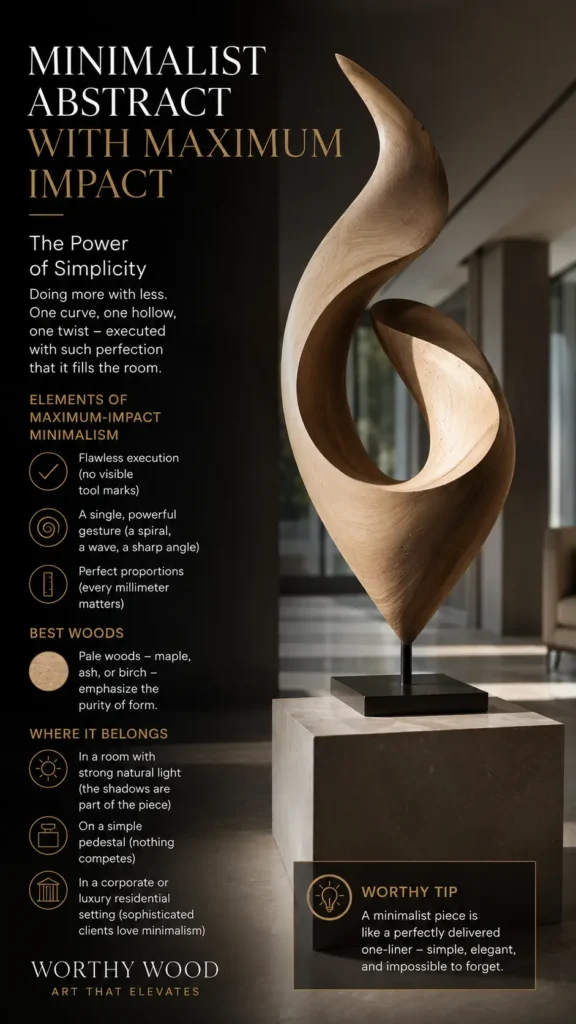
Minimalist abstract with maximum impact is about doing more with less. One curve, one hollow, one twist – but executed with such perfection that it fills the room.
Elements of maximum‑impact minimalism:
- Flawless execution (no visible tool marks)
- A single, powerful gesture (a spiral, a wave, a sharp angle)
- Perfect proportions (every millimeter matters)
Best woods:
Pale woods – maple, ash, or birch – emphasize the purity of form.
Where it belongs:
- In a room with strong natural light (the shadows are part of the piece)
- On a simple pedestal (nothing competes)
- In a corporate or luxury residential setting (sophisticated clients love minimalism)
Worthy tip: “A minimalist piece is like a perfectly delivered one‑liner – simple, elegant, and impossible to forget.”
From Wild to Wow – Curating Creative Wood Sculptures
You now have abstract wood sculpture designs that are wildly creative – from unconventional wood sculpture forms and futuristic abstract wood designs to surreal carved wood shapes, explosive, dynamic wood compositions, twisted and distorted wood forms, floating, gravity‑defying wood art, fragmented and deconstructed sculptures, organic chaos in carved wood, and minimalist abstract with maximum impact.
These pieces challenge, inspire, and transform the spaces they occupy. Whether you’re a designer, a stager, or a collector, abstract wood sculpture offers endless possibilities.
Table of Contents
Call to Action (CTA)
Ready to bring wildly creative wood art into your next project? Email me at admin@woodzaa.com with “Wildly Creative” in the subject line. Describe the space, the mood, and your client’s taste. I’ll sketch a custom concept that pushes the boundaries of wood art.
Let’s create something unforgettable.
– Sheila


Pingback: 7 Biomorphic Carved Wood Sculptures That Feel Alive – Organic Art for Modern Interiors - Woodzaa