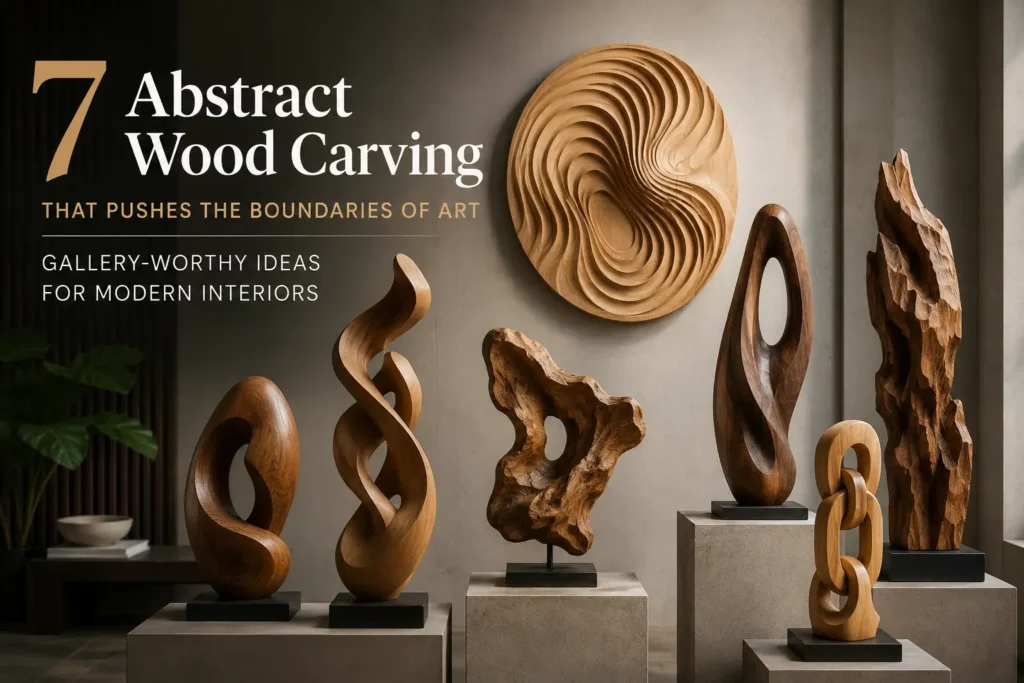
You’ve seen the same predictable wood art – a carved eagle, a live‑edge shelf, a simple bowl. Beautiful, yes. But challenging? Not quite. What if wood could do more? What if it could confuse, delight, and stop you in your tracks?
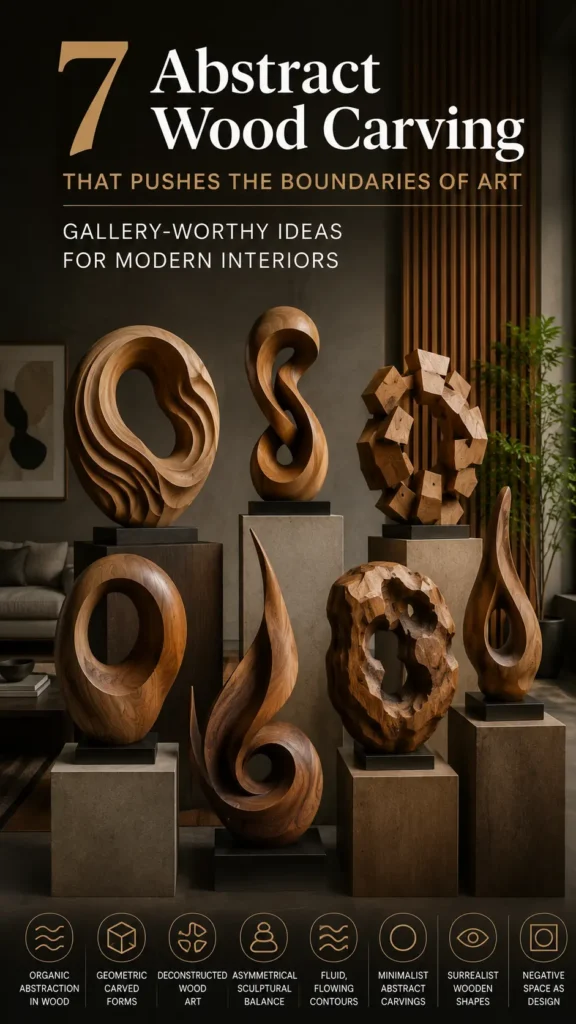
Let me introduce you to abstract wood carving that pushes the boundaries of art. In this guide, you’ll discover non-representational wood sculpture that leaves interpretation open, explore organic abstraction in wood, master geometric carved wood forms, embrace deconstructed wood art, balance asymmetrical sculptural balance, create fluid, flowing wood contours, design minimalist abstract carvings, experiment with surrealist wooden shapes, and use negative space as primary design.
These pieces aren’t just decor – they’re statements. They challenge the viewer and reward repeated looking. And they’re perfect for interior designers and luxury decorators who want to offer something truly unique.
1. Non‑Representational Wood Sculpture – Art Without Rules
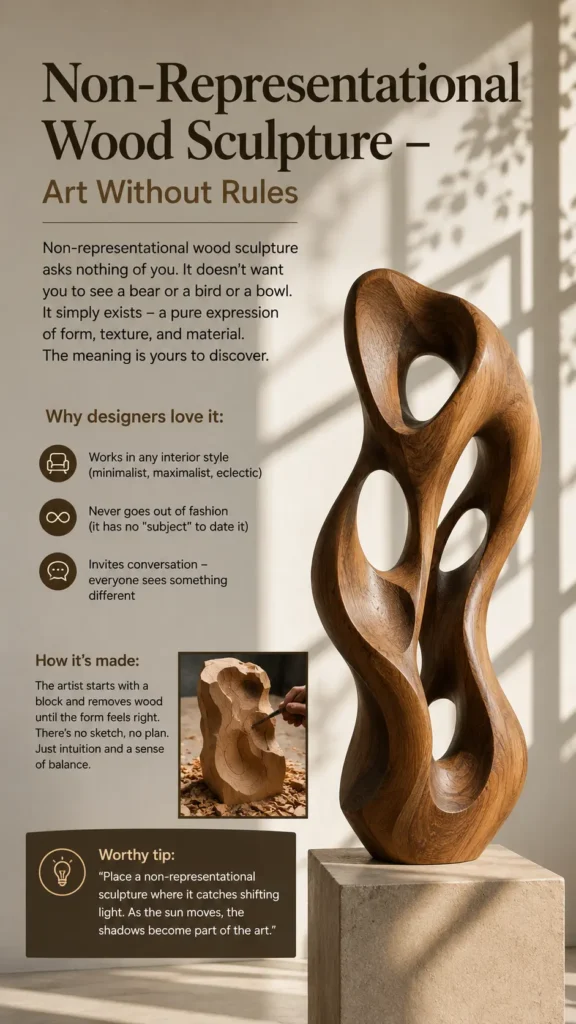
Non-representational wood sculpture asks nothing of you. It doesn’t want you to see a bear or a bird or a bowl. It simply exists – a pure expression of form, texture, and material. The meaning is yours to discover.
Why designers love it:
- Works in any interior style (minimalist, maximalist, eclectic)
- Never goes out of fashion (it has no “subject” to date it)
- Invites conversation – everyone sees something different
How it’s made:
The artist starts with a block and removes wood until the form feels right. There’s no sketch, no plan. Just intuition and a sense of balance.
Worthy tip: “Place a non‑representational sculpture where it catches shifting light. As the sun moves, the shadows become part of the art.”
For more on sculptural concepts, check out our related article: Abstract Wood Carving That Pushes the Boundaries of Art (Mid to High Net Worth)
2. Organic Abstraction in Wood – Flowing Like Nature
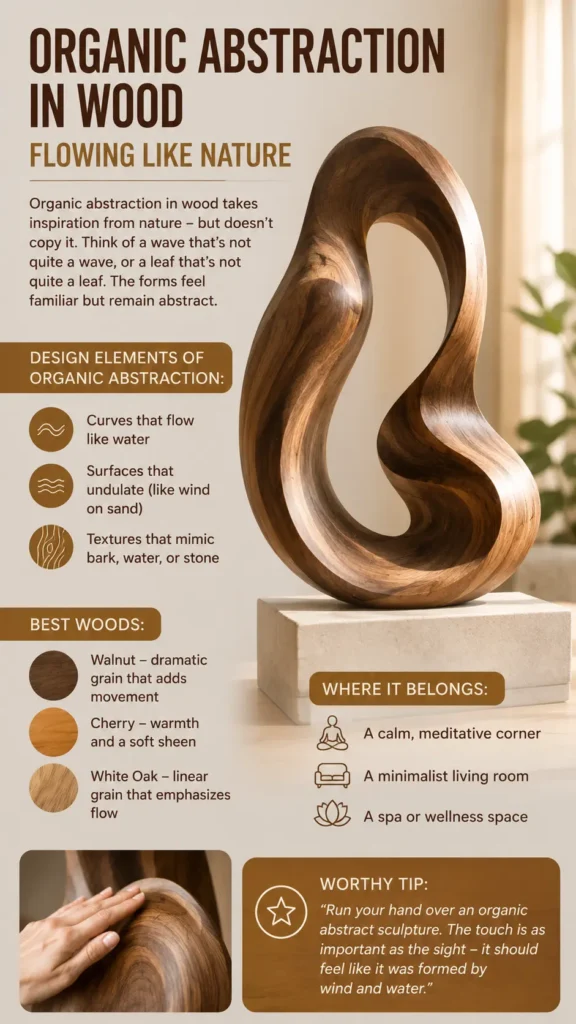
Organic abstraction in wood takes inspiration from nature – but doesn’t copy it. Think of a wave that’s not quite a wave, or a leaf that’s not quite a leaf. The forms feel familiar but remain abstract.
Design elements of organic abstraction:
- Curves that flow like water
- Surfaces that undulate (like wind on sand)
- Textures that mimic bark, water, or stone
Best woods:
Walnut (dramatic grain that adds movement), cherry (warmth and a soft sheen), or white oak (linear grain that emphasizes flow).
Where it belongs:
- A calm, meditative corner
- A minimalist living room
- A spa or wellness space
Worthy tip: “Run your hand over an organic abstract sculpture. The touch is as important as the sight – it should feel like it was formed by wind and water.”
You Might Like : Do You Want Custom Wood Sculpture Click This…
3. Geometric Carved Wood Forms – Precision and Power

Geometric carved wood forms are the opposite of organic abstraction. Think sharp angles, bold lines, and mathematical precision – triangles, hexagons, spirals, and faceted cubes.
Why geometric carvings work:
- They feel modern and architectural
- They draw the eye with stark contrasts (light vs. shadow, smooth vs. textured)
- They work beautifully in contemporary and industrial spaces
Materials:
Geometric carvings require dense, stable wood like maple, mahogany, or black walnut. These woods hold crisp edges without splitting.
Designer tip:
Pair a geometric wood sculpture with soft, curved furniture – the contrast is visually electric.
Worthy tip: “For a dramatic effect, mount a geometric carving where it catches raking light from the side. The sharp angles will throw crisp, linear shadows.”
4. Deconstructed Wood Art – Fragments Tell a Story
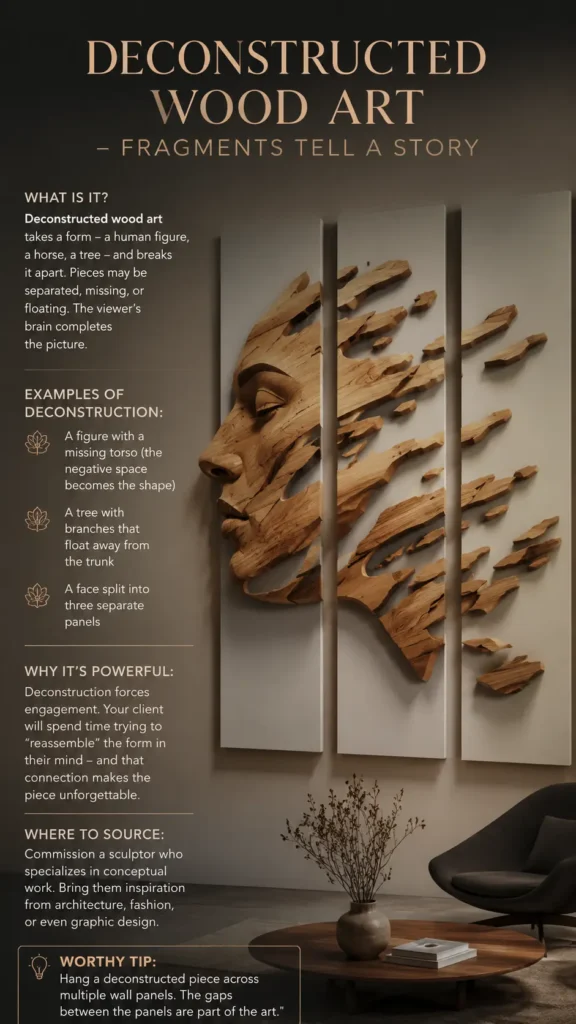
Deconstructed wood art takes a form – a human figure, a horse, a tree – and breaks it apart. Pieces may be separated, missing, or floating. The viewer’s brain completes the picture.
Examples of deconstruction:
- A figure with a missing torso (the negative space becomes the shape)
- A tree with branches that float away from the trunk
- A face split into three separate panels
Why it’s powerful:
Deconstruction forces engagement. Your client will spend time trying to “reassemble” the form in their mind – and that connection makes the piece unforgettable.
Where to source:
Commission a sculptor who specializes in conceptual work. Bring them inspiration from architecture, fashion, or even graphic design.
Worthy tip: “Hang a deconstructed piece across multiple wall panels. The gaps between the panels are part of the art.”
5. Asymmetrical Sculptural Balance – Tension and Harmony
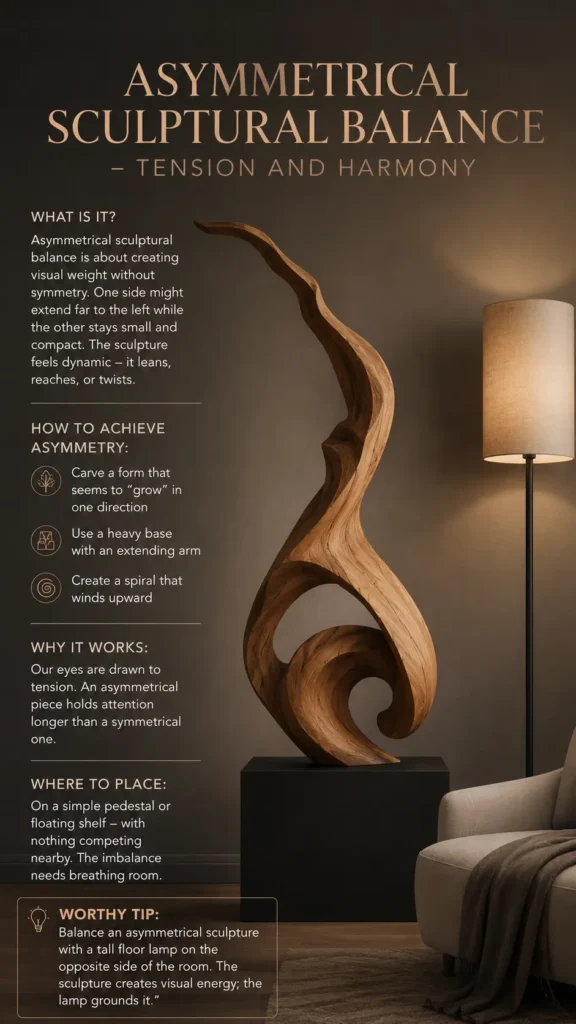
Asymmetrical sculptural balance is about creating visual weight without symmetry. One side might extend far to the left while the other stays small and compact. The sculpture feels dynamic – it leans, reaches, or twists.
How to achieve asymmetry:
- Carve a form that seems to “grow” in one direction
- Use a heavy base with an extending arm
- Create a spiral that winds upward
Why it works:
Our eyes are drawn to tension. An asymmetrical piece holds attention longer than a symmetrical one.
Where to place:
On a simple pedestal or floating shelf, with nothing competing nearby. The imbalance needs breathing room.
Worthy tip: “Balance an asymmetrical sculpture with a tall floor lamp on the opposite side of the room. The sculpture creates visual energy; the lamp grounds it.”
6. Fluid, Flowing Wood Contours – Movement in Stone
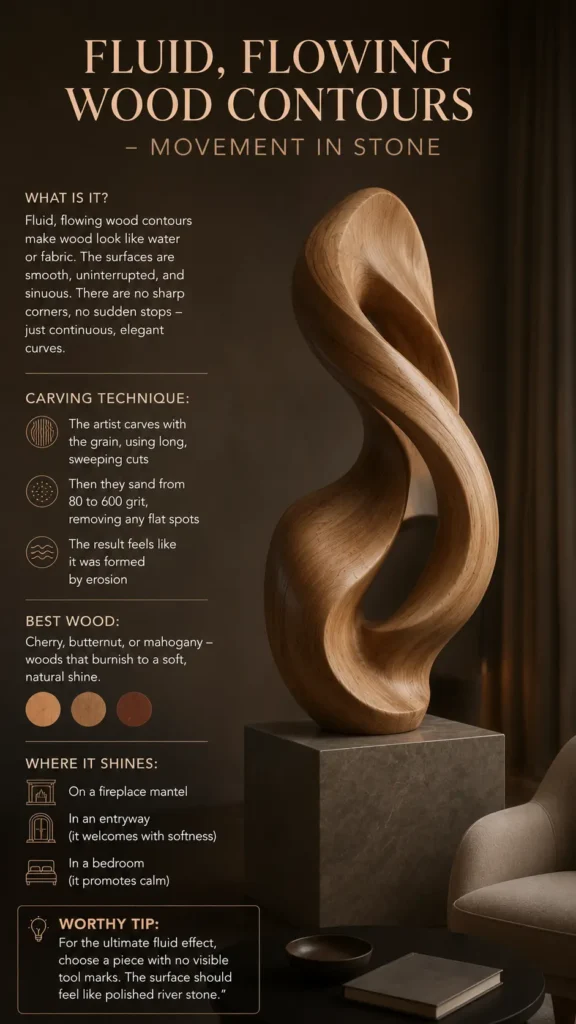
Fluid, flowing wood contours make wood look like water or fabric. The surfaces are smooth, uninterrupted, and sinuous. There are no sharp corners, no sudden stops – just continuous, elegant curves.
Carving technique:
The artist carves with the grain, using long, sweeping cuts. Then they sand from 80 to 600 grit, paying special attention to removing any flat spots. The result feels like it was formed by erosion.
Best wood:
Cherry, butternut, or mahogany – woods that burnish to a soft, natural shine.
Where it shines:
- On a fireplace mantel
- In an entryway (it welcomes with softness)
- In a bedroom (it promotes calm)
Worthy tip: “For the ultimate fluid effect, choose a piece with no visible tool marks. The surface should feel like polished river stone.”
7. Minimalist Abstract Carvings – Less Is More
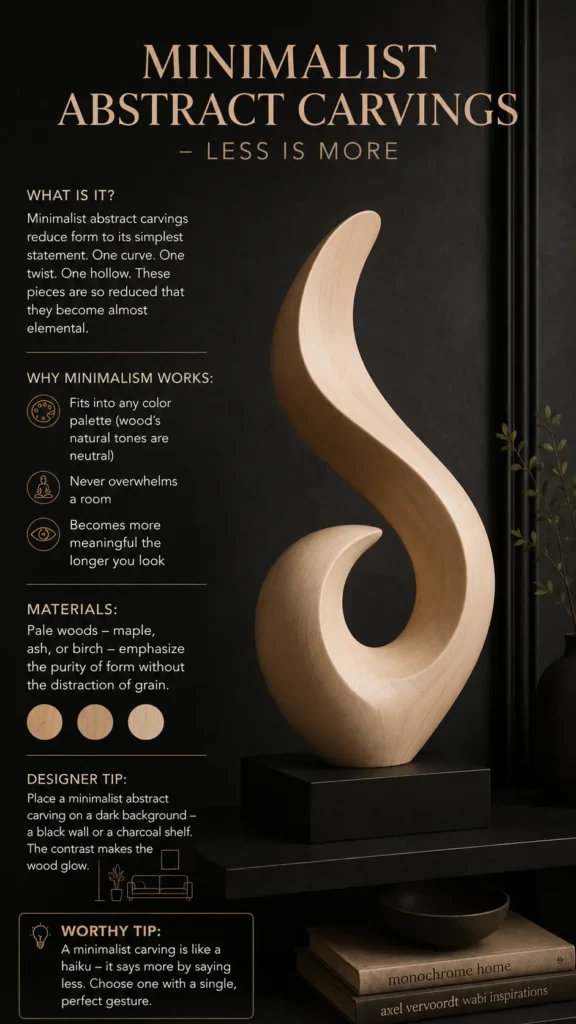
Minimalist abstract carvings reduce form to its simplest statement. One curve. One twist. One hollow. These pieces are so reduced that they become almost elemental.
Why minimalism works:
- Fits into any color palette (wood’s natural tones are neutral)
- Never overwhelms a room
- Becomes more meaningful the longer you look
Materials:
Pale woods – maple, ash, or birch – emphasize the purity of form without the distraction of grain.
Designer tip:
Place a minimalist abstract carving on a dark background – a black wall or a charcoal shelf. The contrast makes the wood glow.
Worthy tip: “A minimalist carving is like a haiku – it says more by saying less. Choose one with a single, perfect gesture.”
8. Surrealist Wooden Shapes – Dreams in Wood
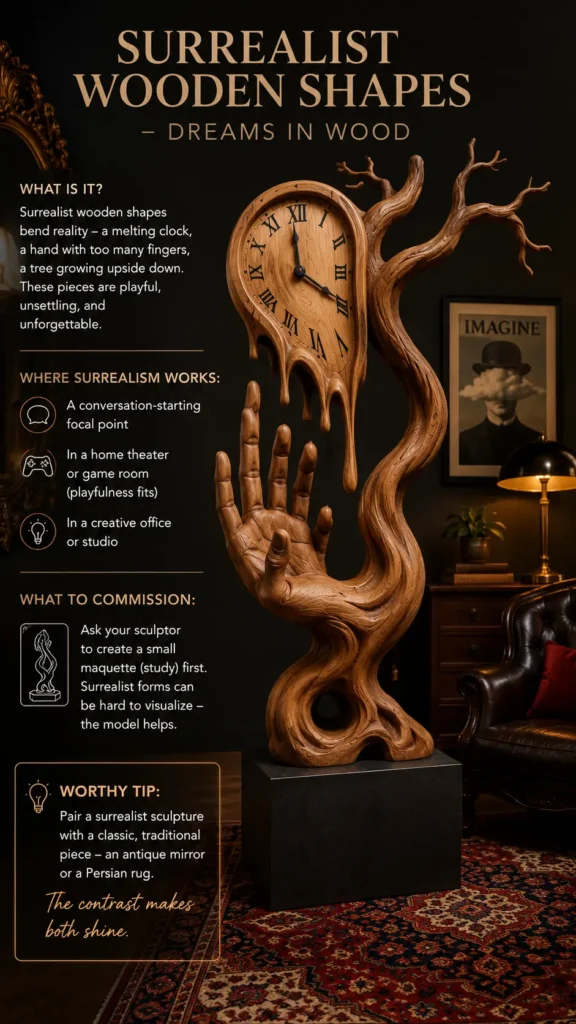
Surrealist wooden shapes bend reality – a melting clock, a hand with too many fingers, a tree growing upside down. These pieces are playful, unsettling, and unforgettable.
Where surrealism works:
- A conversation-starting focal point
- In a home theater or game room (playfulness fits)
- In a creative office or studio
What to commission:
Ask your sculptor to create a small maquette (study) first. Surrealist forms can be hard to visualize – the model helps.
Worthy tip: “Pair a surrealist sculpture with a classic, traditional piece – an antique mirror or a Persian rug. The contrast makes both shine.”
9. Negative Space as Primary Design – What’s Not There Matters

Negative space as primary design means the holes and gaps are just as important as the wood. Think of a face profile defined by the empty space between two figures, or a spiral carved so that the air becomes part of the pattern.
Why negative space works:
- It’s unexpected – most sculpture is about the solid form
- It makes the piece feel lighter and more airy
- It changes as you move around it
Designer tip:
Backlight a negative space sculpture. Light pouring through the holes creates a second artwork on the wall behind.
Worthy tip: “Negative space pieces look incredible in front of a brightly lit window. The gaps become glowing frames.”
From Boundary to Breakthrough
You now have a complete introduction to abstract wood carving that pushes the boundaries of art – from non-representational wood sculpture and organic abstraction in wood to geometric carved wood forms, deconstructed wood art, asymmetrical sculptural balance, fluid, flowing wood contours, minimalist abstract carvings, surrealist wooden shapes, and negative space as primary design.
These aren’t just objects. They’re experiences. They challenge, inspire, and transform the spaces they occupy.
Table of Contents
Call to Action (CTA)
Ready to push boundaries in your next project? Email me at admin@woodzaa.com with “Abstract” in the subject line. Tell me about your space – the room, the light, the mood you want to create. I’ll sketch a custom concept that pushes the boundaries of wood art.
Let’s carve something that stops people in their tracks.
– Sheila


Pingback: 10 Modern Abstract Teak Wood Sculpture for Contemporary Homes – Warmth Meets Bold Design - Woodzaa