


Have you ever compared a cold marble statue to a warm wooden figure and felt something shift inside you? Wood has life. Stone endures; metal impresses. But wood? Wood welcomes you. Today, I want to show you why carved wood sculptures that prove wood is the ultimate medium belong in every designer’s toolkit.
In this article, you’ll learn how master carvers celebrate wood grain as artistic expression, why lightweight vs. stone or metal makes wood easier to install, the truth about wood vs. stone sculpture benefits, the irresistible tactile beauty of carved wood, and how large‑scale wood sculpture feasibility opens doors that marble never could. By the end, you’ll see wood as the world’s most generous sculptural material.
1. Wood Grain as Artistic Expression: Nature’s Own Brushstrokes

Wood grain as artistic expression is something no other medium can match. Stone is uniform. Metal is manufactured. But every piece of wood has a unique fingerprint – swirling grain, knots, medullary rays. Great sculptors don’t fight the grain. They dance with it.
How grain adds value to a sculpture:
- Grain lines can become flowing robes, river currents, or animal fur
- A knot becomes an eye, a navel, or a magical orb
- Figured grain (curly, quilted, birdseye) adds shimmer without paint
For designers: When commissioning, ask to see the raw block first. Choose the grain that tells the right story for your space.
Pin‑worthy tip: “Walnut’s dark, straight lines read as elegant and masculine. Maple’s subtle curl feels soft and ethereal. Let the wood’s personality guide your design.”
For more on the unique qualities of wood, explore our related article: Carved Wood Sculptures That Prove Wood Is the Ultimate Medium (Mid to High Net Worth)
2. Lightweight vs. Stone or Metal: The Practical Advantage

One of the most overlooked benefits is lightweight vs. stone or metal. A marble figure that fits on a pedestal can weigh 300 pounds. The same size in wood – especially hollowed – might weigh 30 pounds. That changes everything.
Practical wins for wood:
- Easier to ship (lower freight costs)
- Can be hung on drywall with proper anchors (no reinforced floors needed)
- One person can move it for staging or rearranging
- Safer in homes with children or elderly residents
Real‑world example:
A 6‑foot tall carved figure in bronze would require a crane and structural engineering. The same figure in cedar can be lifted by two people and mounted with French cleats.
Pin‑worthy tip: “For a large statement piece in a high‑rise apartment, always choose wood over stone. Your building’s freight elevator – and your client’s back – will thank you.”
3. Wood vs. Stone Sculpture Benefits: Warmth, Cost, and Soul

Let’s compare wood vs. stone sculpture benefits side by side. Both are ancient mediums, but wood wins in several categories for modern interiors.
| Factor | Wood | Stone |
|---|---|---|
| Temperature | Warm to the touch | Cold, sometimes clammy |
| Cost | Affordable to commission | Very expensive to carve and ship |
| Repairability | Can be glued, patched, refinished | Difficult to repair without visible seams |
| Environmental impact | Renewable, sustainable | Quarrying is energy‑intensive |
| Sound | Absorbs sound (quieter room) | Reflects sound (echoey) |
Why designers choose wood:
Wood feels like home. Stone feels like a museum. For living spaces, bedrooms, and cozy libraries, wood creates psychological comfort.
Pin‑worthy tip: “In a room with stone floors or marble countertops, add a wood sculpture to balance the thermal and visual coldness. Your clients will notice the difference.”
You Might Like : 7 Incredible Wood Carving Art Sculpture Techniques Explained (With Pro Tips for Designers)
4. Tactile Beauty of Carved Wood: You Can’t Resist Touching It
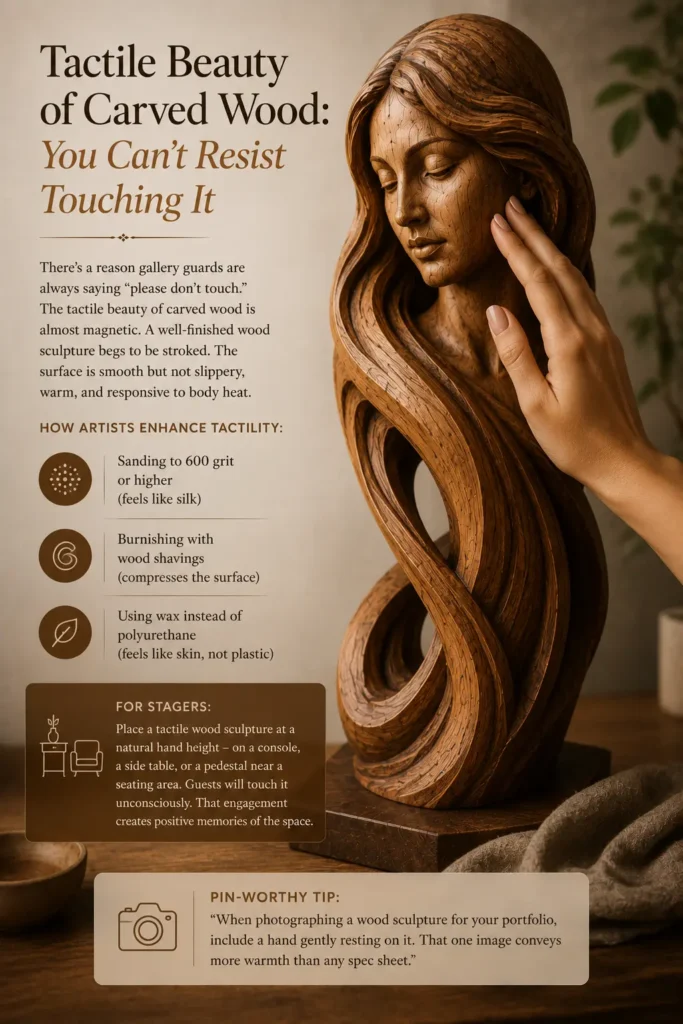
There’s a reason gallery guards are always saying “please don’t touch.” The tactile beauty of carved wood is almost magnetic. A well‑finished wood sculpture begs to be stroked. The surface is smooth but not slippery, warm, and responsive to body heat.
How artists enhance tactility:
- Sanding to 600 grit or higher (feels like silk)
- Burnishing with wood shavings (compresses the surface)
- Using wax instead of polyurethane (feels like skin, not plastic)
For stagers:
Place a tactile wood sculpture at a natural hand height – on a console, a side table, or a pedestal near a seating area. Guests will touch it unconsciously. That engagement creates positive memories of the space.
Pin‑worthy tip: “When photographing a wood sculpture for your portfolio, include a hand gently resting on it. That one image conveys more warmth than any spec sheet.”
5. Large‑Scale Wood Sculpture Feasibility: Go Big Without Breaking the Bank
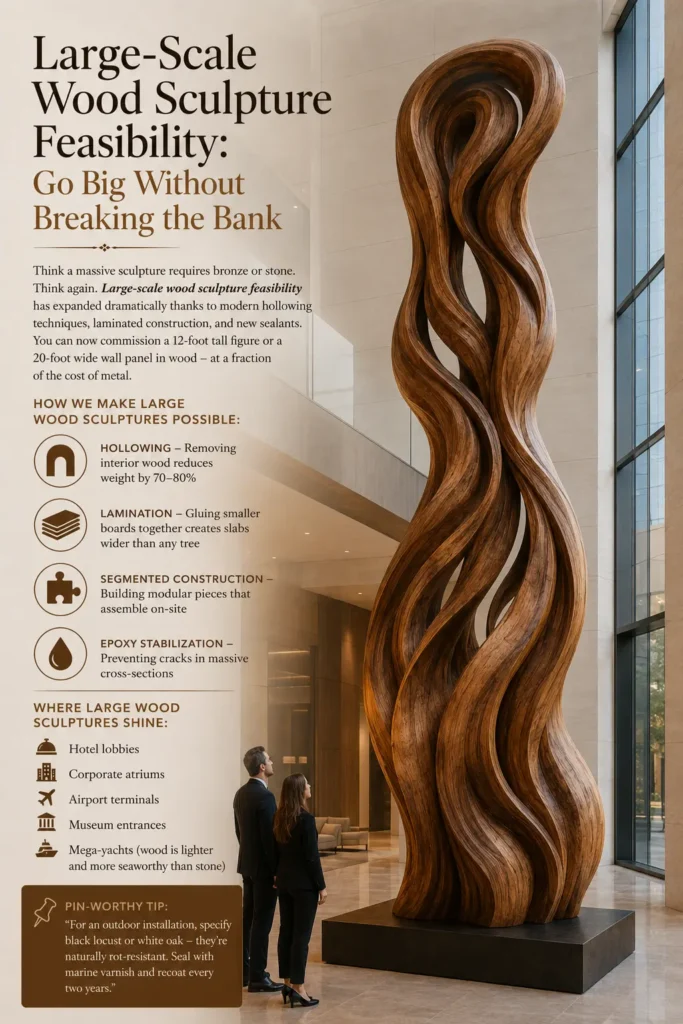
Think a massive sculpture requires bronze or stone. Think again. Large‑scale wood sculpture feasibility has expanded dramatically thanks to modern hollowing techniques, laminated construction, and new sealants. You can now commission a 12‑foot tall figure or a 20‑foot wide wall panel in wood – at a fraction of the cost of metal.
How we make large wood sculptures possible:
- Hollowing – Removing interior wood reduces weight by 70–80%
- Lamination – Gluing smaller boards together creates slabs wider than any tree
- Segmented construction – Building modular pieces that assemble on‑site
- Epoxy stabilization – Preventing cracks in massive cross‑sections
Where large wood sculptures shine:
- Hotel lobbies
- Corporate atriums
- Airport terminals
- Museum entrances
- Mega‑yachts (wood is lighter and more seaworthy than stone)
Pin‑worthy tip: “For an outdoor installation, specify black locust or white oak – they’re naturally rot‑resistant. Seal with marine varnish and recoat every two years.”
6. Why Wood Outperforms Other Mediums for Custom Work
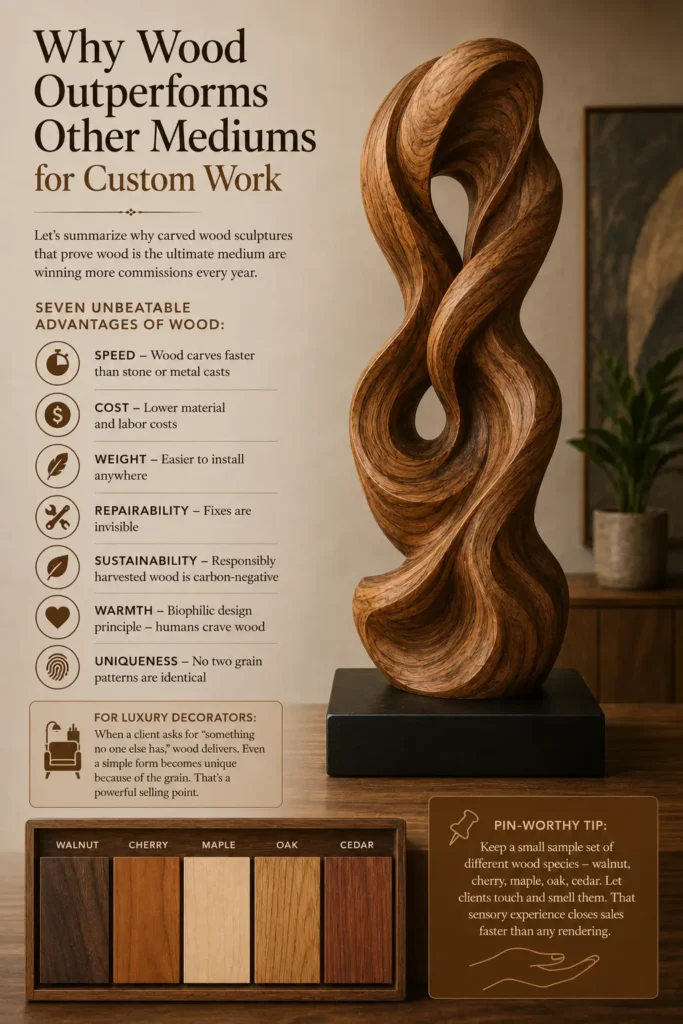
Let’s summarize why carved wood sculptures that prove wood is the ultimate medium are winning more commissions every year.
Seven unbeatable advantages of wood:
- Speed – Wood carves faster than stone or metal casts
- Cost – Lower material and labor costs
- Weight – Easier to install anywhere
- Repairability – Fixes are invisible
- Sustainability – Responsibly harvested wood is carbon‑negative
- Warmth – Biophilic design principle – humans crave wood
- Uniqueness – No two grain patterns are identical
For luxury decorators:
When a client asks for “something no one else has,” wood delivers. Even a simple form becomes unique because of the grain. That’s a powerful selling point.
Pin‑worthy tip: “Keep a small sample set of different wood species – walnut, cherry, maple, oak, cedar. Let clients touch and smell them. That sensory experience closes sales faster than any rendering.”
7. Real‑World Examples: Wood Sculptures That Stun

Need inspiration? Here are three real projects where wood proved its superiority.
Project 1: Beachfront penthouse
A 7‑foot abstract wave carved from bleached maple. The client wanted something that felt like ocean movement but wouldn’t corrode (like metal) or crack (like stone in salt air). Wood delivered – and weighed only 45 pounds.
Project 2: Corporate law library
A 12‑foot wide relief carving of an oak tree, its branches spreading across the wall. Carved from a single slab of English walnut. The grain itself became the bark texture. Stone would have cost 5x more and felt cold in the reading room.
Project 3: Children’s hospital lobby
A life‑sized carved bear holding a balloon. Wood was chosen because it’s warm, non‑threatening, and can be repaired if accidentally damaged. The bear has been hugged by thousands of children – and still looks perfect.
Pin‑worthy tip: “For healthcare or educational spaces, always specify wood. It reduces anxiety and feels human in a way that metal and stone never can.”
Wood Wins. Every Time.
You’ve seen the evidence: wood grain as artistic expression, the practical magic of lightweight vs. stone or metal, the clear wood vs. stone sculpture benefits, the irresistible tactile beauty of carved wood, and the surprising large‑scale wood sculpture feasibility.
The next time a client asks for a statement piece – something warm, unique, and surprisingly practical – you’ll know the answer. Wood isn’t just an alternative. It’s the ultimate medium.
Table of Contents
Call to Action (CTA)
Ready to prove to your clients that wood is magic? Let’s create something together. Email me at admin@woodzaa.com with your project’s dimensions, preferred wood species, and a few inspiration images. I’ll send back a concept sketch and a quote within a week.
Let’s turn a tree into a treasure.
– Sheila


Pingback: 7 Simple Wood Carving Projects You Can Start This Weekend (Even If You’ve Never Carved) - Woodzaa