
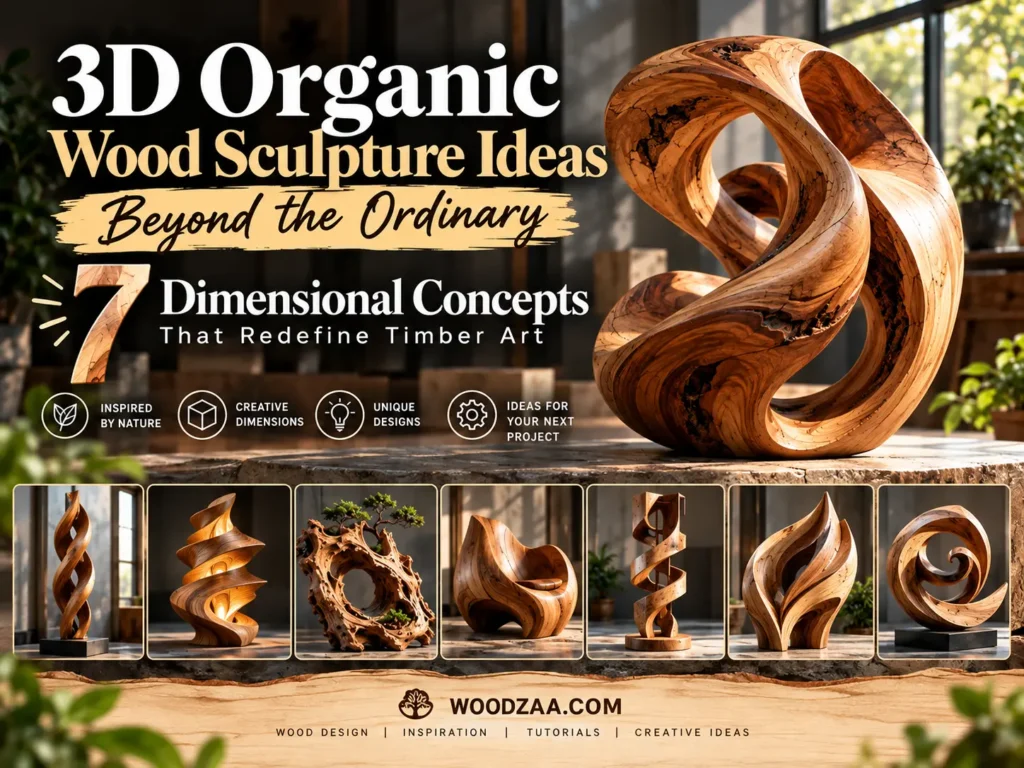
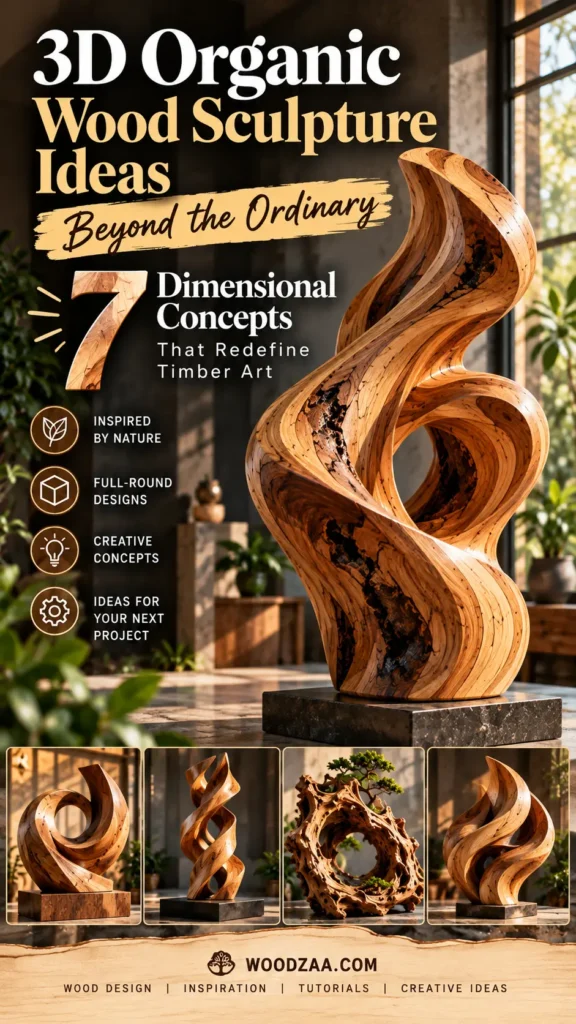
You’ve seen wood sculpture before. Flat panels, simple forms, pieces that look beautiful from one angle and forgettable from every other. But there’s a different kind of work out there — sculpture you can walk around, that reveals new forms as you move, that seems to occupy space rather than simply fill it. That’s the world of 3D organic wood sculpture ideas beyond the ordinary — dimensional, full-round, and endlessly rewarding.
In this guide, you’ll discover seven concepts that push past conventional wood art. You’ll explore full-round organic carving that’s finished on all sides, in-the-round wood carving that demands a 360-degree view, and dimensional organic sculpture that creates real presence in a room. You’ll learn about three-dimensional timber art that changes with your position, 3D carved wood forms that play with shadow and light, and extraordinary organic wood art that refuses easy categorisation. Whether you’re a collector, a designer, or simply someone drawn to work that rewards exploration, these seven concepts will change how you think about sculptural wood.
1. Full-Round Organic Carving — Finished on Every Side
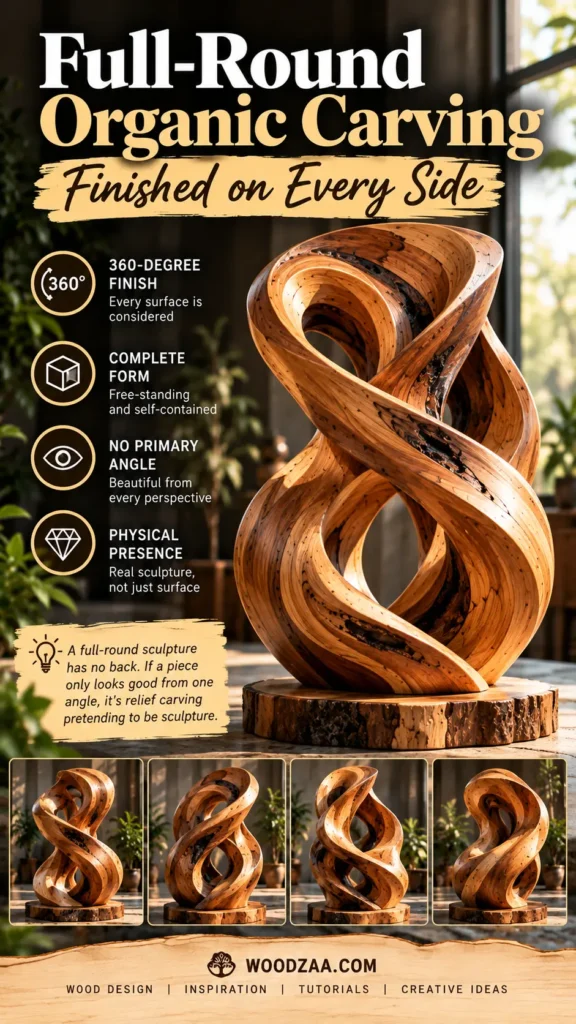
Full-round organic carving is the foundation of truly three-dimensional work. Unlike relief carving, which is designed for a single viewing angle, full-round sculpture is finished on every side — no flat back, no hidden surfaces, no shortcuts.
What defines full-round carving:
- 360-degree finish — every surface is sanded, oiled, and considered
- Complete form — the piece is self-contained and free-standing
- No viewing angle is primary — each perspective is equally valid
- Physical presence — the work occupies real space, not just surface
Why full-round work is more demanding: A relief carving can hide errors on the back. A full-round sculpture can’t. Every curve, every transition, and every surface must work — which is why full-round carving takes significantly longer and demands greater skill.
What to look for when buying:
- Check underneath — the base should be finished to the same standard as the top
- Walk around it — the form should hold interest from every angle
- Look for consistency — no side should feel neglected
- Feel the surface — the finish should be uniform throughout
Best woods for full-round work: Cherry, walnut, butternut, and maple all hold detail beautifully and finish to a silk-like surface. Avoid softwoods for anything with fine detail — they crush and bruise.
Worthy tip: “A full-round sculpture has no back. If a piece only looks good from one angle, it’s relief carving pretending to be sculpture.”
For more on flowing organic forms, explore our related article: Organic Biomorphic Wood Sculptures With Lifelike Flow (Mid to High Net Worth)
2. In-the-Round Wood Carving — The Discipline of Constant Rotation
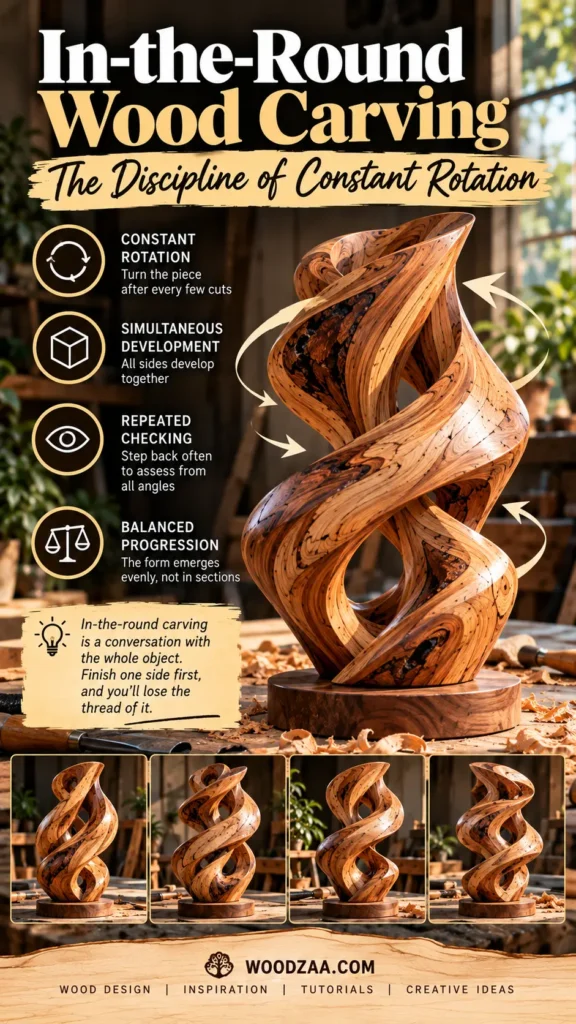
In-the-round wood carving is the traditional approach to full-round sculpture — and it’s as much a discipline as a technique. The carver works the entire piece continuously, turning it constantly so that all sides develop together.
The in-the-round method:
- Constant rotation — the piece is turned after every few cuts
- Simultaneous development — no side is finished before the others
- Repeated checking — the carver steps back frequently to assess from all angles
- Balanced progression — the form emerges evenly rather than in sections
Why this discipline matters: If you finish one side completely before starting another, you lose your reference points. The proportions drift, the form becomes unbalanced, and the piece ends up looking different from every angle — in a bad way.
The sound test: Tap the outside of your carving as you work. The sound changes as material is removed — your ears become a reliable guide to wall thickness and internal structure.
Common mistakes in in-the-round work:
- Falling in love with one angle — beginners often over-develop the side they see most
- Neglecting the underside — the base of a sculpture deserves the same attention as the face
- Working too fast — in-the-round carving is slower by nature; rushing produces imbalance
Worthy tip: “In-the-round carving is a conversation with the whole object. Finish one side first, and you’ll lose the thread of it.”
You Might Like : Brutalist Wood Wall Sculpture: Raw, Bold, Unforgettable
3. Dimensional Organic Sculpture — Presence and Scale
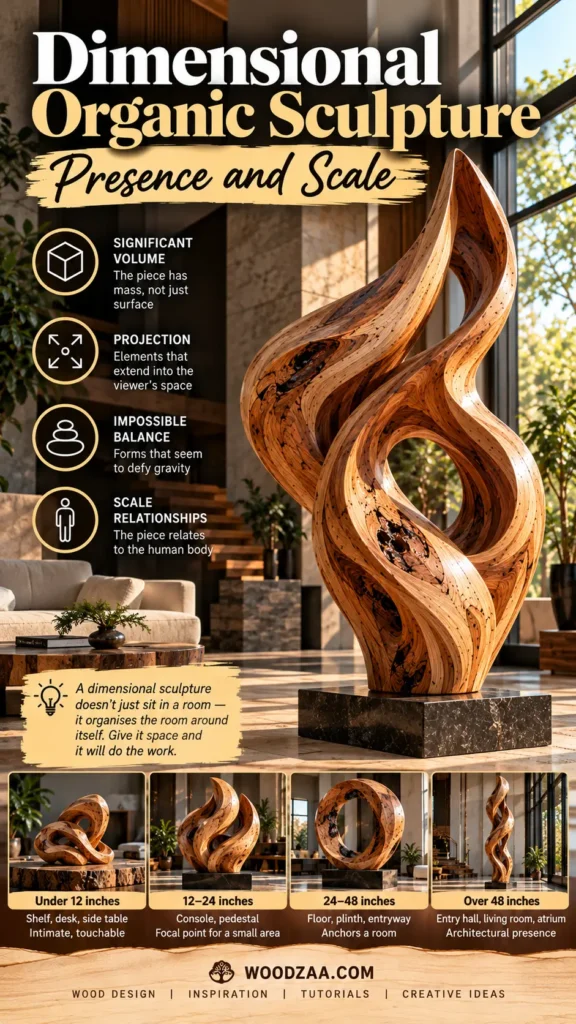
Dimensional organic sculpture goes beyond the object itself to consider how it occupies space. These pieces aren’t just three-dimensional — they actively shape the room around them.
What creates dimensional presence:
- Significant volume — the piece has mass, not just surface
- Projection — elements that extend into the viewer’s space
- Impossible balance — forms that seem to defy gravity
- Scale relationships — the piece relates to the human body
Why presence matters: A sculpture that sits politely on a shelf is decoration. A sculpture that changes the way you move through a room is architecture. The most compelling 3D organic work does the latter.
Scale guidelines:
| Scale | Best Placement | Effect |
|---|---|---|
| Under 12 inches | Shelf, desk, side table | Intimate, touchable |
| 12–24 inches | Console, pedestal | Focal point for a small area |
| 24–48 inches | Floor, plinth, entryway | Anchors a room |
| Over 48 inches | Entry hall, living room, atrium | Architectural presence |
The negative space rule: Dimensional sculpture needs room to breathe. At least three feet of clearance on all sides allows the piece to function as intended — as a presence rather than an object.
Worthy tip: “A dimensional sculpture doesn’t just sit in a room — it organises the room around itself. Give it space, and it will do the work.”
4. 3D Carved Wood Forms — Playing With Shadow and Light
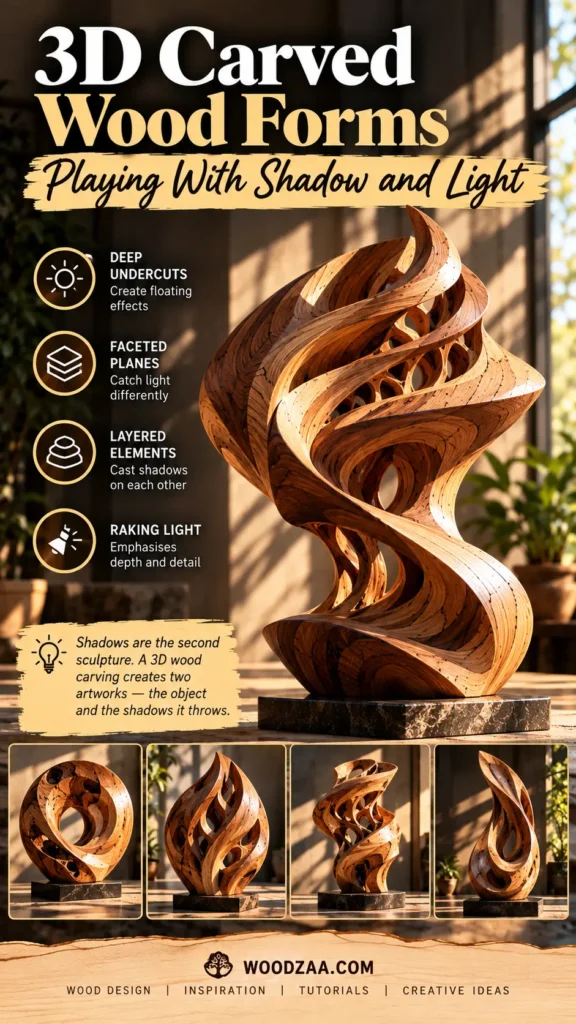
3D carved wood forms exploit one of the medium’s great advantages: the way carved surfaces interact with light. Deep undercuts, varied planes, and layered elements all create shadows that become part of the artwork.
How to maximise shadow play:
- Deep undercuts — carve behind the surface to create floating effects
- Faceted planes — angled surfaces that catch light differently from each other
- Layered elements — overlapping forms that cast shadows on each other
- Raking light — position the piece where directional light emphasises depth
The light test: Move your sculpture under different lighting conditions. In raking light, the shadows should reveal forms and details you can’t see in flat light. If nothing changes, the carving isn’t exploiting its three-dimensional potential.
Best woods for shadow play: Basswood and butternut hold fine detail and deep undercuts well. Cherry and walnut add richness that makes shadows feel warmer and more dramatic.
The photography lesson: Photograph your piece at three different times of day. If the images look like three different sculptures, you’ve achieved genuine dimensional depth.
Worthy tip: “Shadows are the second sculpture. A 3D wood carving creates two artworks — the object and the shadows it throws.”
5. Beyond Ordinary Wood Sculpture — Breaking the Pedestal
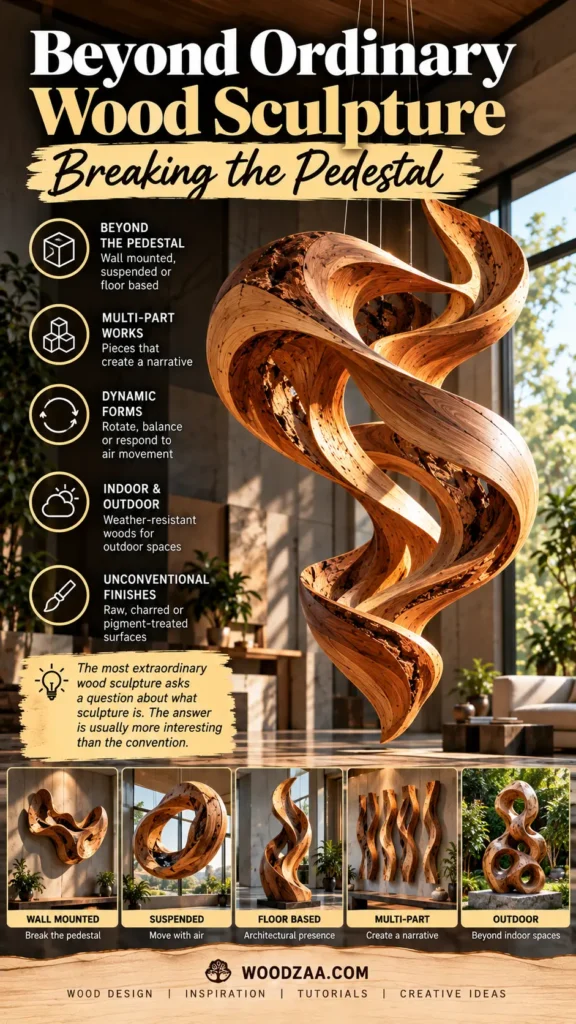
Beyond ordinary wood sculpture means questioning the conventions that most sculptors accept without thinking. Does it have to sit on a pedestal? Does it have to be static? Does it have to be a single object?
Conventions worth breaking:
- The pedestal — why not mount the piece on the wall, suspend it, or let it sit directly on the floor?
- The single object — multi-part works that relate to each other create narrative
- The static form — pieces that rotate, balance, or respond to air movement
- The indoor setting — weather-resistant woods allow dimensional work outdoors
- The conventional finish — raw, charred, or pigment-treated surfaces expand the vocabulary
Why breaking conventions matters: The most memorable 3D organic work is the work that makes you reconsider what sculpture can be. A piece suspended from the ceiling, a form that balances impossibly on a single point, or an installation that changes as you move through it — these are the works that stay with you.
Practical examples:
- Suspended forms — hung from the ceiling to rotate slowly in air currents
- Floor-based installations — large works that require you to walk around them
- Modular compositions — multiple pieces arranged to create a larger whole
- Interactive elements — works that can be repositioned
Worthy tip: “The most extraordinary wood sculpture asks a question about what sculpture is. The answer is usually more interesting than the convention.”
6. Extraordinary Organic Wood Art — Form That Feels Alive
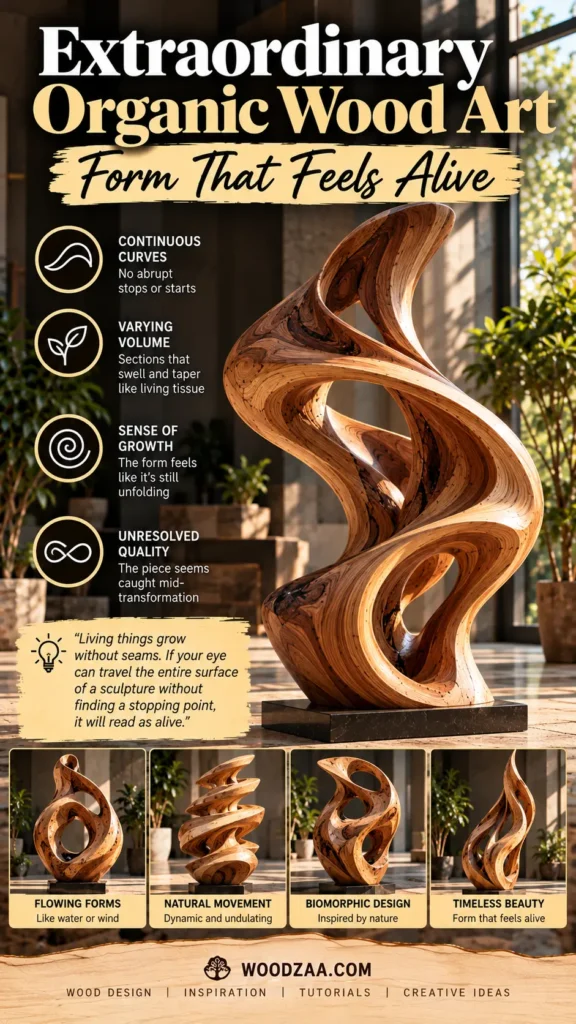
Extraordinary organic wood art achieves the most difficult effect in sculpture: the illusion of life. These pieces don’t depict living things — they seem to embody the qualities of living things.
What makes organic forms feel alive:
- Continuous curves — no abrupt stops or starts
- Varying volume — sections that swell and taper like living tissue
- Sense of growth — the form feels like it’s still unfolding
- Unresolved quality — the piece seems caught mid-transformation
Where this quality comes from: Living things grow continuously, without seams. A sculpture that mimics that continuity — where the eye can travel the entire surface without finding a stopping point — reads as alive, even when it doesn’t resemble anything specific.
The artists to know:
Joseph Walsh creates gravity-defying forms that “seem to flow like water or rustle like wind, capturing the poetry of movement in solid wood”. His lamination technique allows curves that solid wood can’t achieve.
Mirko Zrinšćak creates “elongated, pulsating, rhythmical forms” that are “meditations on the underlying, invisible forces of nature, created in dialogue with the trees they are made from”.
Pia Maria Raeder creates “dynamic, undulating sculptures” from thousands of hand-arranged beechwood rods, with works that have “an emotional communicative presence”.
Worthy tip: “Living things grow without seams. If your eye can travel the entire surface of a sculpture without finding a stopping point, it will read as alive.”
7. 3D Timber Sculpture Concepts — Ideas Worth Exploring
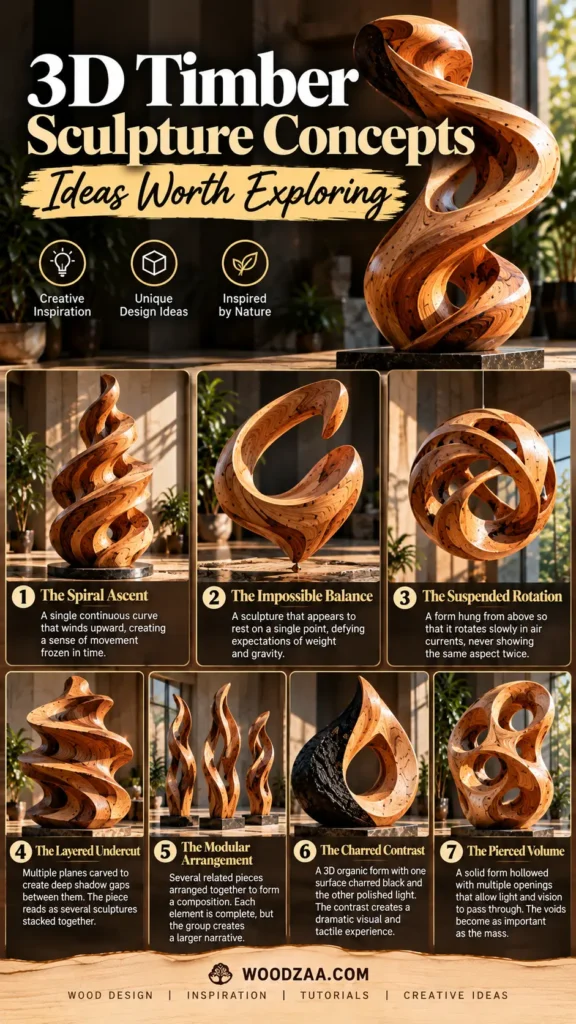
3D timber sculpture concepts are the starting points — the ideas that lead to genuinely dimensional work. Here are seven concepts worth exploring, whether you’re commissioning or creating.
Concept 1: The spiral ascent
A single continuous curve that winds upward around an invisible axis. The form appears to grow, creating a sense of movement frozen in time.
Concept 2: The impossible balance
A sculpture that appears to rest on a single point, defying expectations of weight and gravity. The tension between appearance and physics holds attention.
Concept 3: The suspended rotation
A form hung from above so that it rotates slowly in air currents. The piece changes continuously, never showing the same aspect twice.
Concept 4: The layered undercut
Multiple planes carved to create deep shadow gaps between them. The piece reads as several sculptures stacked together.
Concept 5: The modular arrangement
Several related pieces arranged together to form a composition. Each element is complete, but the group creates a larger narrative.
Concept 6: The charred contrast
A 3D organic form with one surface charred black and the other polished light. The contrast creates a dramatic visual and tactile experience.
Concept 7: The pierced volume
A solid form hollowed with multiple openings that allow light and vision to pass through. The voids become as important as the mass.
Worthy tip: “Every great 3D wood sculpture began as a simple concept. The concept doesn’t need to be complicated — it needs to be clear.”
From Ordinary to Extraordinary — The Dimensional Approach
You now have a complete guide to 3D organic wood sculpture ideas beyond the ordinary. From the discipline of full-round organic carving and in-the-round wood carving to the presence of dimensional organic sculpture, from the shadow play of 3D carved wood forms to the boundary-pushing of beyond-ordinary wood sculpture, from the lifelike quality of extraordinary organic wood art to the concepts of 3D timber sculpture — you have everything you need to appreciate, commission, or create work that refuses to be flat.
Key takeaways:
- Full-round means finished on every side — no back, no shortcuts
- In-the-round requires constant rotation — develop all sides together
- Presence comes from volume and space — give dimensional work room to breathe
- Shadows are the second sculpture — use raking light to reveal depth
- Break conventions deliberately — pedestals, static forms, and single objects aren’t rules
- Continuous curves read as alive — the eye should never find a stopping point
- Concepts don’t need to be complex — they need to be clear
Three-dimensional organic wood sculpture rewards exploration. Unlike flat art, it changes as you move — revealing new forms, new shadows, and new relationships with every step. That quality is what makes it worth living with.
Table of Contents
Call to Action (CTA)
Which 3D concept speaks to you most — the spiral ascent, the impossible balance, or the suspended rotation? I’d love to hear what kind of dimensional work you’re drawn to. Email me at admin@woodzaa.com with “3D Organic” in the subject line. Tell me about your space, the scale you’re considering, and the effect you want to create. I’ll help you find or commission a dimensional sculpture that rewards exploration.
Let’s go beyond the ordinary together.
— Sheila

