
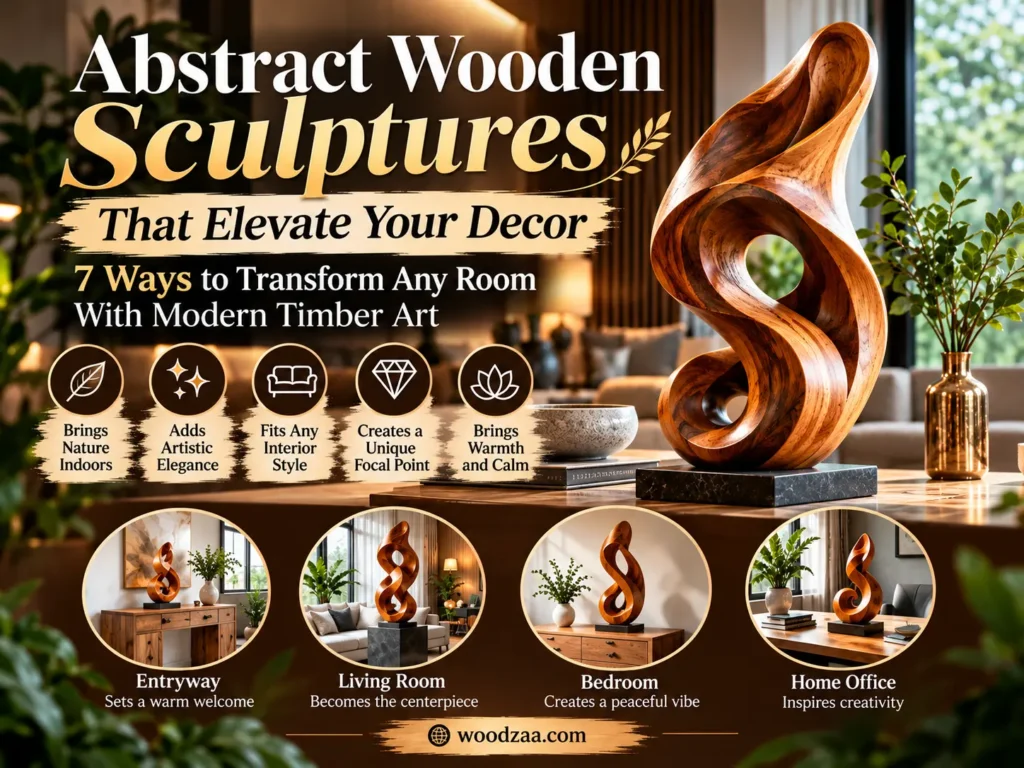
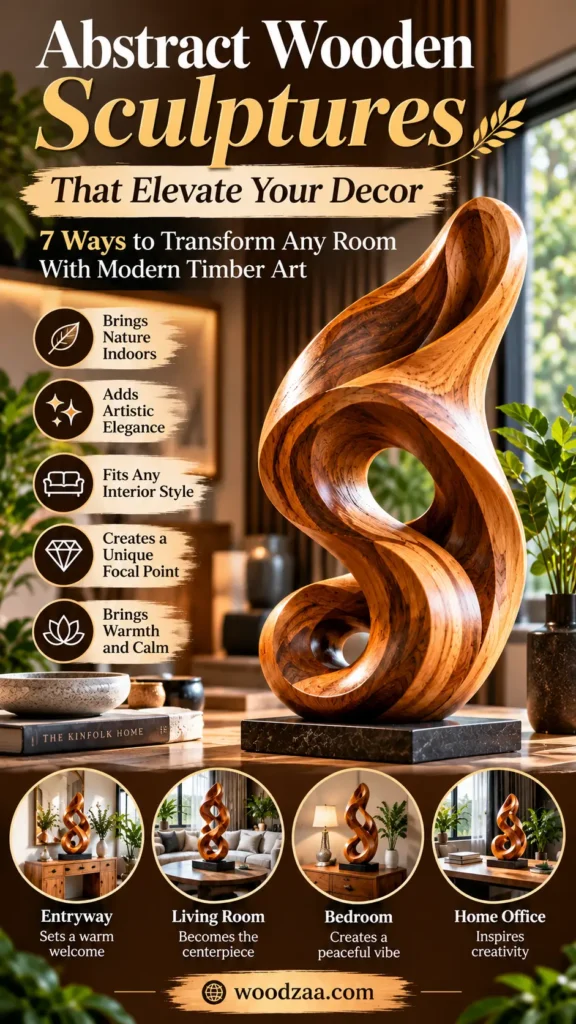
Your home is almost there. The furniture works, the lighting is warm, the palette is coherent. But something still feels unresolved — a shelf that reads empty, a console that lacks a focal point, a room that feels finished rather than designed. What’s missing is often the same thing: one piece of art with real presence. And nothing delivers that presence quite like abstract wooden sculptures that elevate your decor.
In this guide, you’ll discover why abstract wood art has become the go-to choice for designers working in contemporary spaces. You’ll explore contemporary abstract wood art across seven distinct styles — from minimalist abstract wood decor to geometric abstract wood carving, from organic abstract wood forms to biomorphic abstract sculpture. You’ll learn how non-representational wood sculpture functions as decor, how to place it for maximum impact, and how to choose a piece that will still feel right in ten years. By the end, you’ll know exactly what your space is missing — and how to find it.
1. Why Abstract Wood Sculpture Elevates a Room Instantly
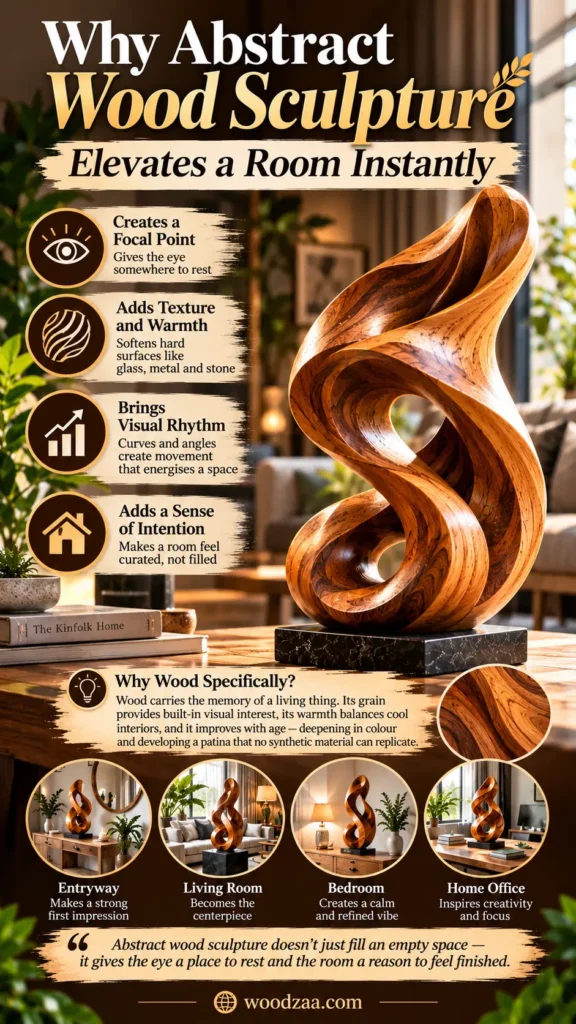
Abstract wooden sculpture works as decor in a way that few other objects can. It doesn’t compete with your furniture, doesn’t introduce a competing narrative, and doesn’t date the way figurative art sometimes does. Instead, it does three things at once.
What abstract wood sculpture brings to a room:
- A focal point — the eye needs somewhere to rest, and abstraction provides it
- Texture and warmth — wood softens hard surfaces like glass, metal, and stone
- Visual rhythm — curves and angles create movement that energises a space
- A sense of intention — abstract art signals that a room was curated, not filled
Why wood specifically: Materials like resin, acrylic, and metal can feel cold or mass-produced. Wood carries the memory of a living thing. Its grain provides built-in visual interest, its warmth balances cool interiors, and it improves with age — deepening in colour and developing a patina that no synthetic material can replicate.
The finishing factor: What separates a piece that elevates a room from one that merely occupies it is usually the finish. A sculpture sanded to 400 grit and oiled with beeswax has a tactile quality that invites engagement. A piece left rough or coated in polyurethane feels inert. Finishing is where good decor becomes great decor.
Worthy tip: “Abstract wood sculpture doesn’t just fill an empty space — it gives the eye a place to rest and the room a reason to feel finished.”
For more on where bold wood carving begins, explore our related article: First Wood Carving Ideas That Spark a Lifelong Hobby (Mid to High Net Worth)
2. Minimalist Abstract Wood Decor — The Power of Less
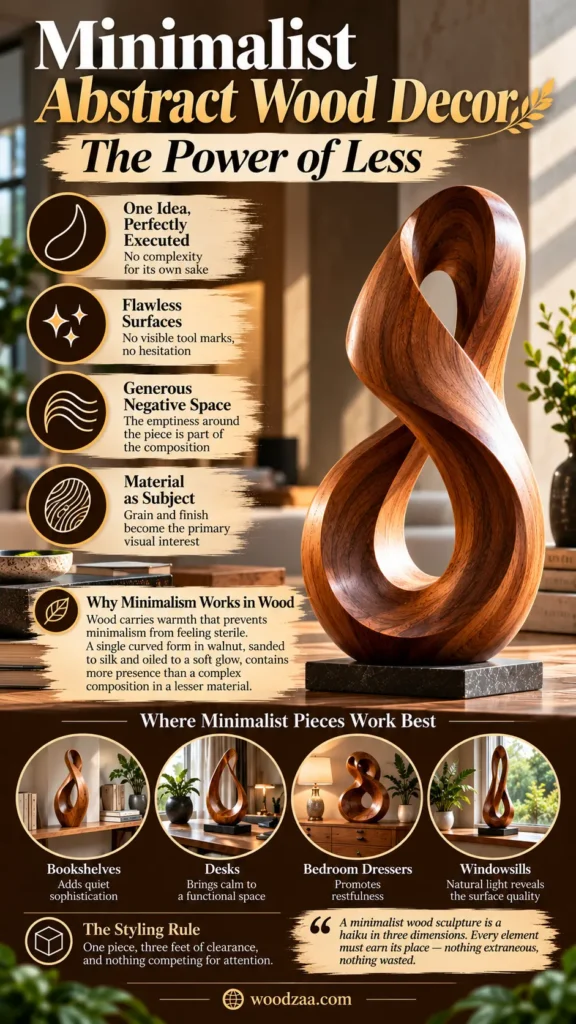
Minimalist abstract wood decor proves that a single gesture can carry an entire room. These pieces strip away everything non-essential, leaving one curve, one volume, one quiet statement.
What defines minimalist abstract wood sculpture:
- One idea, perfectly executed — no complexity for its own sake
- Flawless surfaces — no visible tool marks, no hesitation
- Generous negative space — the emptiness around the piece is part of the composition
- Material as subject — grain and finish become the primary visual interest
Why minimalism works in wood: Wood carries warmth that prevents minimalism from feeling sterile. A single curved form in walnut, sanded to silk and oiled to a soft glow, contains more presence than a complex composition in a lesser material.
Where minimalist pieces work best:
- Bookshelves — one small piece among books adds quiet sophistication
- Desks — brings calm to a functional space
- Bedroom dressers — promotes restfulness
- Windowsills — natural light reveals the surface quality
The styling rule: Minimalist sculpture needs space. If you crowd it with other objects, it stops functioning as a focal point and becomes clutter. One piece, three feet of clearance, and nothing competing for attention.
Worthy tip: “A minimalist wood sculpture is a haiku in three dimensions. Every element must earn its place — nothing extraneous, nothing wasted.”
You Might Like : Organic Biomorphic Wood Sculptures With Lifelike Flow
3. Geometric Abstract Wood Carving — Structure and Precision
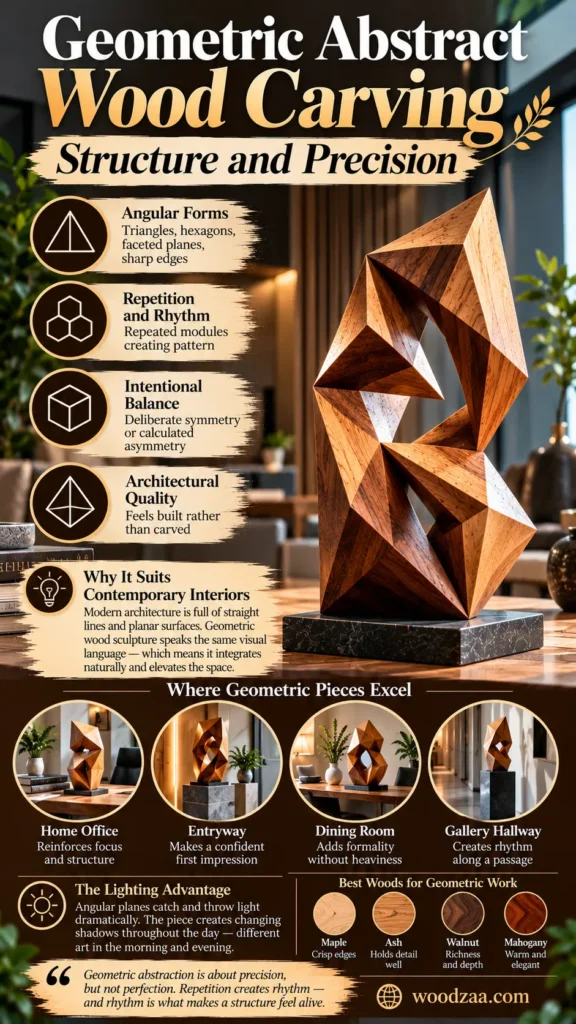
Geometric abstract wood carving occupies the opposite end of the spectrum from minimalism’s softness. These are pieces defined by angles, planes, and mathematical precision.
What defines geometric abstract wood art:
- Angular forms — triangles, hexagons, faceted planes, sharp edges
- Repetition and rhythm — repeated modules creating pattern
- Deliberate symmetry or calculated asymmetry — nothing accidental
- Architectural quality — the piece feels built rather than carved
Why geometric work suits contemporary interiors: Modern architecture is full of straight lines, right angles, and planar surfaces. Geometric sculpture speaks the same visual language — which means it integrates naturally rather than fighting the space.
Where geometric pieces excel:
| Location | Why It Works |
|---|---|
| Home office | Reinforces focus and structure |
| Entryway | Makes a confident first impression |
| Dining room | Adds formality without heaviness |
| Gallery hallway | Creates rhythm along a passage |
The lighting advantage: Angular planes catch and throw light dramatically. A geometric sculpture with raking light produces shadows that change throughout the day — the piece effectively becomes different art in the morning and evening.
Best woods for geometric work: Maple and ash hold crisp edges beautifully. Walnut and mahogany add richness and depth. Avoid softwoods for sharp geometric forms — they crush and bruise at the edges.
Worthy tip: “Geometric abstraction is about precision, but not perfection. Repetition creates rhythm — and rhythm is what makes a structure feel alive.”
4. Organic Abstract Wood Forms — Nature Without Subject Matter
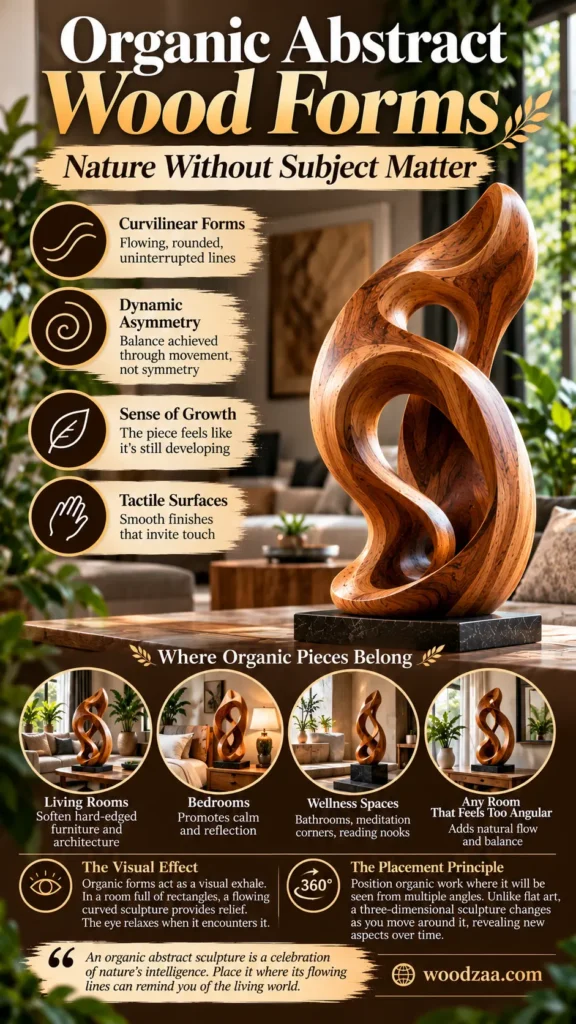
Organic abstract wood forms draw from the shapes of living things without depicting any specific organism. They suggest growth, movement, and unfolding — the visual language of nature itself.
What defines organic abstraction:
- Curvilinear forms — flowing, rounded, uninterrupted lines
- Dynamic asymmetry — balance achieved through movement, not symmetry
- Sense of growth — the piece feels like it’s still developing
- Tactile surfaces — smooth finishes that invite touch
Where organic pieces belong:
- Living rooms — soften hard-edged furniture and architecture
- Bedrooms — promote calm and reflection
- Wellness spaces — bathrooms, meditation corners, reading nooks
- Any room that feels too angular
The visual effect: Organic forms act as a visual exhale. In a room full of rectangles — sofas, windows, frames, screens — a flowing curved sculpture provides relief. The eye relaxes when it encounters it.
The placement principle: Position organic work where it will be seen from multiple angles. Unlike flat art, a three-dimensional organic sculpture changes as you move around it — the curves shift, the light catches differently, and the piece reveals new aspects over time.
Worthy tip: “An organic abstract sculpture is a celebration of nature’s intelligence. Place it where its flowing lines can remind you of the living world.”
5. Biomorphic Abstract Sculpture — When Wood Feels Alive
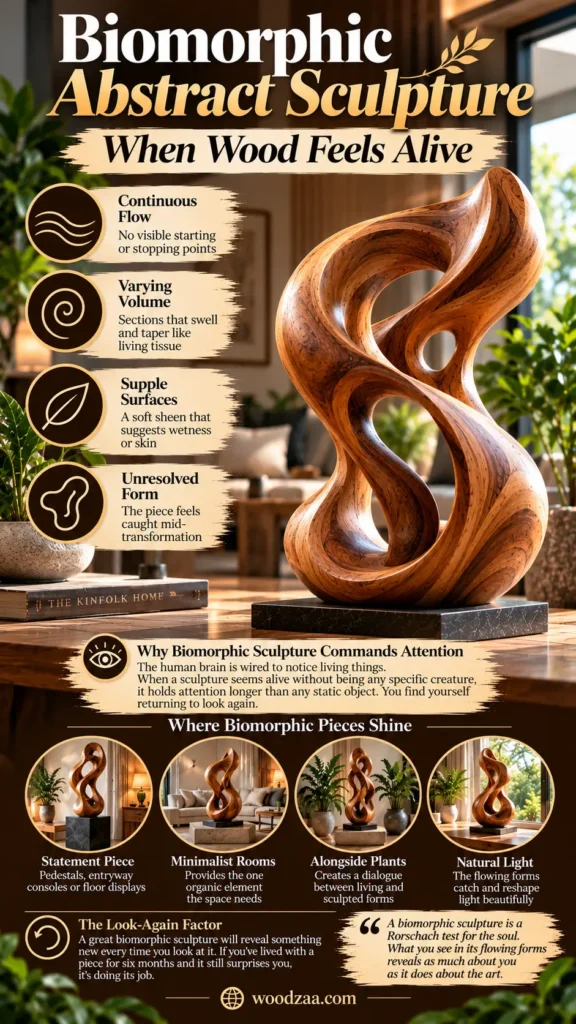
Biomorphic abstract sculpture takes organic abstraction one step further. These pieces don’t just suggest nature — they seem to embody life itself. The forms feel like they’re breathing, growing, or unfolding.
What makes biomorphic work feel alive:
- Continuous flow — no visible starting or stopping points
- Varying volume — sections that swell and taper like living tissue
- Supple surfaces — a soft sheen that suggests wetness or skin
- Unresolved form — the piece feels caught mid-transformation
Why biomorphic sculpture commands attention: The human brain is wired to notice living things. When a sculpture triggers that response — when it seems alive without being any specific creature — it holds attention longer than any static object. You find yourself returning to look again.
Where biomorphic work shines:
- As a statement piece — pedestals, entryway consoles, or floor displays
- In minimalist rooms — provides the one organic element the space needs
- Alongside plants — creates a dialogue between living and sculpted forms
- In rooms with natural light — the flowing forms catch and reshape light
The look-again factor: A great biomorphic sculpture will reveal something new every time you look at it. If you’ve lived with a piece for six months and it still surprises you, it’s doing its job.
Worthy tip: “A biomorphic sculpture is a Rorschach test for the soul. What you see in its flowing forms reveals as much about you as it does about the art.”
6. Curvilinear Wood Art and Free-Form Abstraction — Breaking the Grid
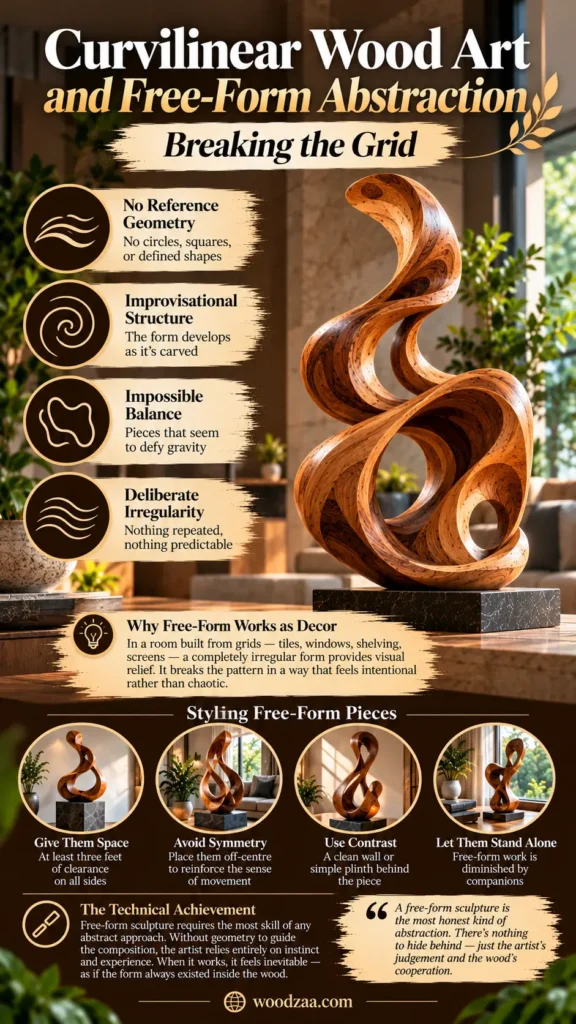
Curvilinear wood art and free-form abstract timber art reject geometric structure entirely. These pieces follow their own internal logic — flowing, winding, and refusing to sit still.
What distinguishes free-form abstraction:
- No reference geometry — no circles, squares, or defined shapes
- Improvisational structure — the form develops as it’s carved
- Impossible balance — pieces that seem to defy gravity
- Deliberate irregularity — nothing repeated, nothing predictable
Why free-form works as decor: In a room built from grids — tiles, windows, shelving, screens — a completely irregular form provides visual relief. It breaks the pattern in a way that feels intentional rather than chaotic, because it’s the only element in the room without structure.
Styling free-form pieces:
- Give them space — at least three feet of clearance on all sides
- Avoid symmetry — place them off-centre to reinforce the sense of movement
- Use contrast — a clean wall or a simple plinth behind the piece
- Let them stand alone — free-form work is diminished by companions
The technical achievement: Free-form sculpture requires the most skill of any abstract approach. Without geometry or reference to guide the composition, the artist must rely entirely on instinct and experience to know when the piece is finished. When it works, it feels inevitable — as if the form always existed inside the wood.
Worthy tip: “A free-form sculpture is the most honest kind of abstraction. There’s nothing to hide behind — just the artist’s judgement and the wood’s cooperation.”
7. Avant-Garde Wood Decor — When Sculpture Challenges the Room
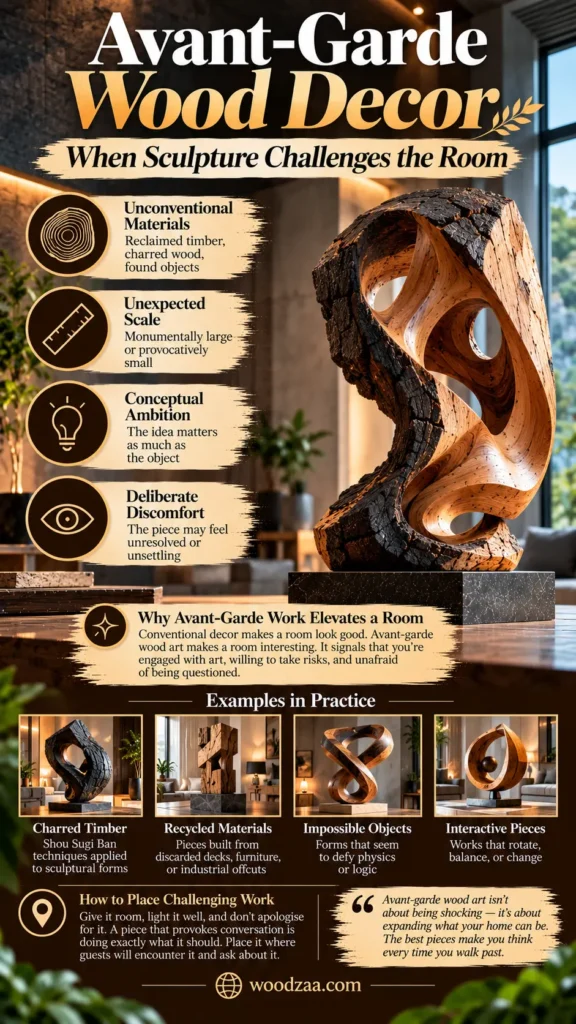
Avant-garde wood decor pushes past decor entirely. These are pieces that challenge, provoke, and refuse to blend in — work that makes you think rather than simply pleasing the eye.
What makes wood decor avant-garde:
- Unconventional materials — reclaimed timber, charred wood, found objects
- Unexpected scale — monumentally large or provocatively small
- Conceptual ambition — the idea matters as much as the object
- Deliberate discomfort — the piece may feel unresolved or unsettling
Why avant-garde work elevates a room: Conventional decor makes a room look good. Avant-garde work makes a room interesting. It signals that the person who lives there is engaged with art, willing to take risks, and unafraid of being questioned.
Examples in practice:
- Charred and blackened timber — Shou Sugi Ban techniques applied to sculptural forms
- Recycled material sculptures — pieces built from discarded decks, furniture, or industrial offcuts
- Impossible objects — forms that seem to defy physics or logic
- Interactive pieces — works that rotate, balance, or change
How to place challenging work: Give it room, light it well, and don’t apologise for it. A piece that provokes conversation is doing exactly what it should. Place it where guests will encounter it and ask about it.
Worthy tip: “Avant-garde wood art isn’t about being shocking — it’s about expanding what your home can be. The best pieces make you think every time you walk past.”
8. How to Choose Abstract Wood Sculpture That Will Last
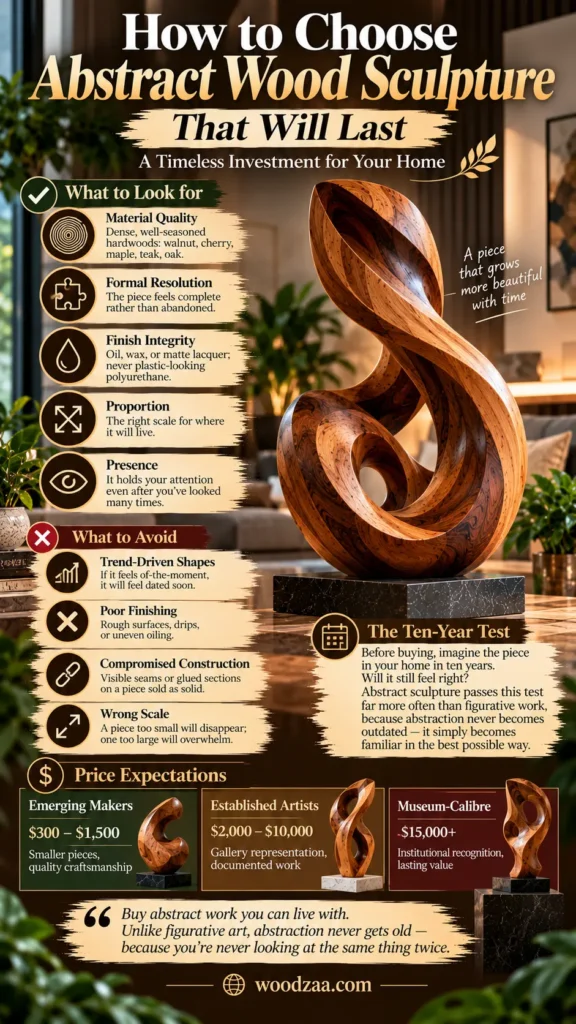
Modern abstract timber sculpture is an investment — both financially and in terms of the space it occupies. Here’s how to choose a piece you’ll still love in ten years.
What to look for:
- Material quality — dense, well-seasoned hardwoods: walnut, cherry, maple, teak, oak
- Formal resolution — the piece feels complete rather than abandoned
- Finish integrity — oil, wax, or matte lacquer; never plastic-looking polyurethane
- Proportion — the piece is the right scale for where it will live
- Presence — it holds your attention even after you’ve looked many times
What to avoid:
- Trend-driven shapes — if it feels of-the-moment, it will feel dated soon
- Poor finishing — rough surfaces, drips, or uneven oiling
- Compromised construction — visible seams or glued sections on a piece sold as solid
- Wrong scale — a piece too small for its space will disappear; one too large will overwhelm
The ten-year test: Before buying, imagine the piece in your home in ten years. Will it still feel right? Abstract sculpture passes this test far more often than figurative work, because abstraction never becomes outdated — it simply becomes familiar in the best possible way.
Price expectations:
| Level | Range | What You Get |
|---|---|---|
| Emerging makers | $300–$1,500 | Smaller pieces, quality craftsmanship |
| Established artists | $2,000–$10,000 | Gallery representation, documented work |
| Museum-calibre | $15,000+ | Institutional recognition, lasting value |
Worthy tip: “Buy abstract work you can live with. Unlike figurative art, abstraction never gets old — because you’re never looking at the same thing twice.”
9. Styling Abstract Wood Sculpture for Maximum Impact
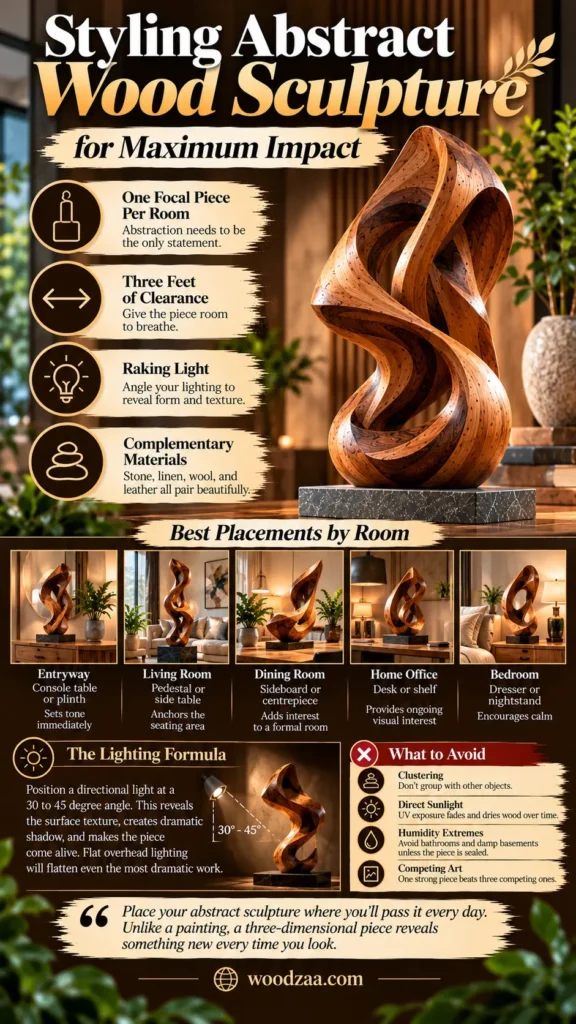
Sculptural wood abstraction needs the right setting to do its job. Here’s how to place it.
Placement principles:
- One focal piece per room — abstraction needs to be the only statement
- Three feet of clearance minimum — give the piece room to breathe
- Raking light — angle your lighting to reveal form and texture
- Complementary materials — stone, linen, wool, and leather all pair beautifully
Best placements by room:
| Room | Placement | Why |
|---|---|---|
| Entryway | Console table or plinth | Sets tone immediately |
| Living room | Pedestal or side table | Anchors the seating area |
| Dining room | Sideboard or centrepiece | Adds interest to a formal room |
| Home office | Desk or shelf | Provides ongoing visual interest |
| Bedroom | Dresser or nightstand | Encourages calm |
The lighting formula: Position a directional light — a small spotlight or picture light — so it rakes across the sculpture at a 30 to 45 degree angle. This reveals the surface texture, creates dramatic shadow, and makes the piece come alive. Flat overhead lighting will flatten even the most dramatic work.
What to avoid:
- Clustering — don’t group abstract sculptures with other objects
- Direct sunlight — UV exposure fades and dries wood over time
- Humidity extremes — avoid bathrooms and damp basements unless the piece is sealed
- Competing art — one strong piece beats three competing ones
Worthy tip: “Place your abstract sculpture where you’ll pass it every day. Unlike a painting, a three-dimensional piece reveals something new every time you look.”
From Timber to Transformation — Elevating Every Room
You now have a complete guide to abstract wooden sculptures that elevate your decor. From the quiet power of minimalist abstract wood decor to the structure of geometric abstract wood carving, from the flowing warmth of organic abstract wood forms to the living presence of biomorphic abstract sculpture, from the improvisation of free-form abstract timber art to the provocation of avant-garde wood decor — you have everything you need to choose, place, and live with contemporary abstract wood art.
Key takeaways:
- Abstract sculpture gives the eye a place to rest — it completes a room
- Wood adds warmth and texture — materials that other art forms can’t match
- Finishing is everything — sand to 400 or 600 grit, oil with wax, never polyurethane
- Choose for resolution, not trend — the piece should feel complete and timeless
- Give it space — three feet of clearance, raking light, nothing competing
- Buy what holds your attention — if it still surprises you after months, it’s right
Abstract wood sculpture is more than decor. It’s the piece that turns a room from furnished into curated, from pleasant into memorable, from finished into designed. And unlike almost any other decorative object, it improves with time — the wood deepens, the surface matures, and the piece becomes more yours every year.
Table of Contents
Call to Action (CTA)
Which abstract style speaks to you most — minimalist, geometric, organic, biomorphic, free-form, or avant-garde? I’d love to hear what your space is missing. Email me at admin@woodzaa.com with “Elevate My Decor” in the subject line. Tell me about your room, your palette, and the feeling you want to create — and I’ll help you find or commission an abstract wooden sculpture that transforms the space.
Let’s elevate your home together.
— Sheila

