
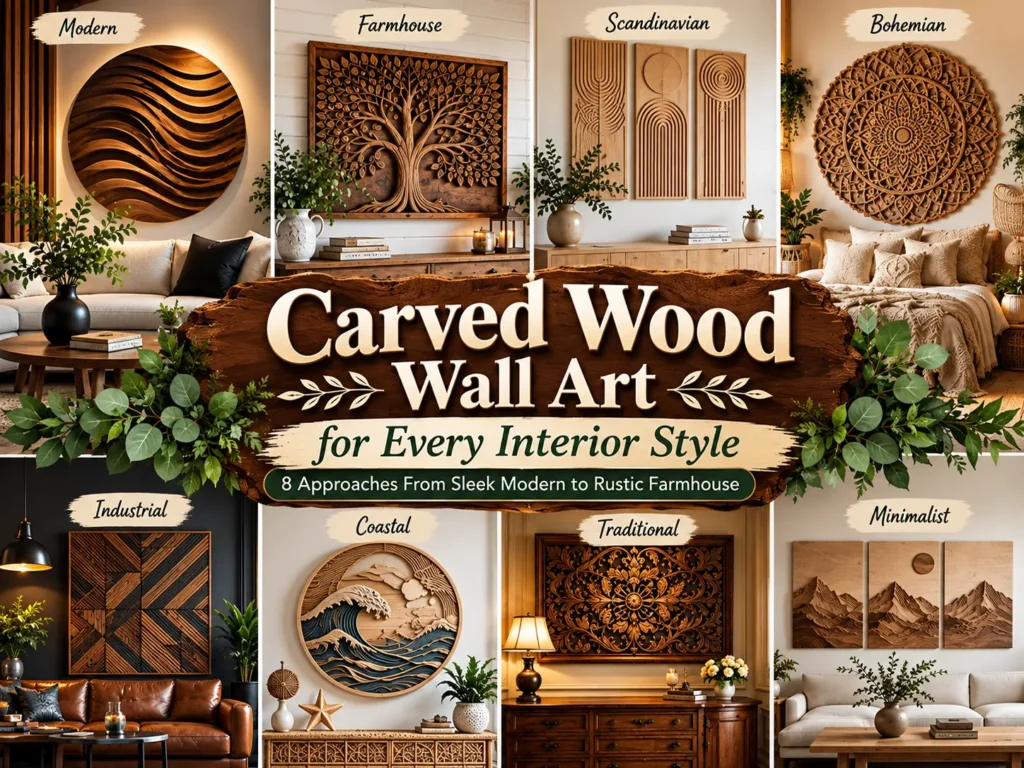
You’ve found the perfect piece of carved wood wall art. It’s beautiful, it’s handmade, it has real presence. And then you bring it home and realise it fights everything else in the room. The scale is right, the finish is wrong. Or the style is right, and the mood is off.
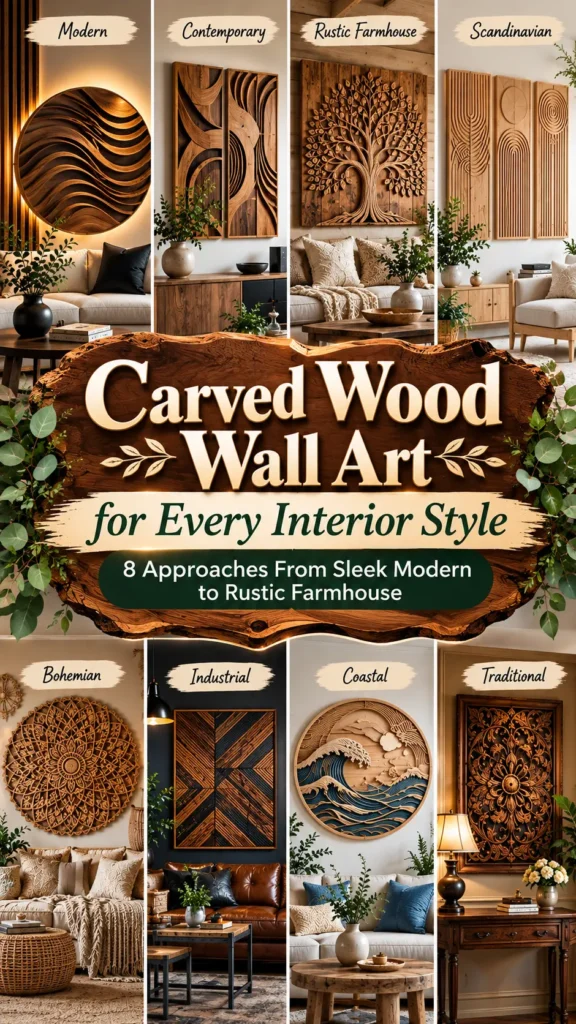
That’s the challenge with wood wall art — it has an enormous stylistic range, and carved wood wall art for every interior style only works when the piece matches the room it lives in. The same material can read as sleek minimalist, bold contemporary, or rustic farmhouse depending entirely on how it’s cut, finished, and detailed.
In this guide, you’ll discover eight approaches across the stylistic spectrum — from modern carved wood wall art and sleek modern wood wall panels to rustic carved wood wall art and barnwood wall art. You’ll learn what distinguishes each style, what to look for when buying, and how to match the right piece to your space.
1. Why Carved Wood Works Across Every Style
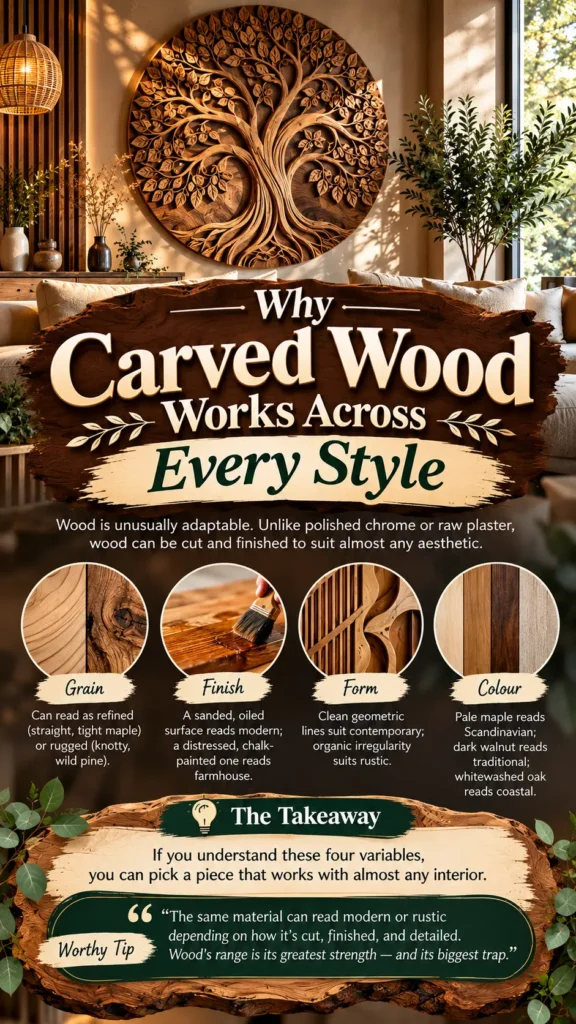
Wood is unusually adaptable. Unlike a material such as polished chrome, which only really suits modern interiors, or raw plaster, which skews rustic, wood can be cut and finished to suit almost any aesthetic.
What makes wood so versatile:
- Grain — can read as refined (straight, tight maple) or rugged (knotty, wild pine)
- Finish — a sanded, oiled surface reads modern; a distressed, chalk-painted one reads farmhouse
- Form — clean geometric lines suit contemporary; organic irregularity suits rustic
- Colour — pale maple reads Scandinavian; dark walnut reads traditional; whitewashed oak reads coastal
The takeaway: If you understand these four variables, you can pick a piece that works with almost any interior. Let’s look at each style.
Worthy tip: “The same material can read modern or rustic depending on how it’s cut, finished, and detailed. Wood’s range is its greatest strength — and its biggest trap.”
For more on organic forms, explore our related article: Organic Biomorphic Wood Sculptures With Lifelike Flow.
2. Modern Carved Wood Wall Art — Clean Lines, Refined Surfaces
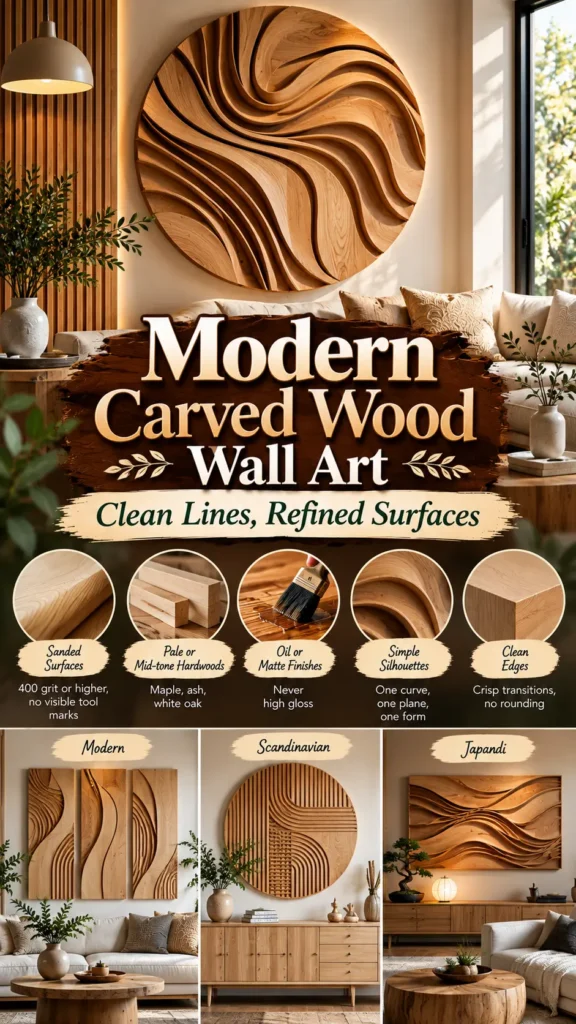
Modern carved wood wall art is defined by restraint. Nothing fussy, nothing ornate, nothing that reads as “made to look old.”
What to look for:
- Sanded surfaces — 400 grit or higher, with no visible tool marks
- Pale or mid-tone hardwoods — maple, ash, white oak
- Oil or matte finishes — never high gloss
- Simple silhouettes — one curve, one plane, one form
- Clean edges — crisp transitions, no rounding
Where it works: Modern, Scandinavian, and Japandi interiors. Also works well in transitional spaces that blend old and new.
What to avoid: Heavy ornamentation, faux-distressing, or dark muddy stains. In a modern room, those details look out of place.
Visit Our Shop : Click Here…
3. Contemporary Timber Wall Sculpture — Bold Shapes, Strong Shadow
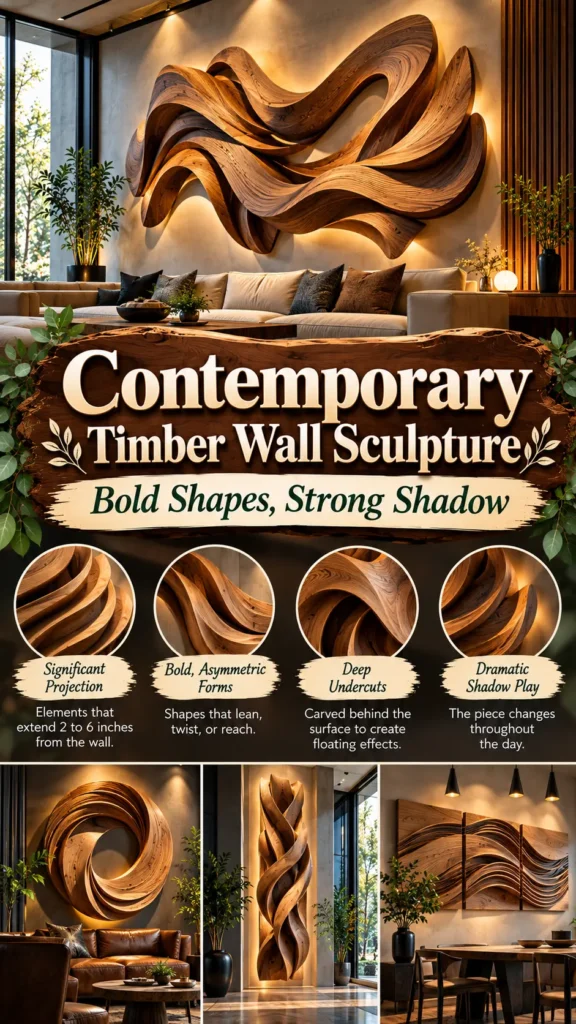
Contemporary timber wall sculpture pushes further than modern minimalist work. It’s more sculptural, more dimensional, more willing to make a statement.
What defines the contemporary look:
- Significant projection — elements that extend 2 to 6 inches from the wall
- Bold, asymmetric forms — shapes that lean, twist, or reach
- Deep undercuts — carved behind the surface to create floating effects
- Dramatic shadow play — the piece changes throughout the day
Where it works: Contemporary and industrial interiors, high-ceilinged living rooms, and spaces with good directional lighting.
The lighting requirement: Contemporary dimensional work needs raking light to reveal its depth. Flat overhead lighting will flatten it.
4. Minimalist Carved Wood Decor — The Power of Reduction
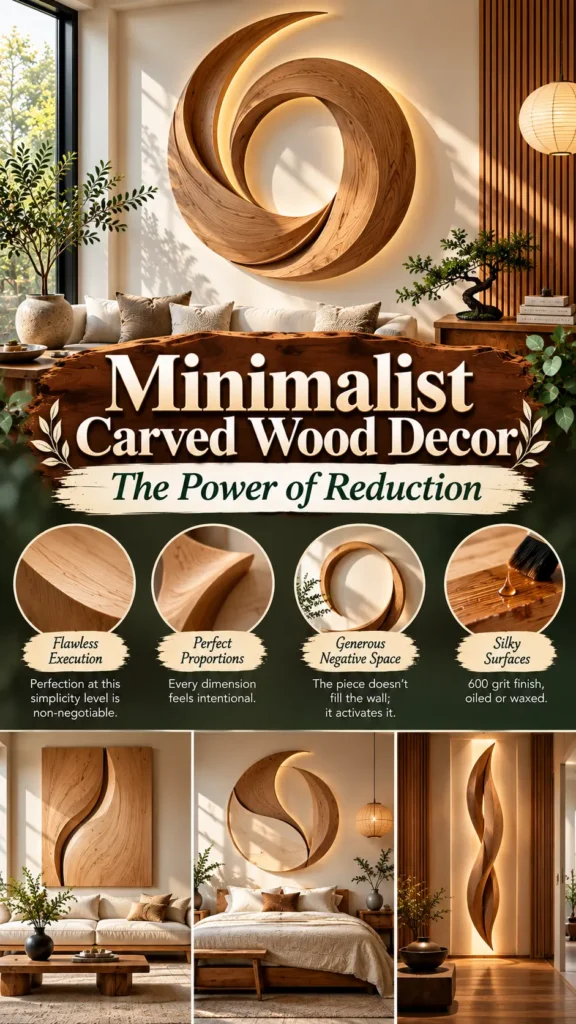
Minimalist carved wood decor takes refinement to its logical conclusion. One form. One gesture. Nothing more.
What to look for:
- Flawless execution — perfection at this simplicity level is non-negotiable
- Perfect proportions — every dimension feels intentional
- Generous negative space — the piece doesn’t fill the wall; it activates it
- Silky surfaces — 600 grit finish, oiled or waxed
Where it works: Minimalist, Scandi, and Japanese-inspired interiors. Also a strong choice in bedrooms and meditation spaces, where calm matters more than drama.
The caution: Minimalism is unforgiving. A minimalist piece that isn’t executed to the highest standard looks cheap. This is one style where you shouldn’t compromise on quality.
5. Abstract Contemporary Wood Carving — Gesture Over Representation
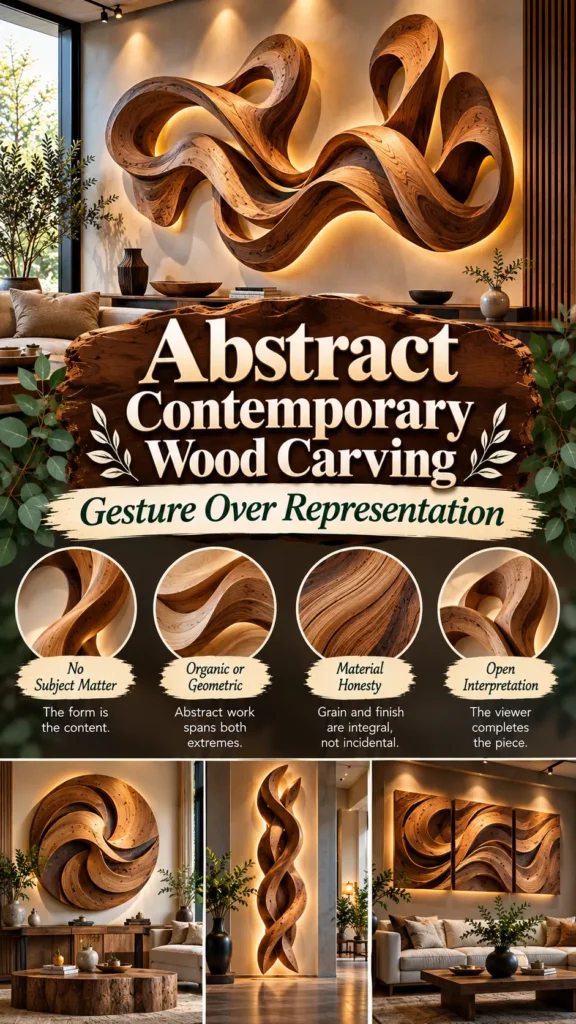
Abstract contemporary wood carving doesn’t try to depict anything. It works with pure form — curve, mass, void, rhythm.
What defines abstract contemporary work:
- No subject matter — the form is the content
- Organic or geometric — abstract work spans both extremes
- Material honesty — grain and finish are integral, not incidental
- Open interpretation — the viewer completes the piece
Where it works: Almost everywhere — which is abstract art’s advantage. It never dates and never conflicts with surrounding decor because it doesn’t reference anything specific.
The best approach for a mixed-style home: Abstract work is the safest choice when you’re unsure. It bridges styles because it doesn’t belong to any one of them.
6. Geometric Modern Wood Wall Art — Structure and Rhythm
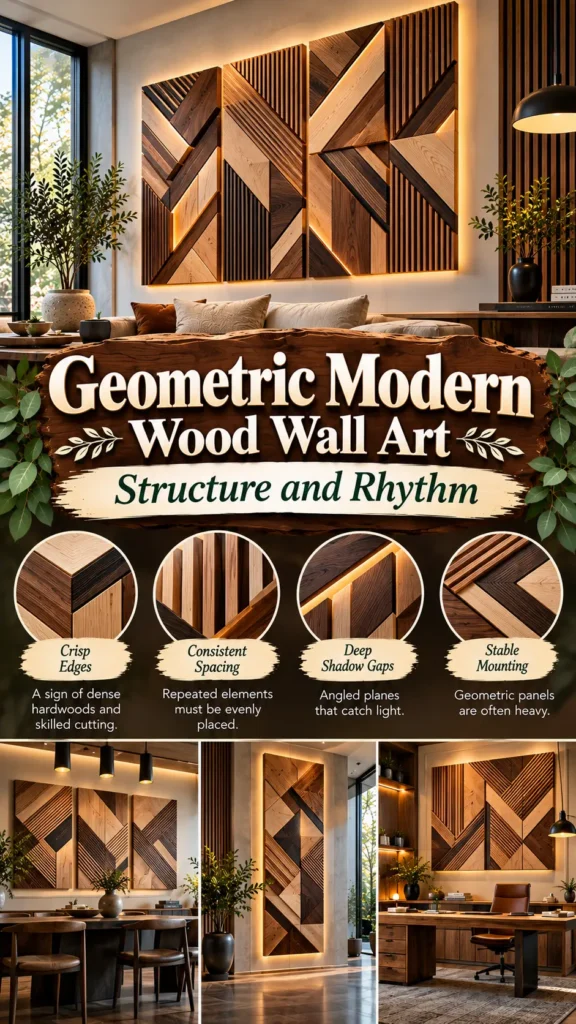
Geometric modern wood wall art is built from hard angles, repeated modules, and mathematical structure.
What to look for:
- Crisp edges — a sign of dense hardwoods and skilled cutting
- Consistent spacing — repeated elements must be evenly placed
- Deep shadow gaps — angled planes that catch light
- Stable mounting — geometric panels are often heavy
Where it works: Contemporary, industrial, and mid-century interiors. Also excellent in home offices and dining rooms, where structure adds formality without heaviness.
Best woods: Maple, ash, and walnut hold a sharp edge. Softwoods crush at the corners and undermine the aesthetic.
7. Rustic Carved Wood Wall Art — The Opposite End of the Spectrum
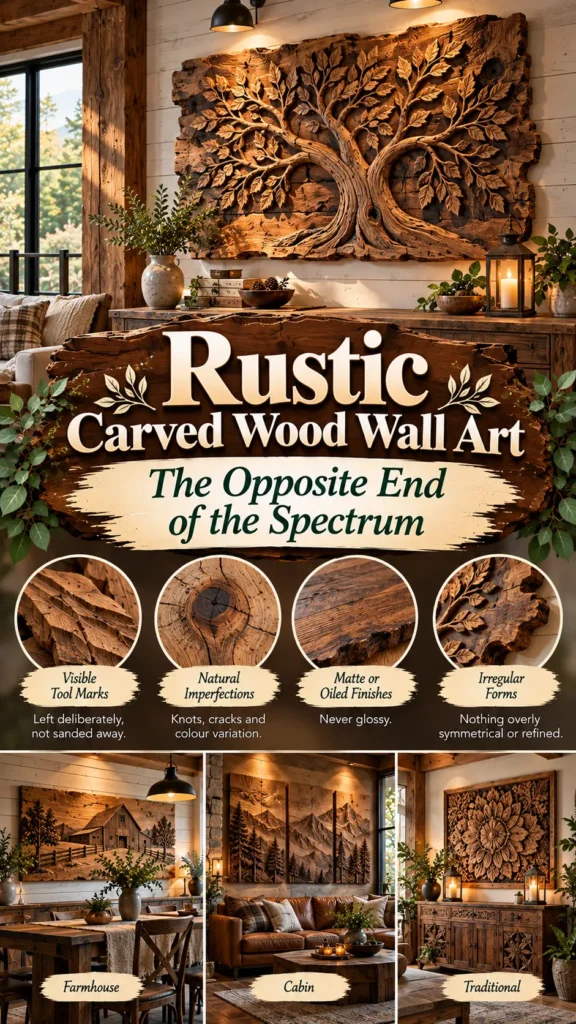
Rustic carved wood wall art celebrates imperfection. Visible tool marks, uneven surfaces, knotty grain, and an overall sense of hand-hewn character.
What defines rustic work:
- Visible tool marks — left deliberately, not sanded away
- Natural imperfections — knots, cracks, and colour variation
- Matte or oiled finishes — never glossy
- Irregular forms — nothing overly symmetrical or refined
Where it works: Farmhouse, cabin, and country interiors. Also a good choice for traditional homes that need softening.
Farmhouse timber wall decor specifically leans toward whitewashed finishes, simple motifs, and slightly distressed surfaces. It’s rustic but not rough — refined enough to work in transitional homes.
8. Reclaimed, Distressed, and Barnwood Wall Art — History on the Wall
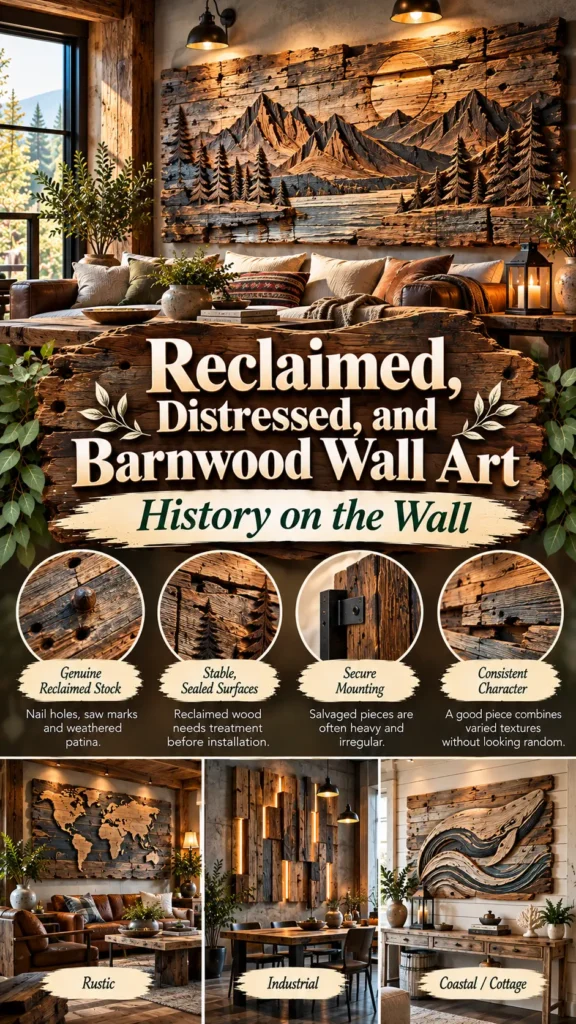
Reclaimed wood wall carving, distressed wood wall sculpture, and barnwood wall art bring something no new material can offer: authenticity.
What to look for:
- Genuine reclaimed stock — nail holes, saw marks, and weathered patina
- Stable, sealed surfaces — reclaimed wood needs treatment before installation
- Secure mounting — salvaged pieces are often heavy and irregular
- Consistent character — a good piece combines varied textures without looking random
Primitive carved wood panels take this further into rougher territory — hand-cut forms, chunky proportions, and a folk-art quality.
Where it works: Rustic, industrial, coastal, and cottage interiors. A single reclaimed piece can warm up even a very modern room.
The installation caution: Reclaimed pieces are often irregular and heavy. Plan for French cleats and stud anchoring — drywall anchors alone won’t hold.
9. Matching the Piece to Your Interior — A Quick Reference
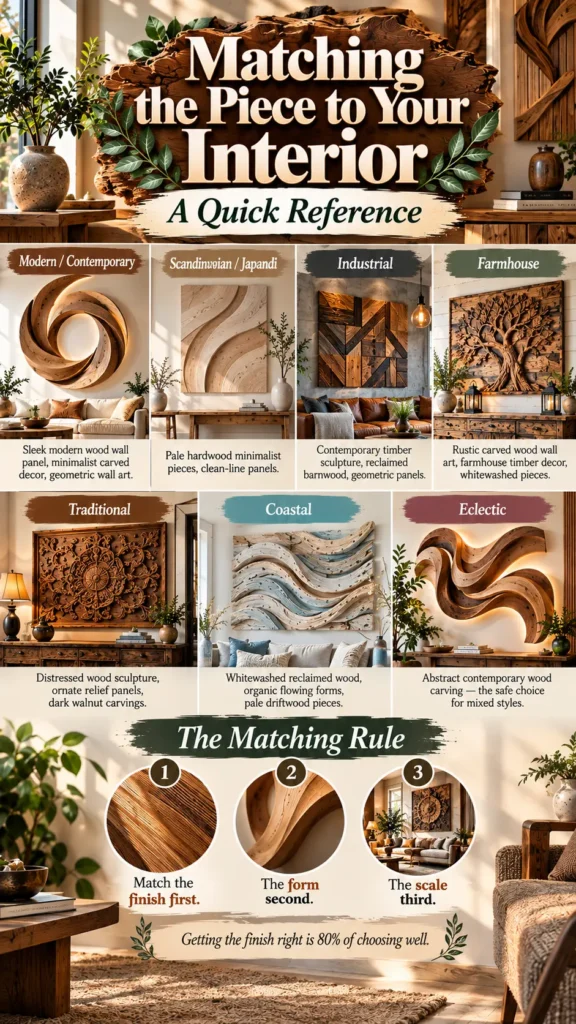
| Your Style | Best Matches |
|---|---|
| Modern / Contemporary | Sleek modern wood wall panel, minimalist carved decor, geometric wall art |
| Scandinavian / Japandi | Pale hardwood minimalist pieces, clean-line panels |
| Industrial | Contemporary timber sculpture, reclaimed barnwood, geometric panels |
| Farmhouse | Rustic carved wood wall art, farmhouse timber decor, whitewashed pieces |
| Traditional | Distressed wood sculpture, ornate relief panels, dark walnut carvings |
| Coastal | Whitewashed reclaimed wood, organic flowing forms, pale driftwood pieces |
| Eclectic | Abstract contemporary wood carving — the safe choice for mixed styles |
The matching rule: Match the finish first, the form second, and the scale third. A piece with the right finish but the wrong form can often work; the reverse rarely does.
Worthy tip: “Match the finish first, the form second, and the scale third. Getting the finish right is 80% of choosing well.”
From One Style to Yours
You now have a complete guide to carved wood wall art for every interior style. From modern carved wood wall art and contemporary timber wall sculpture to minimalist carved wood decor and sleek modern wood wall panels, from abstract contemporary wood carving and geometric modern wood wall art to rustic carved wood wall art and farmhouse timber wall decor, from reclaimed wood wall carving and distressed wood wall sculpture to primitive carved wood panels and barnwood wall art — you have everything you need to choose a piece that matches your space.
Key takeaways:
- Wood adapts to any style — grain, finish, form, and colour are the four variables
- Match the finish first — it’s the single biggest factor in style fit
- Minimalism demands quality — there’s nowhere to hide
- Abstract work bridges styles — the safest choice for mixed interiors
- Rustic requires restraint — the wrong level of roughness looks chaotic
- Reclaimed pieces need planning — check weight and mounting before buying
The right carved wood wall art doesn’t just fit your interior style — it elevates it. The wrong piece fights everything around it. Understanding the spectrum is the difference between a wall that looks designed and one that looks accidental.
Table of Contents
Call to Action (CTA)
Which interior style are you working with — modern, contemporary, minimalist, rustic, or something in between? I’d love to help you find the right piece. Email me at admin@woodzaa.com with “Interior Style” in the subject line. Tell me about your room, your palette, and the mood you want to create, and I’ll help you find or commission carved wood wall art that fits perfectly.
Let’s find the piece that belongs on your wall.
— Sheila
