


Your living room has the sofa, the rug, the lighting, the coffee table. Everything is in place — and yet the room still feels unfinished. The walls are the culprit. Flat art can only do so much, and paint alone can’t create depth. What your space needs is wood wall sculpture ideas that transform a living room — dimensional, tactile, architectural artwork that turns a blank surface into a focal point.
In this guide, you’ll discover seven approaches to wood wall sculpture for living rooms, along with the practical guidance designers use to get placement, scale, and lighting right. You’ll explore living room wall art ideas ranging from organic carved wood to 3D wood wall art, learn how to choose a large wood wall sculpture, and understand why a single statement wood wall piece often does more than an entire gallery arrangement. By the end, you’ll know exactly how to transform a living room with wood art — and how to avoid the mistakes that make sculptural pieces look awkward.
1. Why Wood Wall Sculpture Transforms a Living Room Instantly

Wooden wall sculpture decor does something that no flat artwork can replicate: it changes how a room is perceived in three dimensions.
What dimensional wood art brings to a living space:
- Depth and shadow — projection from the wall creates changing shadows throughout the day
- Texture — grain, carving marks, and finish add tactile richness that paint cannot
- Warmth — wood softens hard surfaces like glass, metal, and stone
- Focus — a single sculptural piece gives the eye somewhere to land
- Architectural presence — a large piece reads as part of the room’s structure, not an addition to it
The scale advantage: The living room is usually the largest wall space in a home — which means it’s the best place in the house for a substantial sculptural piece. A large wood wall sculpture that might overwhelm a hallway or bedroom feels completely natural above a sofa or on a double-height wall.
The material advantage: Wood carries the memory of a living thing. Its grain provides built-in visual interest that no paint can match, and its warmth balances the cool surfaces that dominate most modern living rooms. That combination is why wood sculpture consistently reads as more sophisticated than synthetic alternatives.
Worthy tip: “A living room with flat art on the wall is decorated. A living room with sculptural wood art is designed. The difference is depth.”
For more on organic dimensional work, explore our related article: Organic Biomorphic Wood Sculptures With Lifelike Flow (Mid to High Net Worth)
2. Organic Carved Wood Sculpture — Softening a Rectangular Room
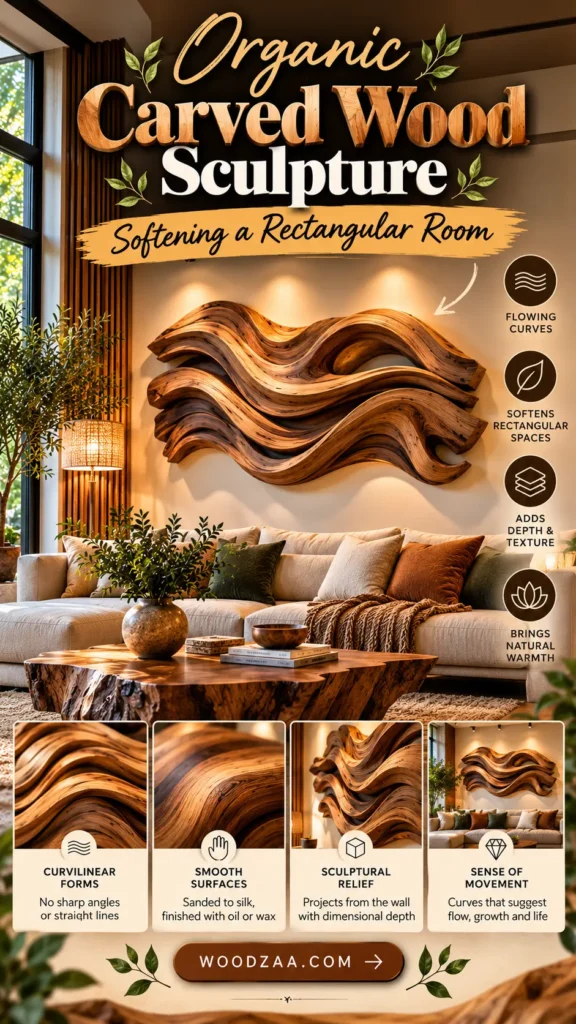
Organic carved wood sculpture is the most forgiving option for a living room — and often the most beautiful. These pieces feature flowing curves, biomorphic forms, and smooth surfaces that soften the hard edges of furniture and architecture.
What defines organic wall sculpture:
- Curvilinear forms — no sharp angles or straight lines
- Smooth, tactile surfaces — sanded to silk and finished with oil or wax
- Sculptural relief — forms project from the wall while remaining attached
- Sense of movement — the curves suggest flow, growth, or unfolding
Why organic forms work in living rooms: Living rooms are full of rectangles — windows, frames, screens, sofa cushions, coffee tables. After a series of straight lines, the eye relaxes when it encounters a flowing curve. Organic wood sculpture provides that visual exhale.
Best placement: Above a sofa or on a wall opposite the main seating area. Organic pieces read best when they have at least three feet of clearance on all sides and no competing objects nearby.
What to look for: Consistent flow between curves, flawless sanding (at least 400 grit), and an oil or wax finish — never high-gloss polyurethane, which contradicts the material’s natural character.
Worthy tip: “Organic wood sculpture softens a room full of rectangles. It’s the visual equivalent of a slow exhale.”
Visit Our Shop : Click Here…
3. Geometric 3D Wood Wall Art — Structure and Drama

3D wood wall art living room installations at the geometric end of the spectrum offer something entirely different: structure, precision, and dramatic shadow play.
What defines geometric wall sculpture:
- Angular forms — triangles, hexagons, faceted planes
- Repetition — repeated modules creating pattern and rhythm
- Deep projection — elements that extend several inches from the wall
- Strong shadows — angled planes catch and throw light dramatically
Why geometric work suits contemporary living rooms: Modern architecture is built on straight lines and planar surfaces. Geometric sculpture speaks the same language — which means it integrates naturally rather than fighting the space.
Design approaches that work well:
| Approach | Effect |
|---|---|
| Stacked rectangular blocks | Architectural, resembles carved structure |
| Interlocking triangles | Dynamic visual tension |
| Faceted hexagonal grid | Repeating pattern with dramatic shadow play |
| Vertical fin arrangement | Rhythm and shadow striping |
What to look for: Crisp edges (which require dense hardwoods like maple, ash, or walnut), consistent spacing between repeated elements, and secure mounting hardware rated well above the piece’s weight.
Worthy tip: “Geometric wall art needs raking light. Position a directional light at 30 to 45 degrees, and the shadows become a second layer of composition.”
4. Carved Relief Panels — Depth That Draws the Eye

Sculptural wood wall decor in the relief tradition offers a middle ground between flat art and freestanding sculpture. Relief panels project from the wall while remaining attached — creating depth without taking up floor space.
What defines relief wall panels:
- Projection of ½ to 3 inches — enough to create shadow, not enough to intrude
- Carved surface detail — patterns, textures, and imagery cut into the wood
- Background and foreground — the composition has depth within itself
- Continuous surface — the piece reads as a single panel
Relief types worth knowing:
- Bas-relief (low relief) — subtle projection, refined detail, painterly quality
- High relief — significant projection, dramatic shadows, near-sculptural presence
- Undercut relief — carved behind the surface to create floating elements
Why relief works in living rooms: Relief panels are substantial enough to anchor a wall but flat enough to hang above furniture without intruding into the seating area. They’re the ideal compromise for rooms where freestanding sculpture isn’t practical.
Worthy tip: “Relief carving gives you sculpture-level depth with painting-level practicality. It’s the perfect living room compromise.”
5. Live-Edge and Reclaimed Wood Wall Pieces — Natural Character

Living room timber wall art created from live-edge or reclaimed wood brings a different quality entirely: authenticity, history, and natural irregularity.
What defines live-edge and reclaimed wall pieces:
- Preserved natural edges — bark, curves, and irregular contours
- Visible history — nail holes, saw marks, and weathered patina
- Unique forms — no two pieces are alike
- Sustainable materials — often salvaged or reclaimed timber
Why these pieces resonate in living rooms: They bring the outdoors in — and they carry a story. A piece of reclaimed barn wood or storm-fallen timber has a history that no new material can replicate. That narrative quality makes the work more than decoration; it becomes a conversation piece.
Best placement: Live-edge pieces work beautifully above a fireplace, on a large wall behind a sofa, or as a vertical element in a double-height space. Their irregular shapes suit rooms with natural, organic, or rustic-leaning interiors.
What to look for: Genuine live edges (not simulated), stable and sealed surfaces, and secure mounting — large reclaimed pieces can be heavy and require proper anchoring.
Worthy tip: “A reclaimed wood wall piece carries the history of its previous life. That story is part of the artwork.”
6. Choosing the Right Scale and Placement
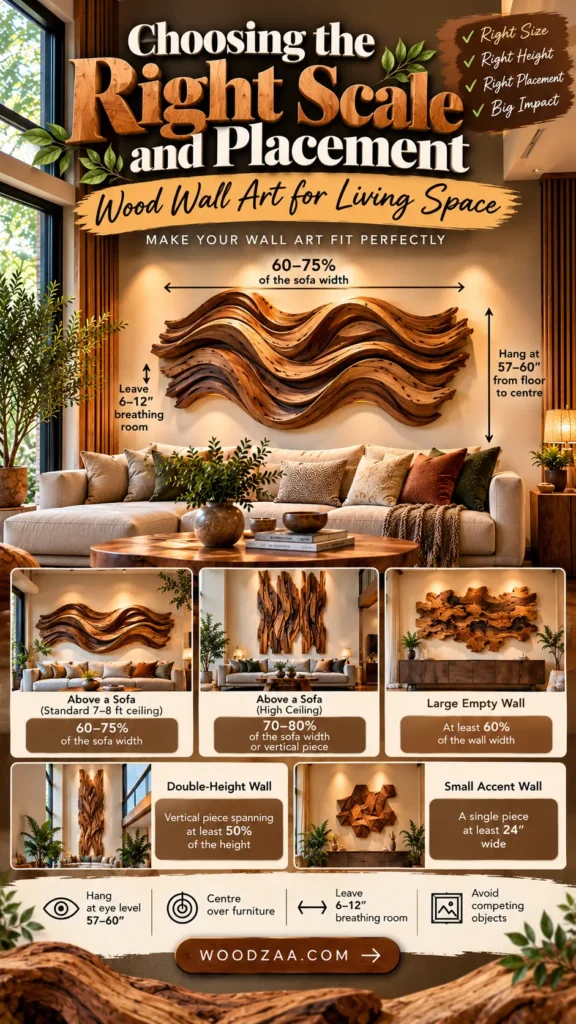
Wood wall art for living space succeeds or fails on scale and placement. Here’s how to get both right.
Scale guidelines:
| Wall Type | Recommended Piece Size |
|---|---|
| Above a sofa (standard 7–8 ft ceiling) | 60–75% of the sofa width |
| Above a sofa (high ceiling) | 70–80% of the sofa width, or vertical emphasis |
| Large empty wall | At least 60% of the wall width |
| Double-height wall | Vertical pieces spanning at least 50% of the height |
| Small accent wall | A single piece at least 24 inches wide |
Placement principles:
- Hang at eye level — 57 to 60 inches from floor to centre is the museum standard
- Centre over furniture — align the piece with the sofa or console below
- Leave breathing room — at least 6 to 12 inches between the piece and nearby furniture
- Avoid competing objects — a sculptural piece needs to be the only statement on that wall
The proportions rule: A piece that’s too small will disappear. One that’s too large will overwhelm. If you’re unsure, err on the larger side — sculptural work that feels slightly bold is always better than work that feels timid.
Worthy tip: “A statement wood wall piece should feel like it was made for the wall. If it looks like an afterthought, it’s the wrong scale.”
7. Lighting and Installation — The Details That Make It Work
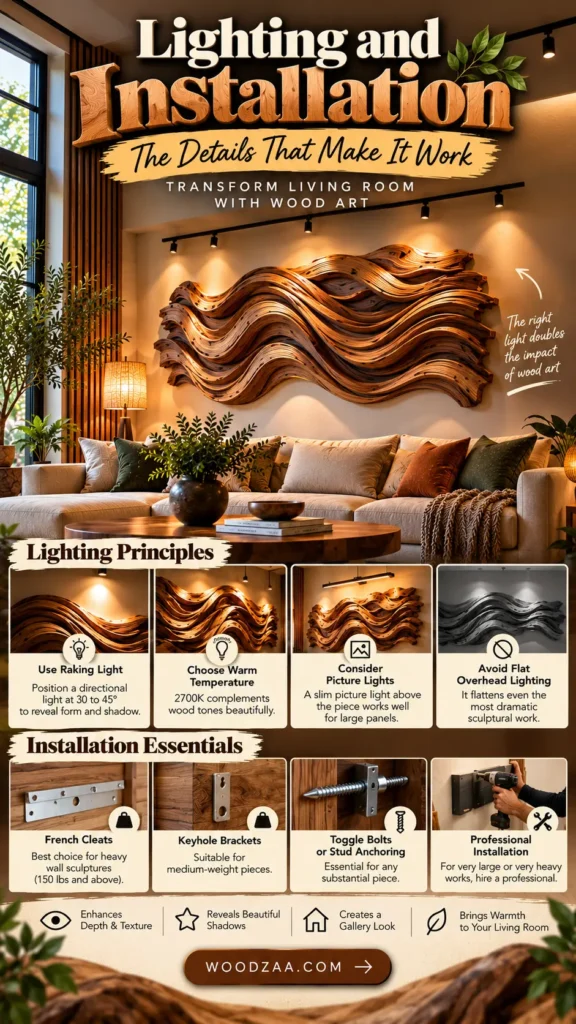
Transforming a living room with wood art requires two final considerations: lighting and installation. Get these right, and the piece becomes architectural. Get them wrong, and even a masterpiece looks flat.
Lighting principles:
- Use raking light — position a directional light at 30 to 45 degrees to reveal form and shadow
- Choose warm temperature — 2700K complements wood tones beautifully
- Consider picture lights — a slim picture light above the piece works well for large panels
- Avoid flat overhead lighting — it flattens even the most dramatic sculptural work
Installation essentials:
- French cleats — the best choice for heavy wall sculptures (150 lbs and above)
- Keyhole brackets — suitable for medium-weight pieces
- Toggle bolts or stud anchoring — essential for any substantial piece
- Professional installation — for very large or very heavy works, hire a professional
The lighting test: View your piece at three different times of day. If it reveals something new each time, both the placement and the lighting are correct.
Worthy tip: “A wood wall sculpture without proper lighting is a missed opportunity. The right light doubles the impact of the piece.”
From Blank Wall to Living Room Centerpiece
You now have seven wood wall sculpture ideas that transform a living room — from the flowing softness of organic carved wood to the structure of geometric 3D wood wall art, from the depth of carved relief panels to the authenticity of live-edge and reclaimed pieces. You’ve also learned the scale, placement, lighting, and installation principles that separate a successful living room transformation from a piece that never quite works.
Key takeaways:
- Depth is the difference — sculptural wood art changes how a room is perceived
- Scale must be decisive — bold enough to anchor the wall, never timid
- Organic softens, geometric structures — choose based on your room’s existing lines
- Relief offers the best compromise — sculpture depth with painting practicality
- Reclaimed pieces carry story — authenticity that new wood can’t replicate
- Placement follows furniture — centre over the sofa, hang at eye level
- Raking light is essential — it reveals the form and creates dramatic shadow
A living room wall is the largest canvas in your home — and wood sculpture is the most compelling way to fill it. Unlike flat art, a sculptural piece changes with the light, rewards close inspection, and becomes more meaningful as you live with it. That’s not decoration. That’s transformation.
Table of Contents
Call to Action (CTA)
Ready to transform your living room wall? I’d love to help you find the perfect piece. Email me at admin@woodzaa.com with “Living Room Wall” in the subject line. Tell me about your wall — the width, the ceiling height, the light — and the feeling you want to create. I’ll help you find or commission a wood wall sculpture that anchors the room and changes it completely.
Let’s turn that blank wall into the best part of your living room.
— Sheila

