
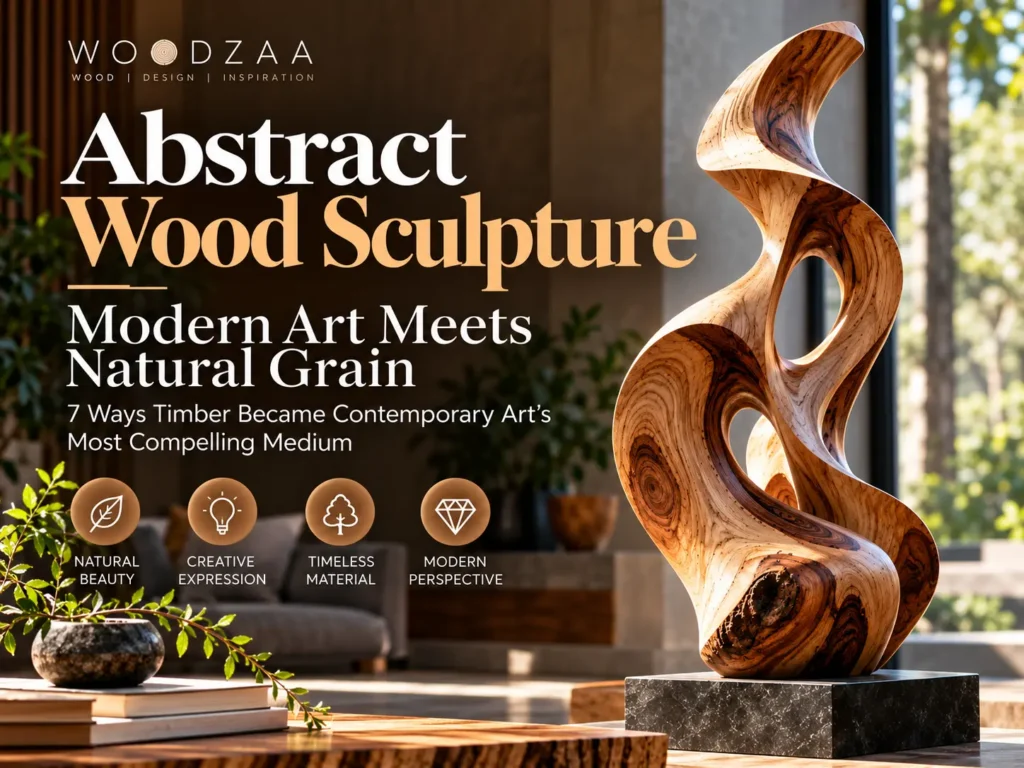
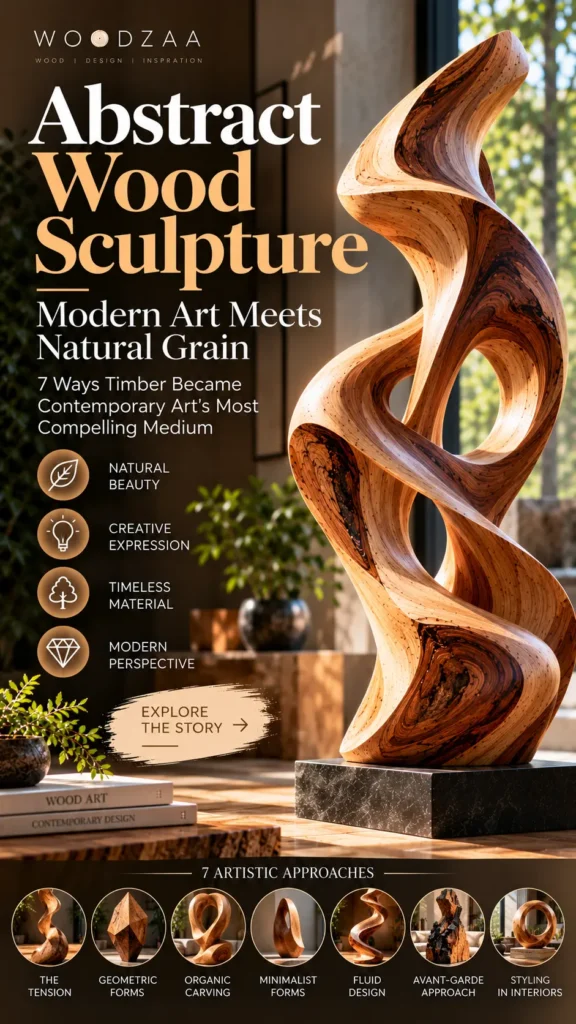
There’s a tension at the heart of every great abstract wood sculpture. On one side sits the artist — imposing vision, intention, and form. On the other sits the tree — decades of growth, unpredictable grain, and natural character that no human hand can replicate. When those two forces meet in balance, something extraordinary happens: a piece that feels both designed and grown, both modern and ancient.
That’s the story of abstract wood sculpture: modern art meets natural grain. In this guide, you’ll discover how contemporary artists navigate this collaboration and why the results have become so collectible. You’ll explore modern abstract timber art across seven distinct approaches — from geometric abstract wood art to organic abstract wood carving, from minimalist abstract wood forms to fluid abstract wood design. You’ll learn what separates genuine sculptural wood abstraction from decoration, how to evaluate craftsmanship, and how to place abstract timber work so it elevates rather than overwhelms a room. By the end, you’ll understand why wood has become contemporary art’s most compelling material.
1. The Essential Tension: Artist Versus Grain
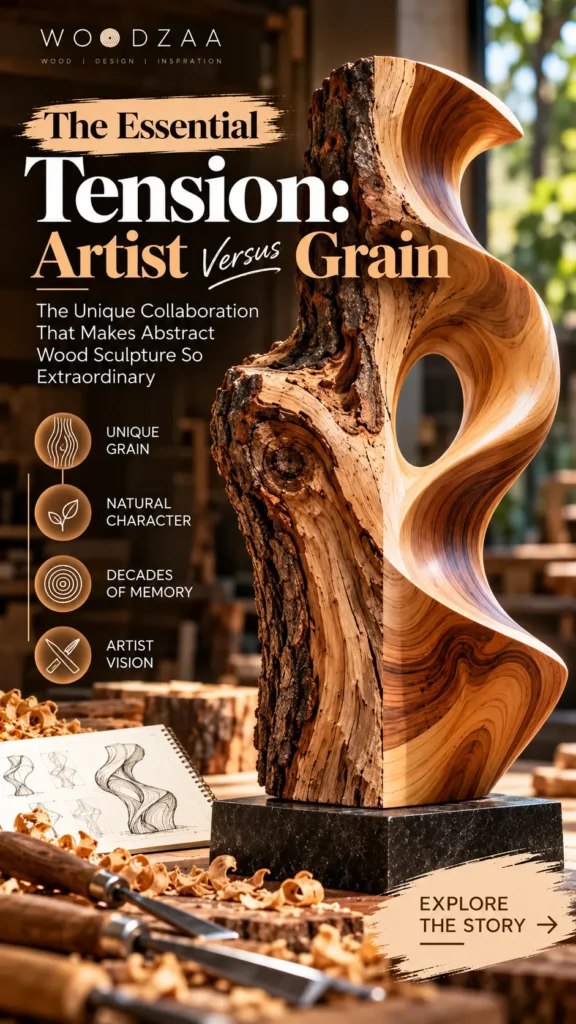
Abstract wood sculpture is unique among art forms because the material arrives with its own agenda. Marble is uniform. Bronze is cast to specification. Wood, by contrast, has opinions.
What the grain brings to the collaboration:
- Direction — grain flows in specific paths that the artist must respect or fight
- Character — knots, burls, and colour variations that no carving can invent
- Memory — visible growth rings recording decades of seasons
- Resistance — density variations that shape how tools cut and forms emerge
Two artistic approaches:
| Approach | Philosophy | Result |
|---|---|---|
| Grain as collaborator | The artist follows the wood’s suggestion | Organic, flowing, natural-feeling work |
| Grain as material | The artist imposes form and treats grain as texture | Geometric, precise, controlled work |
Why both work: Neither approach is superior. The greatest abstract wood artists move fluidly between them — following the grain where it serves the composition, imposing form where the piece needs structure. That negotiation is what makes wood abstraction so compelling.
The tell-tale sign of mastery: Look at how the grain interacts with the form. In a masterful piece, the two feel inevitable — as if the sculpture could not have been any other way. In weaker work, the grain and the form fight each other visibly.
Worthy tip: “With stone, you’re the only artist in the room. With wood, you’re collaborating with a tree that spent eighty years preparing for this.”
For more on flowing organic forms, explore our related article: Organic Biomorphic Wood Sculptures With Lifelike Flow (Mid to High Net Worth)
2. Geometric Abstract Wood Art — Precision Against Nature
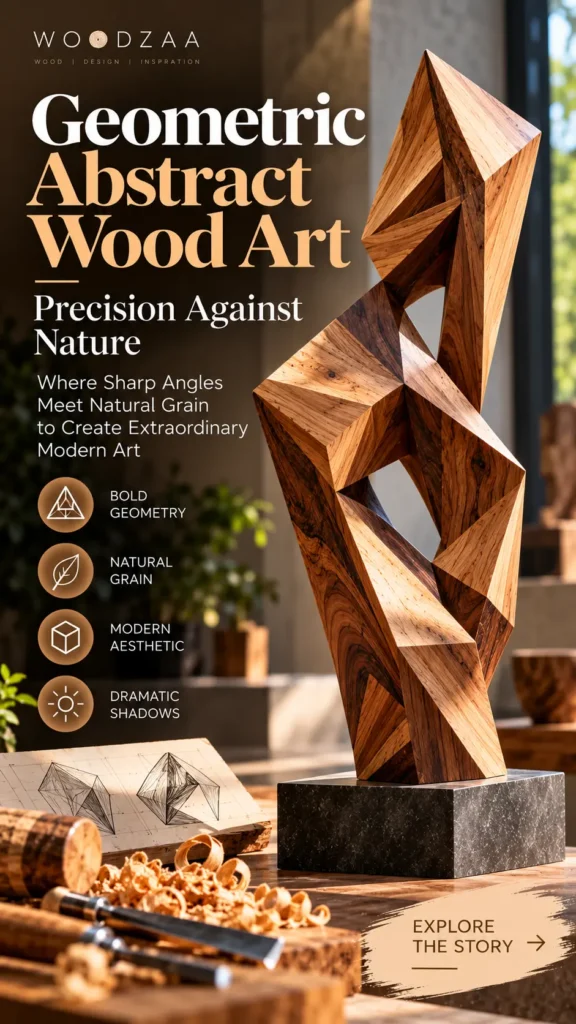
Geometric abstract wood art represents the most assertive approach to the material. The artist imposes hard angles, precise planes, and mathematical structure onto a material that grows in curves.
What defines geometric wood abstraction:
- Angular forms — triangles, hexagons, faceted planes, sharp edges
- Repetition — repeated modules creating rhythm and pattern
- Calculated asymmetry — imbalance used deliberately
- Architectural quality — the work feels built rather than grown
Why the tension works: The contrast between the organic material and the imposed geometry creates visual energy. A faceted sphere carved from walnut reads as both natural and constructed — a dialogue between two kinds of order.
Best woods for geometric work:
- Maple — pale, dense, holds crisp edges beautifully
- Ash — strong linear grain reinforces geometric structure
- Walnut — rich colour adds drama to sharp planes
- Oak — dense and durable, ideal for architectural scale
What to avoid: Softwoods like basswood and pine crush and bruise at the edges, undermining the precision that geometric abstraction demands.
The shadow advantage: Angular planes catch and throw light dramatically. Positioned with raking light, a geometric piece produces hard shadows that become a second layer of composition — changing throughout the day.
Worthy tip: “Geometric abstraction is about precision, but not perfection. The tension between natural material and imposed structure is where the drama lives.”
You Might Like : Contemporary Carved Wood Relief Sculptures for Collectors
3. Organic Abstract Wood Carving — Nature Without Subject Matter
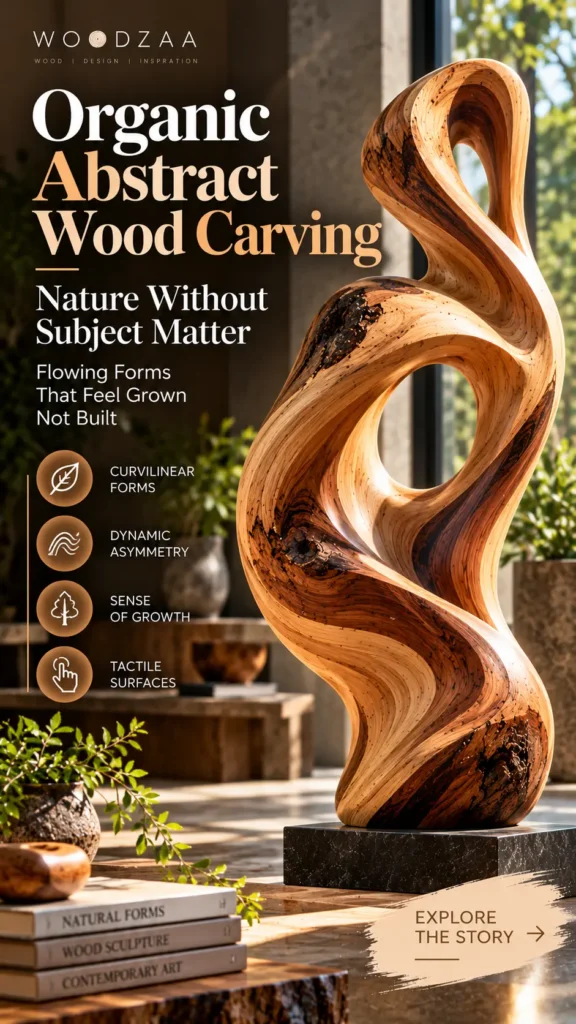
Organic abstract wood carving takes the opposite approach. Rather than imposing geometry, the artist follows the material’s natural inclinations — developing forms that feel grown rather than built.
What defines organic abstraction:
- Curvilinear forms — flowing, rounded, uninterrupted lines
- Dynamic asymmetry — balance achieved through movement
- Sense of growth — the form feels like it’s still unfolding
- Tactile surfaces — smooth finishes that invite touch
Why organic work resonates: In interiors dominated by rectangles — windows, screens, frames, furniture — organic forms provide visual relief. The eye relaxes when it encounters a flowing curve after a series of straight lines.
The pioneers: Jean Arp (1886–1966) established the biomorphic vocabulary in the early 20th century, developing “a new, abstract ‘biomorphic’ language” of “curvilinear, organic shapes”. He called his work l’art concret — art as “concrete and sensual as a leaf or stone”.
Contemporary masters: Thaddeus Mosley, working at 98, carves monumental organic forms from salvaged timber using only a mallet and chisel. His sculptures “burst with vitality and variation”, demonstrating how organic abstraction can achieve architectural scale.
Best woods for organic work: Cherry, butternut, and walnut all offer warm tones and beautiful grain that enhance flowing forms. The material’s natural character becomes part of the composition.
Worthy tip: “Organic abstraction is nature’s vocabulary without nature’s subject matter. It feels alive because it borrows the shapes of living things.”
4. Minimalist Abstract Wood Forms — The Power of Reduction
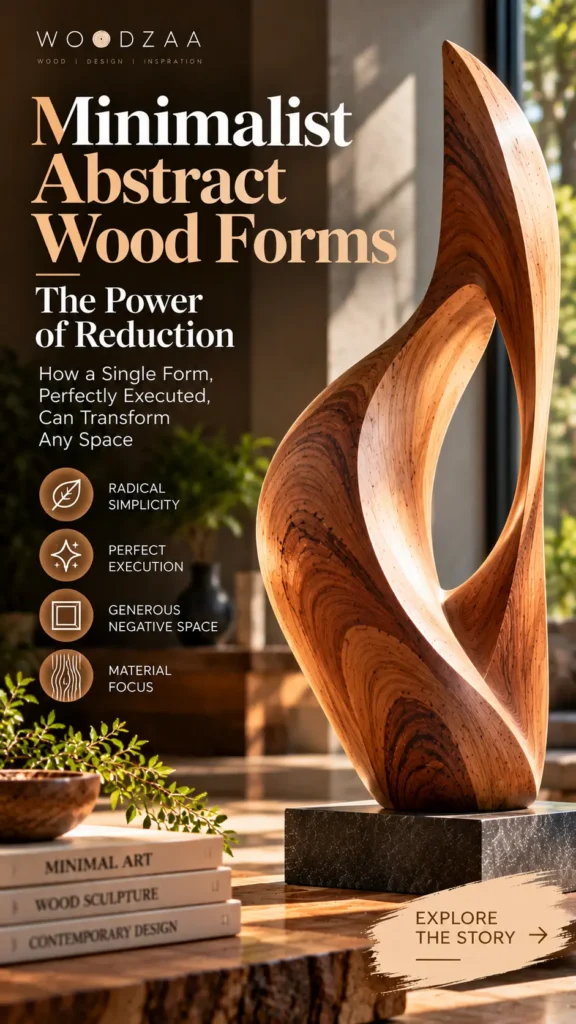
Minimalist abstract wood forms strip away everything non-essential. What remains is a single gesture, a single volume, a single curve — executed with such clarity that it commands the space entirely.
What defines minimalist wood abstraction:
- Radical simplicity — one form, one idea, nothing more
- Perfect execution — no visible tool marks or hesitation
- Generous negative space — the emptiness is part of the composition
- Material focus — grain and finish become the primary subject
Why minimalism works in wood: Wood carries warmth and organic character that prevents minimalism from feeling sterile. A single curved form in cherry, sanded to 600 grit and oiled to a soft glow, contains more presence than a complex composition in a lesser material.
What to look for in minimalist work:
- Flawless surfaces — sanded to at least 400 grit, ideally 600
- Considered proportions — every dimension feels intentional
- Material quality — beautiful grain, even colour, no defects
- Finish integrity — oil or wax, never plastic-looking polyurethane
The collectors who love minimalism: Abstract minimalist sculpture appeals to collectors with sophisticated, pared-back interiors — people who understand that restraint requires more skill than complexity.
Worthy tip: “A minimalist wood sculpture is a haiku in three dimensions. Every element must earn its place — nothing extraneous, nothing wasted.”
5. Fluid Abstract Wood Design — The Illusion of Movement
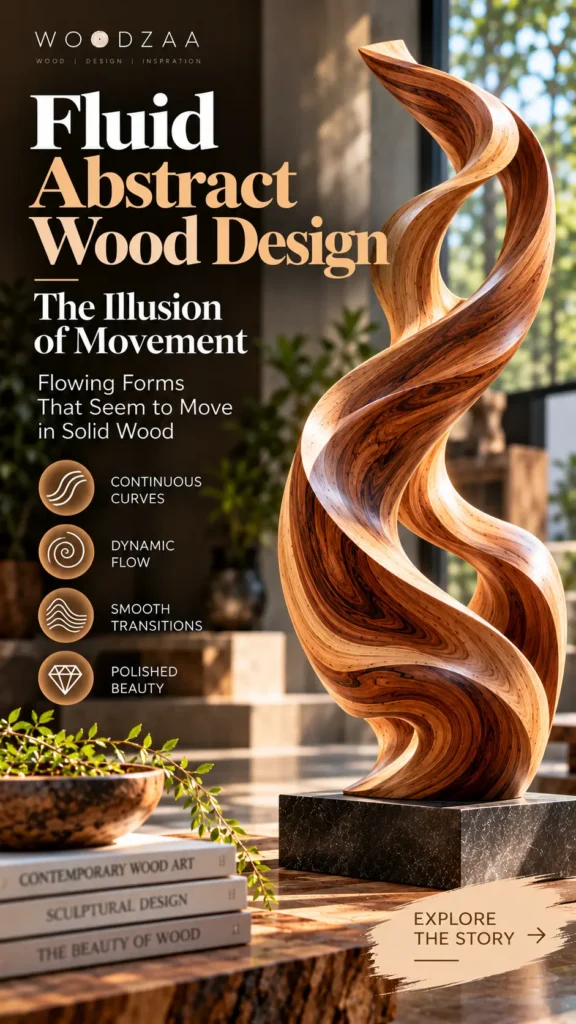
Fluid abstract wood design captures the most difficult effect in sculpture: the illusion of motion in a static object. These pieces seem to flow, ripple, or twist — as if the wood itself were liquid, frozen mid-movement.
How artists achieve the illusion:
- Continuous curves — no visible starting or stopping points
- Varying volume — sections that swell and taper like living tissue
- Smooth transitions — no abrupt changes in direction or surface
- Polished surfaces — a soft sheen that suggests wetness
Joseph Walsh creates some of the most extraordinary fluid forms in contemporary wood art. His signature technique — layering and laminating multiple thin veneers — allows curves of remarkable fluidity and strength. His works “seem to flow like water or rustle like wind, capturing the poetry of movement in solid wood”.
Mirko Zrinšćak creates “elongated, pulsating, rhythmical forms” that he describes as “meditations on the underlying, invisible forces of nature, created in dialogue with the trees they are made from”.
Why fluid forms command attention: The human eye reads continuous curves as movement. When there are no breaks, no angles, and no interruptions, the brain interprets the form as something caught mid-flow — a snapshot of motion rather than a static object. That quality holds attention longer than anything static.
Worthy tip: “A fluid abstract sculpture is a meditation on movement. Place it where the light changes throughout the day — the shadows will make it seem to dance.”
6. Avant-Garde Wood Sculpture — Beyond Conventional Boundaries
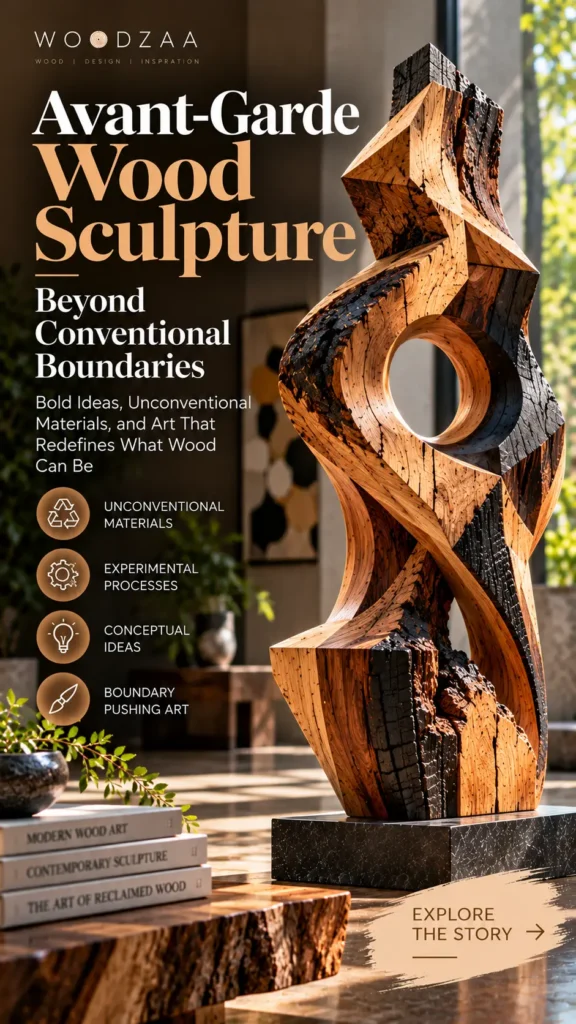
Avant-garde wood sculpture challenges what the medium can be. These works question assumptions, break rules deliberately, and expand the territory of wood abstraction.
What makes wood abstraction avant-garde:
- Unconventional materials — reclaimed skateboards, charred timber, found objects
- Unexpected processes — chainsaws, blowtorches, chance-based composition
- Conceptual ambition — the idea matters as much as the object
- Institutional risk — the work may be difficult or deliberately unresolved
Haroshi creates sculptures entirely from discarded skateboard decks, transforming broken boards into intricate mosaic forms. Because he incorporates every part of the old deck, some pieces conceal hidden objects inside.
Raul De Lara explores identity, belonging, and the immigrant experience through playful yet profound abstract figures — cacti moonlighting as chairs, larger-than-life plants, droopy expressive forms.
Jürgen Lingl sculpts directly into wood with a chainsaw, creating powerful, textured forms that preserve the tool’s aggression as an aesthetic choice.
Why avant-garde work matters to collectors: Conventional abstract sculpture makes a room look good. Avant-garde work makes a room interesting. It signals that the collector is engaged with art, willing to take risks, and unafraid of being questioned.
Worthy tip: “Avant-garde wood art isn’t about being shocking — it’s about expanding what’s possible. The best experimental work still respects the material.”
7. Styling Abstract Wood Sculpture — Where Grain Meets Room
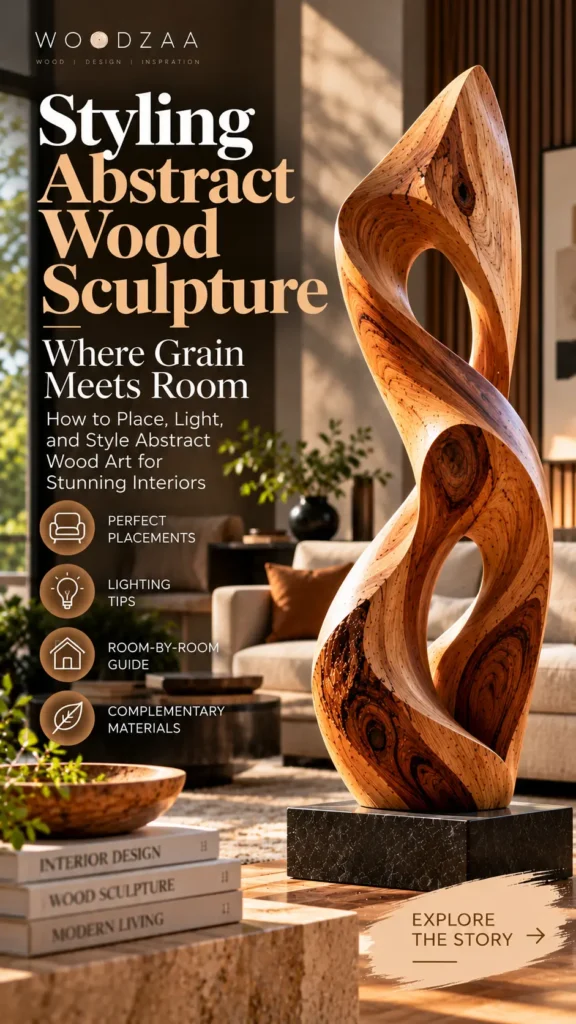
Refined abstract wood art transforms interiors — but only when placed thoughtfully. Abstract sculpture needs space, light, and the right context.
Placement principles:
- One focal piece per room — abstraction needs to be the only statement
- Three feet of clearance minimum — give the piece room to breathe
- Raking light — angle your lighting to reveal form, texture, and grain
- Complementary materials — stone, linen, wool, and leather all pair beautifully
Best placements by room:
| Room | Placement | Why |
|---|---|---|
| Entryway | Console or plinth | Sets a contemporary tone immediately |
| Living room | Pedestal or side table | Anchors the seating area |
| Home office | Desk or shelf | Provides ongoing visual interest |
| Bedroom | Dresser or nightstand | Promotes calm and reflection |
| Dining room | Sideboard or centrepiece | Adds interest to formal spaces |
The lighting formula: Position a directional light so it rakes across the sculpture at 30 to 45 degrees. This reveals the surface texture, creates dramatic shadow, and — crucially — makes the natural grain visible. Flat overhead lighting will flatten even the most dramatic piece and hide the grain that makes wood abstraction unique.
What to avoid:
- Clustering — don’t group abstract sculptures with other objects
- Direct sunlight — UV exposure fades and dries wood over time
- Humidity extremes — avoid bathrooms and damp basements
- Competing art — one strong piece beats three competing ones
Worthy tip: “Place your abstract wood sculpture where the light can find the grain. The material is half the artwork — don’t hide it in shadow.”
From Timber to Transcendence — The Future of Wood Abstraction
You now have a complete guide to abstract wood sculpture: modern art meets natural grain. From the assertive precision of geometric abstract wood art to the flowing warmth of organic abstract wood carving, from the radical restraint of minimalist abstract wood forms to the movement of fluid abstract wood design, from the boundary-pushing energy of avant-garde wood sculpture to the biomorphic tradition of biomorphic abstract timber art — you have everything you need to appreciate, collect, and place contemporary wood abstraction.
Key takeaways:
- Wood is a collaborator, not a canvas — the grain has its own agenda
- Geometric and organic are two valid approaches — mastery lies in the negotiation
- Minimalism requires perfection — simplicity leaves nowhere to hide
- Fluid forms create the illusion of life — continuous curves read as movement
- Avant-garde expands the medium — reclaimed materials and new processes
- Lighting reveals the grain — raking light is essential for wood abstraction
- Placement demands restraint — one strong piece, generous space, nothing competing
Wood abstraction has moved from the margins of contemporary art to its centre — and for good reason. No other material offers the same combination of warmth, history, and collaboration. When an artist and a tree work together, the result is something neither could have achieved alone.
Table of Contents
Call to Action (CTA)
Which approach to abstract wood sculpture speaks to you most — geometric, organic, minimalist, fluid, or avant-garde? I’d love to hear your perspective. Email me at admin@woodzaa.com with “Wood Abstraction” in the subject line. Tell me which style resonates with you and what your space needs. I’ll help you discover more about the artists shaping this movement and how you can bring abstract wood sculpture into your own home.
Let’s celebrate the collaboration between artist and grain.
— Sheila

