
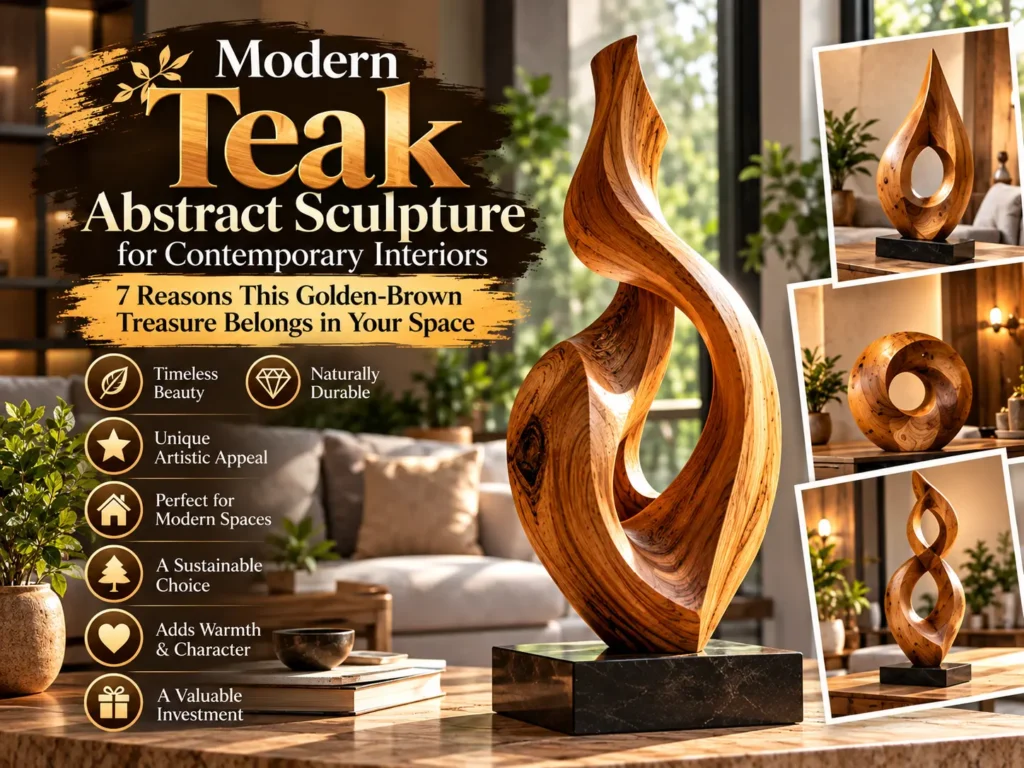
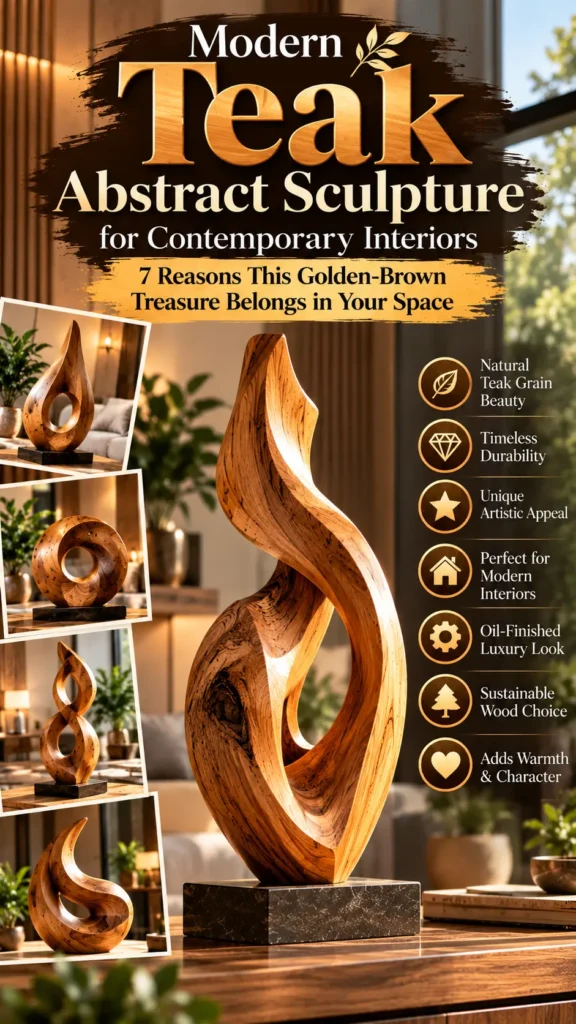
You’ve curated a home that feels intentional. The furniture is considered, the palette is controlled, and every object earns its place. But there’s a gap — a corner that feels unresolved, a console that needs an anchor, a room that could use one more layer of meaning. You don’t want another generic accessory. You want something with presence, warmth, and soul. That’s exactly what modern teak abstract sculpture for contemporary interiors delivers — a form that speaks quietly but commands attention, in a material that improves with age.
In this guide, you’ll discover why teak has become the material of choice for designers working in contemporary spaces. You’ll explore the qualities of solid teak wood sculpture, the visual appeal of natural teak grain abstract art, and the warmth of golden-brown teak timber sculpture. You’ll learn about oil-finished teak abstract carving, the appeal of sustainable teak wood art, and why kiln-dried teak wood sculpture is the mark of genuine quality. Whether you’re sourcing for a client or searching for your own space, this guide will show you exactly why teak belongs.
1. Why Teak Is the Designer’s Choice for Abstract Sculpture
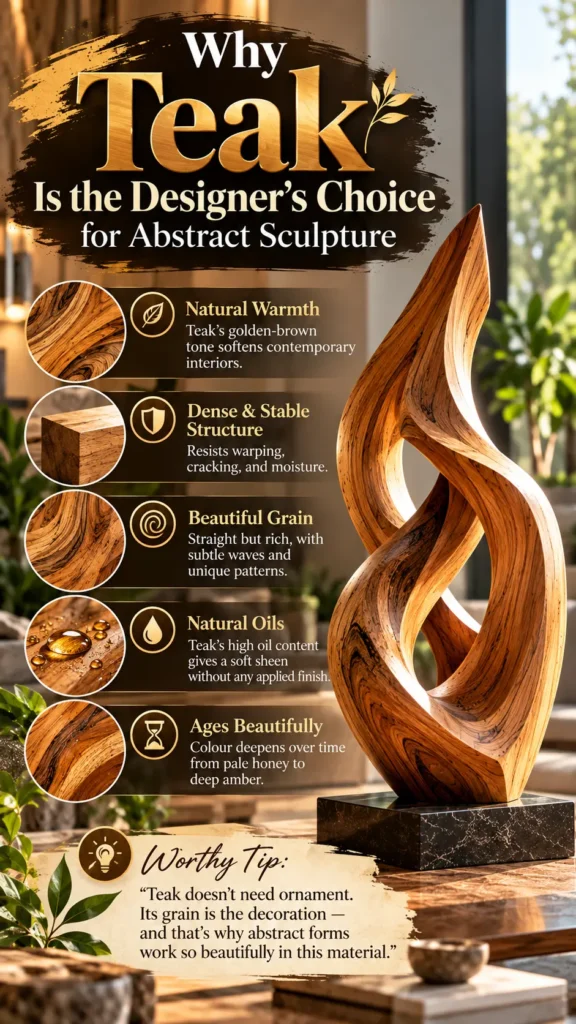
Modern teak abstract sculpture combines three qualities that are difficult to find together: beauty, durability, and sustainability. That combination is why designers keep returning to teak when they need a piece that will hold a room for decades.
What makes teak exceptional:
- Natural warmth — teak’s golden-brown tone softens contemporary interiors that might otherwise feel cold
- Dense, stable structure — the wood resists warping, cracking, and moisture
- Beautiful grain — straight but rich, with subtle waves and occasional figured sections
- Natural oils — teak’s high oil content gives it a soft sheen without any applied finish
- Ages beautifully — colour deepens over time from pale honey to deep amber
Why this matters for abstraction: Abstract sculpture lives or dies by its surface. A geometric or biomorphic form carved in a plain, characterless wood reads as generic. The same form in teak reads as intentional — because the material itself brings depth, movement, and life to the composition. The natural teak grain abstract art effect means every surface is subtly different, and light reveals new details throughout the day.
Worthy tip: “Teak doesn’t need ornament. Its grain is the decoration — and that’s why abstract forms work so beautifully in this material.”
For more on where bold wood sculpture begins, explore our related article: First Wood Carving Ideas That Spark a Lifelong Hobby (Mid to High Net Worth)
2. Solid Teak Wood Sculpture — The Difference That Matters
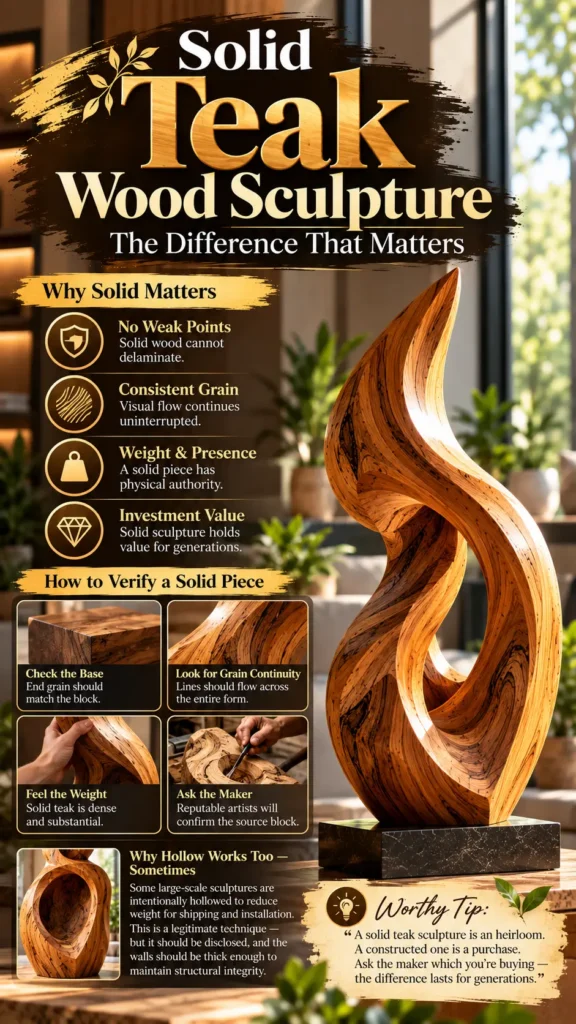
A solid teak wood sculpture is carved from a single block of timber — no laminates, no glued sections, no hidden voids. This is the gold standard, and it’s the difference between art and product.
Why solid matters:
- No weak points — glued joints can fail over decades; solid wood cannot delaminate
- Consistent grain — the visual flow continues uninterrupted across the entire piece
- Weight and presence — a solid piece has physical authority
- Investment value — solid sculpture holds value; constructed pieces rarely do
How to verify a solid piece:
- Check the base — end grain should match the block, not show seams
- Look for grain continuity — lines should flow across the form, not stop abruptly
- Feel the weight — solid teak is dense and substantial
- Ask the maker — reputable artists will confirm the source block
Why hollow works too — sometimes: Some large-scale sculptures are intentionally hollowed to reduce weight for shipping and installation. This is a legitimate technique — but it should be disclosed, and the walls should be thick enough to maintain structural integrity.
Worthy tip: “A solid teak sculpture is an heirloom. A constructed one is a purchase. Ask the maker which you’re buying — the difference lasts for generations.”
Visit Our Shop : Click Here…
3. Natural Teak Grain — The Beauty You Can’t Replicate
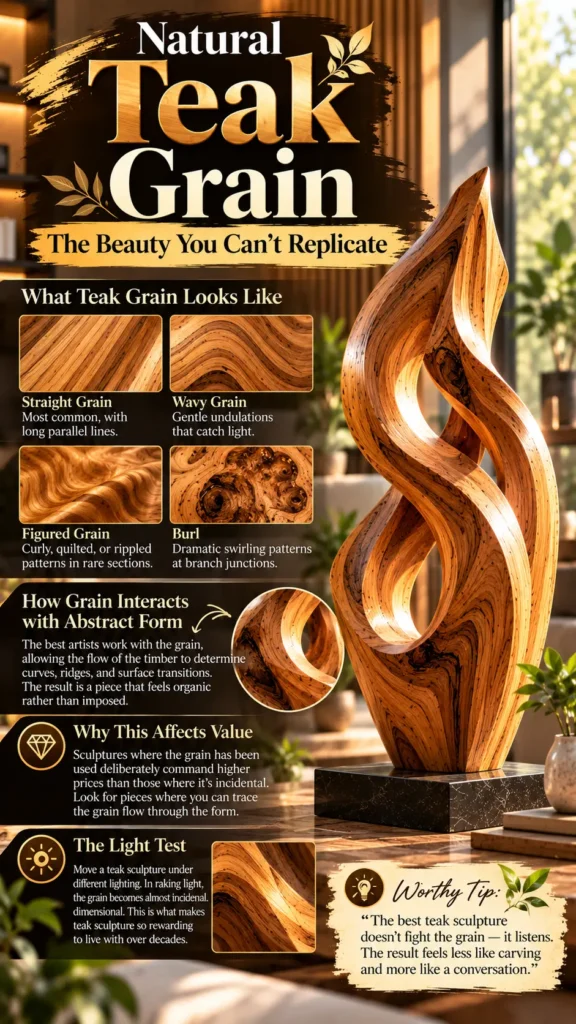
Natural teak grain abstract art is a phrase that captures something true: in teak, the grain itself performs. It flows, swirls, occasionally figures, and always contributes to the composition.
What teak grain looks like:
- Straight grain — most common, with long parallel lines
- Wavy grain — gentle undulations that catch light
- Figured grain — curly, quilted, or rippled patterns in rare sections
- Burl — dramatic swirling patterns at branch junctions or growth irregularities
How grain interacts with abstract form: A carver working abstractly has two choices — fight the grain or collaborate with it. The best artists work with it, allowing the flow of the timber to determine curves, ridges, and surface transitions. The result is a piece that feels organic rather than imposed.
Why this affects value: Sculptures where the grain has been used deliberately command higher prices than those where it’s incidental. Look for pieces where you can trace the grain flow through the form — where the carving and the material are in dialogue.
The light test: Move a teak sculpture under different lighting. In raking light, the grain becomes almost three-dimensional. This is what makes teak sculpture so rewarding to live with over decades.
Worthy tip: “The best teak sculpture doesn’t fight the grain — it listens. The result feels less like carving and more like a conversation.”
4. Golden-Brown Teak Timber — Warmth for Contemporary Spaces
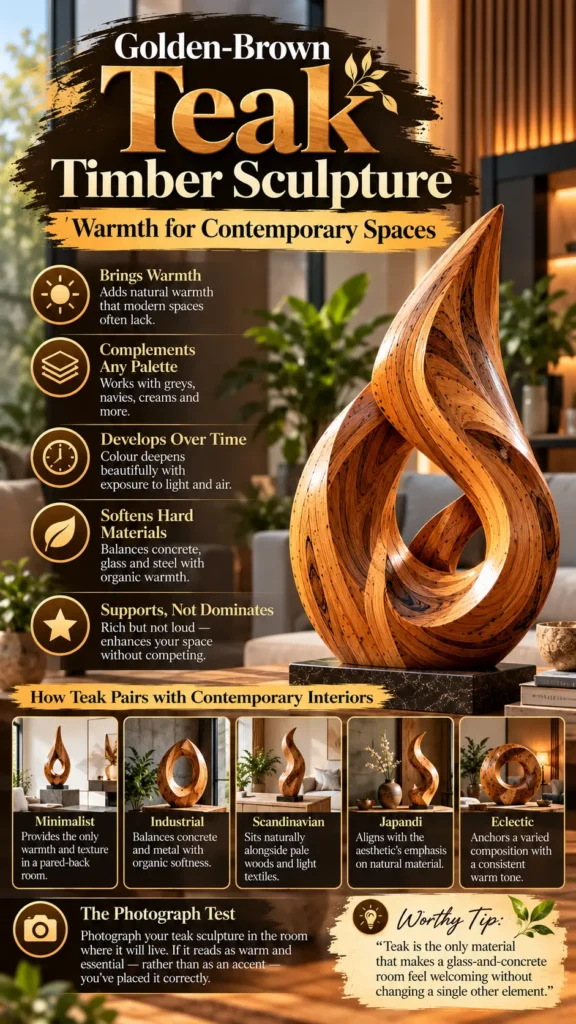
Golden-brown teak timber sculpture brings a specific quality that contemporary interiors often lack: warmth that doesn’t feel dated.
Why teak’s colour works in modern spaces:
- Softens hard materials — the golden tone balances concrete, glass, and steel
- Complements both cool and warm palettes — works with greys, navies, and creams alike
- Develops over time — colour deepens with exposure to light and air
- Doesn’t compete — teak is rich but not loud; it supports rather than dominates
How teak pairs with contemporary interiors:
| Interior Style | How Teak Works |
|---|---|
| Minimalist | Provides the only warmth and texture in a pared-back room |
| Industrial | Balances concrete and metal with organic softness |
| Scandinavian | Sits naturally alongside pale woods and light textiles |
| Japandi | Aligns with the aesthetic’s emphasis on natural material |
| Eclectic | Anchors a varied composition with a consistent warm tone |
The photograph test: Photograph your teak sculpture in the room where it will live. If it reads as warm and essential — rather than as an accent — you’ve placed it correctly.
Worthy tip: “Teak is the only material that makes a glass-and-concrete room feel welcoming without changing a single other element.”
5. Oil-Finished Teak Abstract Carving — The Finish That Preserves Character
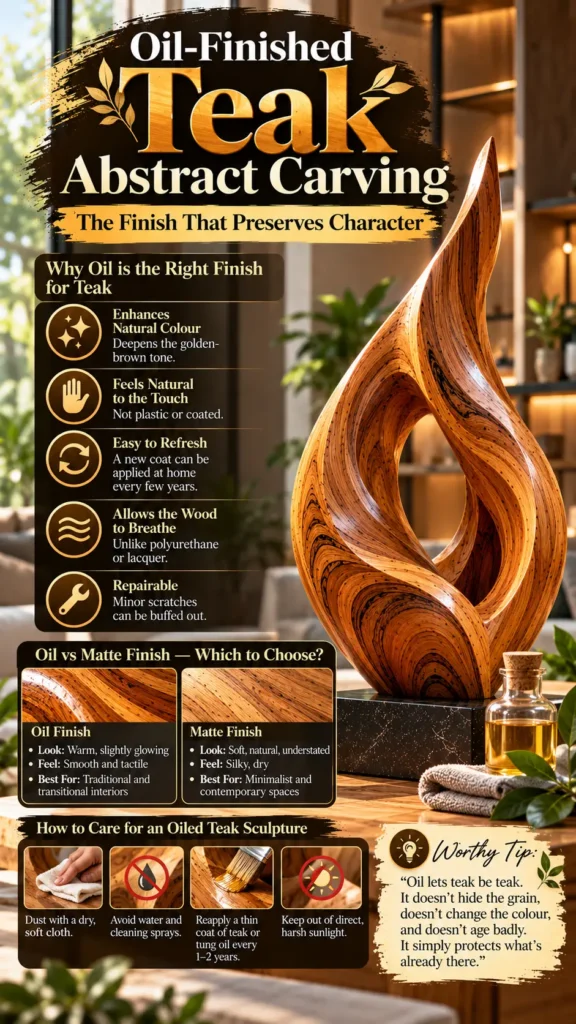
An oil-finished teak abstract carving is the most respectful way to complete a teak sculpture. Oil penetrates the wood and enhances its natural character without masking it behind a film.
Why oil is the right finish for teak:
- Enhances natural colour — deepens the golden-brown tone
- Feels natural to the touch — not plastic or coated
- Easy to refresh — a new coat can be applied at home every few years
- Allows the wood to breathe — unlike polyurethane or lacquer
- Repairable — minor scratches can be buffed out
Oil versus matte finish — which to choose:
| Finish | Look | Feel | Best For |
|---|---|---|---|
| Oil | Warm, slightly glowing | Smooth and tactile | Traditional and transitional interiors |
| Matte | Soft, natural, understated | Silky, dry | Minimalist and contemporary spaces |
Matte teak abstract art has become increasingly popular in contemporary interiors. The matte finish lets teak’s grain read clearly without any gloss, making it feel more architectural and less decorative.
How to care for an oiled teak sculpture:
- Dust with a dry, soft cloth
- Avoid water and cleaning sprays
- Reapply a thin coat of teak or tung oil every 1–2 years
- Keep out of direct, harsh sunlight
Worthy tip: “Oil lets teak be teak. It doesn’t hide the grain, doesn’t change the colour, and doesn’t age badly. It simply protects what’s already there.”
6. Sustainable Teak Wood Art — Beauty With a Conscience
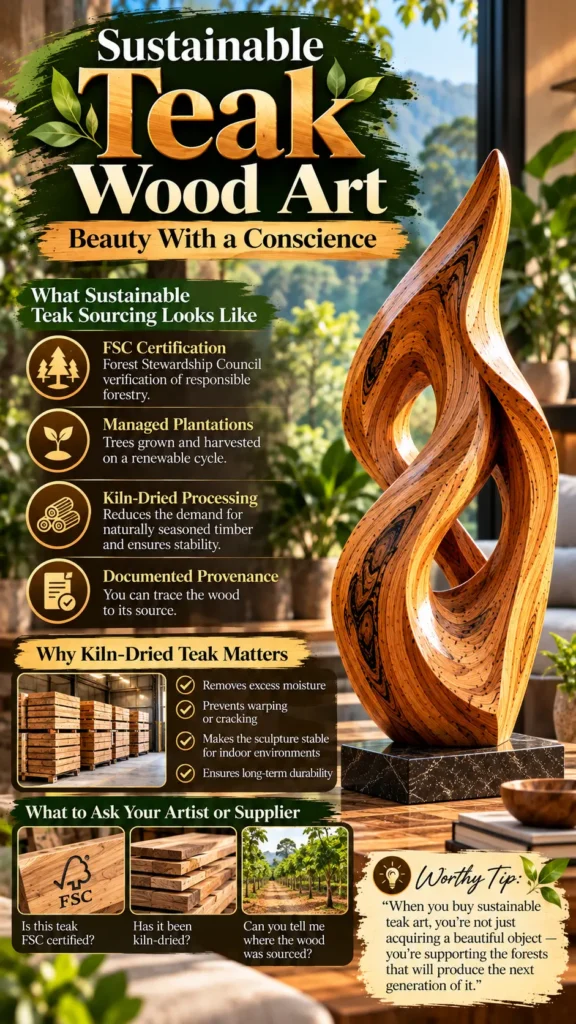
Sustainable teak wood art is not a marketing phrase — it’s a genuine consideration, because teak is a precious resource.
What sustainable teak sourcing looks like:
- FSC certification — Forest Stewardship Council verification of responsible forestry
- Managed plantations — trees grown and harvested on a renewable cycle
- Kiln-dried processing — reduces the demand for naturally seasoned timber
- Documented provenance — you can trace the wood to its source
Why kiln-dried teak matters:
Kiln-dried teak wood sculpture has been carefully dried in a controlled environment to remove excess moisture. This prevents the piece from warping or cracking over time and makes it stable for indoor environments.
What to ask your artist or supplier:
- “Is this teak FSC certified?”
- “Has it been kiln-dried?”
- “Can you tell me where the wood was sourced?”
A responsible supplier will answer all three without hesitation.
Worthy tip: “When you buy sustainable teak art, you’re not just acquiring a beautiful object — you’re supporting the forests that will produce the next generation of it.”
7. Styling Teak Abstract Sculpture in Contemporary Interiors
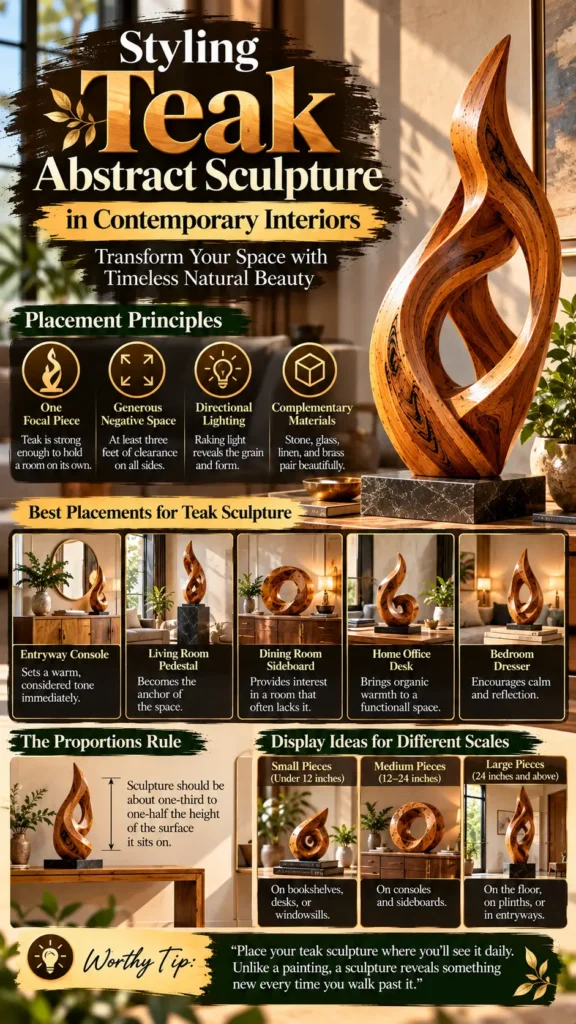
Premium teak sculpture for interiors demands thoughtful placement. Teak’s warmth means it can carry a room — but only if it’s given room to breathe.
Placement principles:
- One focal piece — teak is strong enough to hold a room on its own
- Generous negative space — at least three feet of clearance on all sides
- Directional lighting — raking light reveals the grain and form
- Complementary materials — stone, glass, linen, and brass all pair beautifully
Best placements:
| Location | Why It Works |
|---|---|
| Entryway console | Sets a warm, considered tone immediately |
| Living room pedestal | Becomes the anchor of the space |
| Dining room sideboard | Provides interest in a room that often lacks it |
| Home office desk | Brings organic warmth to a functional space |
| Bedroom dresser | Encourages calm and reflection |
The proportions rule: As a general guide, aim for a sculpture about one-third to one-half the height of the surface it sits on. Any smaller and it gets lost; any larger and it overwhelms.
Display ideas for different scales:
- Small pieces (under 12 inches) — on bookshelves, desks, or windowsills
- Medium pieces (12–24 inches) — on consoles and sideboards
- Large pieces (24 inches and above) — on the floor, on plinths, or in entryways
Worthy tip: “Place your teak sculpture where you’ll see it daily. Unlike a painting, a sculpture reveals something new every time you walk past it.”
From Timber to Treasure — Why Teak Wins in Contemporary Interiors
You now have a complete guide to modern teak abstract sculpture for contemporary interiors. From the structural integrity of solid teak wood sculpture to the visual richness of natural teak grain abstract art, from the warmth of golden-brown teak timber sculpture to the character-preserving quality of oil-finished teak abstract carving, from the responsibility of sustainable teak wood art to the stability of kiln-dried teak wood sculpture — you have everything you need to source, evaluate, and place teak sculpture with confidence.
Key takeaways:
- Teak brings warmth and durability — a rare combination
- Solid beats constructed — and the difference lasts for generations
- Grain is the decoration — the best artists collaborate with it
- Golden-brown works everywhere — from minimalist to eclectic interiors
- Oil or matte, never glossy — the finish should preserve character
- Verify sustainability — FSC certification and kiln-drying matter
- Placement is everything — one strong piece, generous space, raking light
A teak abstract sculpture is more than an accent. It’s a warm, durable, beautiful object that will hold its value, improve with age, and become more meaningful in your home every year. In contemporary interiors dominated by glass, concrete, and steel, teak provides the one thing those materials cannot: life.
Table of Contents
Call to Action (CTA)
Ready to bring a modern teak abstract sculpture into your space? I’d love to help you find the perfect piece. Email me at admin@woodzaa.com with “Teak Sculpture” in the subject line. Tell me about your room, your palette, and the feeling you want to create. I’ll help you source a piece that brings warmth, presence, and lasting beauty to your home.
Let’s bring teak into your story.
— Sheila

