
.](https://woodzaa.com/wp-content/uploads/2026/09/Storytelling-Through-Wood-Secrets-of-Master-Carvers1-1024x768.webp)
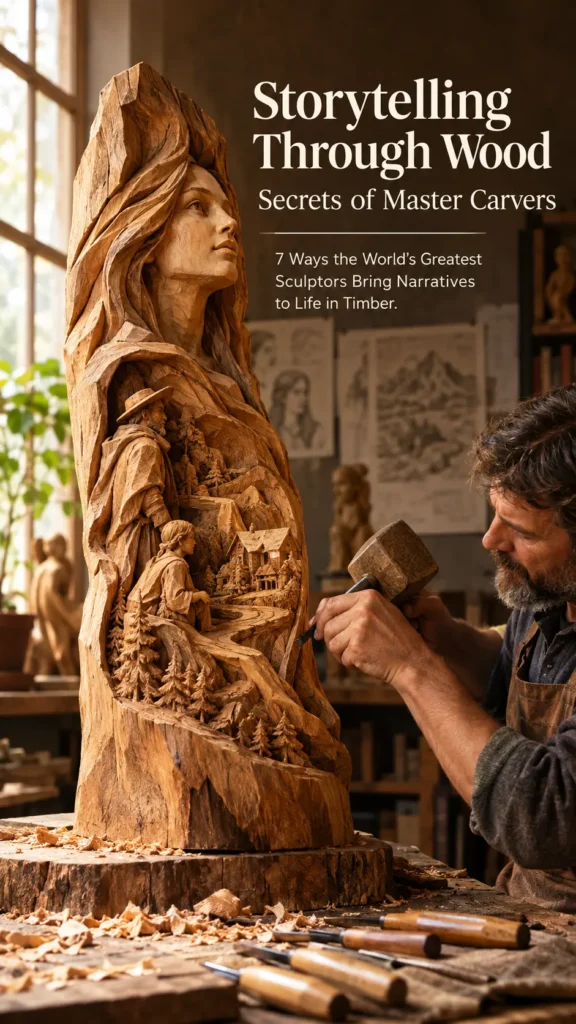
You’ve stood before sculptures that seemed to speak. Pieces that made you feel something — joy, sorrow, wonder — without a single word being uttered. You’ve wondered: How do they do it? How does a block of wood become a story? That’s the mystery at the heart of storytelling through wood: the secrets of master carvers — the ability to transform dead timber into living narrative, to make a static object feel like a moment frozen from a larger tale.
In this guide, you’ll discover the techniques and philosophies that separate master carvers from mere craftspeople. You’ll explore narrative wood sculpture art that tells stories through form, emotional narrative in wood that resonates on a deeply personal level, and wood carving as visual storytelling that speaks across cultures and centuries. You’ll learn about character-driven wood sculpture that creates protagonists and antagonists in timber, expressive narrative carving that captures emotion in every cut, and poetic wood sculpture design that uses metaphor and symbolism. You’ll also discover figurative storytelling in wood, symbolic wood sculpture narratives, and wood carving with a message that challenges, comforts, and inspires.
1. The Carver as Storyteller: Why Every Sculpture Has a Narrative
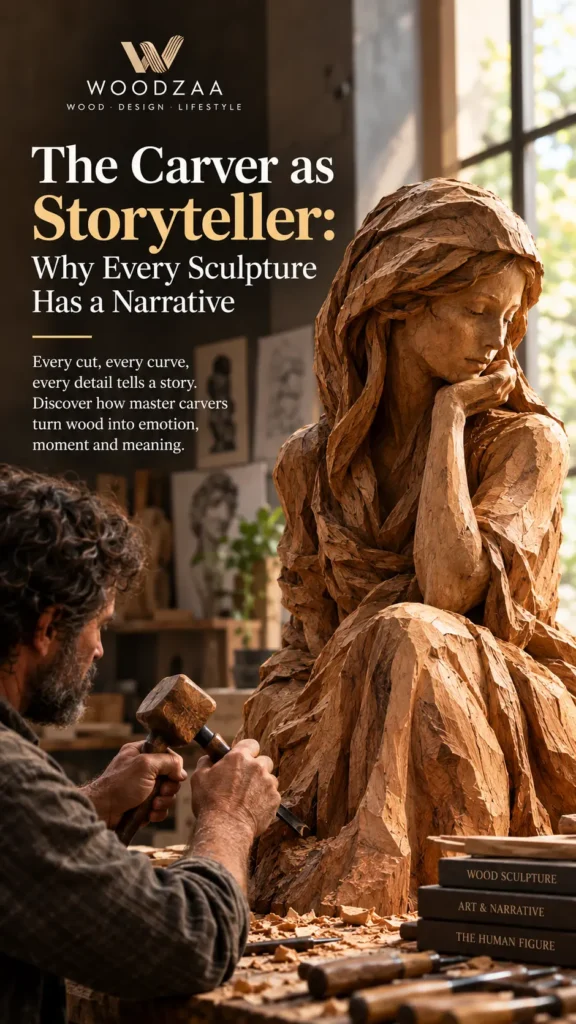
Every sculpture tells a story. Whether the carver intends it or not, every choice — the pose, the expression, the finish, the wood itself — contributes to a narrative that the viewer completes. The master carver understands this and uses it deliberately.
What separates a storyteller from a craftsman:
- Intention: Every cut serves the narrative, not just the form
- Character: The subject has a personality, a history, a motivation
- Moment selection: The carver chooses the exact instant that tells the whole story
- Emotional arc: The piece evokes a journey — beginning, middle, and end
- Openness: The viewer is invited to complete the story, not just observe it
Bruno Walpoth is a master of quiet narrative. His life-size figures capture people “deep in thought — as if they have disassociated themselves from the real world and retreated to a space of their own”. The story isn’t explicit — it’s implied. Who is this person? What are they thinking? What happened moments before? The viewer becomes a collaborator in the narrative.
Shinsuke Inoue carves small-scale figures of restrained emotional expression. His journey into woodcarving began when he sourced Japanese wood to create a three-dimensional rendering of his child. That personal story — a father capturing his child in wood — is woven into every piece he creates.
Worthy tip: “A master carver doesn’t just show you a subject — they show you a moment. The best sculptures feel like stills from a film you’ll never see, but desperately want to.”
For more on the foundations of carving, check out our related article: DIY Wooden Sculpture Art: How to Carve Something Gorgeous (Mid to High Net Worth)
2. Narrative Wood Sculpture Art: The Three Essential Elements
.](https://woodzaa.com/wp-content/uploads/2026/09/Narrative-Wood-Sculpture-Art-The-Three-Essential-Elements-576x1024.webp)
Narrative wood sculpture art relies on three essential elements working together: character, conflict, and resolution. Even in a single, static figure, the master carver implies all three.
Element 1: Character
Every figure must have a personality. This is achieved through:
- Facial expression — the angle of an eyebrow, the curve of a mouth
- Posture — a dropped shoulder, a lifted chin, a clenched fist
- Gesture — reaching, embracing, turning away
- Details — clothing, objects, texture that suggest a life lived
Element 2: Conflict
Conflict creates tension. It can be:
- Internal — a figure torn between two choices
- External — a figure facing a force larger than themselves
- Relational — two figures connected by love, rivalry, or grief
- Existential — a figure confronting mortality, meaning, or isolation
Element 3: Resolution
Resolution isn’t always happy — it’s satisfying. The story feels complete. This can be achieved through:
- Closure — the conflict is addressed
- Ambiguity — the viewer is left to decide
- Transformation — the character has changed
- Stillness — a moment of peace after struggle
Yoshitoshi Kanemaki creates multi-faced figures that capture “the entire range of human emotions simultaneously within a single face”. His sculptures seem to show multiple moments at once — a visual narrative of inner conflict, growth, and transformation. The conflict is internal, and the resolution is open — each viewer completes the story differently.
Worthy tip: “The best narrative sculptures leave room for the viewer. Don’t tell the whole story — tell enough that the viewer must finish it themselves.”
Visit Our Shop : Click Here…
3. Emotional Narrative in Wood: Making Viewers Feel
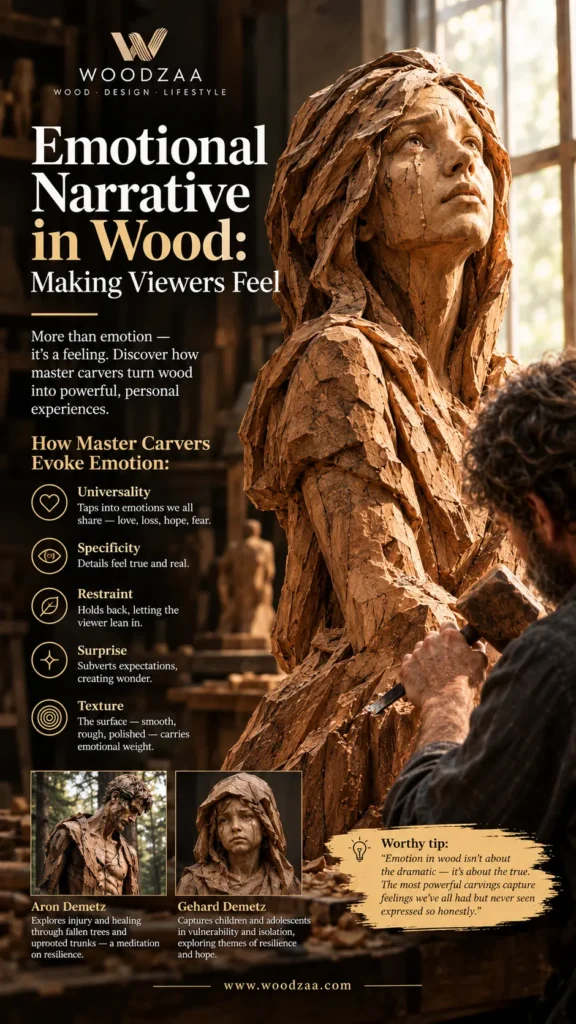
Emotional narrative in wood goes beyond showing emotion — it evokes emotion. The master carver doesn’t just depict sadness; they make you feel sad. They don’t just show joy; they make you smile.
How master carvers evoke emotion:
- Universality: They tap into emotions we all share — love, loss, hope, fear
- Specificity: The details are so particular that they feel true
- Restraint: They hold back, letting the viewer lean in
- Surprise: They subvert expectations, creating moments of wonder
- Texture: The surface of the carving — smooth, rough, polished — carries emotional weight
Aron Demetz creates life-size sculptures that explore themes of injury and healing. He walks in forests searching for fallen trunks and uprooted trees — never cutting down a living tree — and transforms them into figures that bear wounds and scars. His sculptures are “a meditation on resilience” — a reminder that damage can be repaired, that healing is possible. Viewers often report feeling personally addressed by his work.
Gerhard Demetz creates emotionally charged figures that capture children and adolescents in states of vulnerability and isolation. His work “explores themes of vulnerability, isolation, and resilience” with a rawness that resonates deeply with anyone who has ever felt alone.
Worthy tip: “Emotion in wood isn’t about the dramatic — it’s about the true. The most powerful carvings capture feelings we’ve all had but never seen expressed so honestly.”
4. Wood Carving as Visual Storytelling: The Language of Symbolism
.](https://woodzaa.com/wp-content/uploads/2026/09/Wood-Carving-as-Visual-Storytelling-The-Language-of-Symbolism-576x1024.webp)
Wood carving as visual storytelling uses symbols, metaphors, and visual cues to convey meaning. The master carver understands that sometimes the most powerful stories are told through suggestion rather than statement.
Common symbols in narrative wood carving:
- The reaching hand — longing, connection, hope
- The bowed head — grief, shame, prayer, contemplation
- The embrace — love, protection, reunion
- The turned back — rejection, independence, mystery
- The empty space — absence, loss, possibility
Christian Verginer fuses human figures with nature, carving children and adolescents from limewood and adding painted elements that connect them to the natural world. His work is “a dialogue between humanity and nature” — a reminder that we are part of the natural world, not separate from it. The symbolic fusion of child and tree tells a story of growth, rootedness, and connection.
Raul De Lara explores identity, belonging, and the immigrant experience through playful yet profound figures. His sculptures — cacti moonlighting as chairs, larger-than-life plants, droopy expressive forms — “appear to move, shine, and squish, both embracing and defying the rules of nature”. Each piece is a chapter in an ongoing personal narrative, rich with symbolism about borders, belonging, and the search for home.
Worthy tip: “Symbolism is the shorthand of storytelling. A single well-chosen symbol can say what a thousand words cannot.”
5. Figurative Storytelling in Wood: The Human Form as Narrative
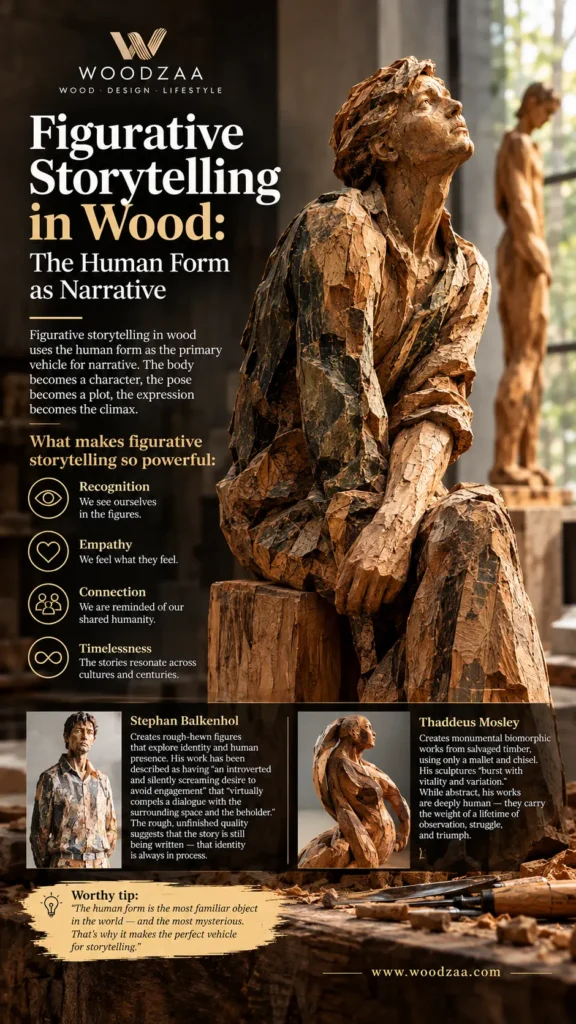
Figurative storytelling in wood uses the human form as the primary vehicle for narrative. The body becomes a character, the pose becomes a plot, the expression becomes the climax.
What makes figurative storytelling so powerful:
- Recognition: We see ourselves in the figures
- Empathy: We feel what they feel
- Connection: We are reminded of our shared humanity
- Timelessness: The stories resonate across cultures and centuries
Stephan Balkenhol creates rough-hewn figures that explore identity and human presence. His work has been described as having “an introverted and silently screaming desire to avoid engagement” that “virtually compels a dialogue with the surrounding space and the beholder”. The rough, unfinished quality of his figures suggests that the story is still being written — that identity is always in process.
Thaddeus Mosley creates monumental biomorphic works from salvaged timber, using only a mallet and chisel. His sculptures “burst with vitality and variation”. While abstract, his works are deeply human — they carry the weight of a lifetime of observation, struggle, and triumph.
Worthy tip: “The human form is the most familiar object in the world — and the most mysterious. That’s why it makes the perfect vehicle for storytelling.”
6. Dramatic Narrative Wood Carving: Tension, Conflict, and Resolution
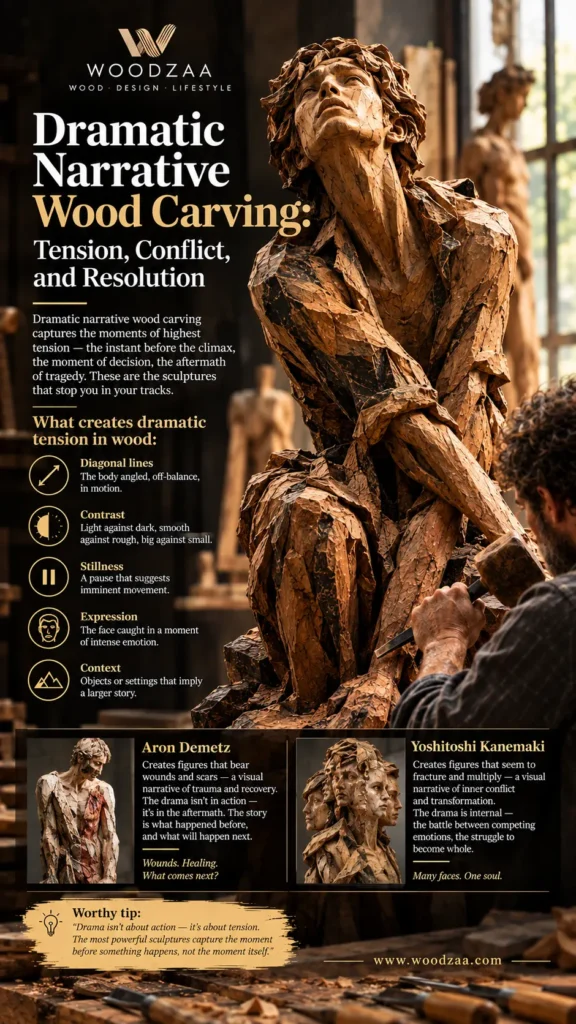
Dramatic narrative wood carving captures the moments of highest tension — the instant before the climax, the moment of decision, the aftermath of tragedy. These are the sculptures that stop you in your tracks.
What creates dramatic tension in wood:
- Diagonal lines: The body angled, off-balance, in motion
- Contrast: Light against dark, smooth against rough, big against small
- Stillness: A pause that suggests imminent movement
- Expression: The face caught in a moment of intense emotion
- Context: Objects or settings that imply a larger story
Aron Demetz creates figures that bear wounds and scars — a visual narrative of trauma and recovery. The drama isn’t in action — it’s in the aftermath. The story is what happened before, and what will happen next.
Yoshitoshi Kanemaki creates figures that seem to fracture and multiply — a visual narrative of inner conflict and transformation. The drama is internal — the battle between competing emotions, the struggle to become whole.
Worthy tip: “Drama isn’t about action — it’s about tension. The most powerful sculptures capture the moment before something happens, not the moment itself.”
7. Wood Carving With a Message: Art That Speaks
.](https://woodzaa.com/wp-content/uploads/2026/09/Wood-Carving-With-a-Message-Art-That-Speaks-576x1024.webp)
Wood carving with a message uses the narrative power of sculpture to advocate, educate, and inspire. These are pieces that don’t just tell stories — they tell the stories that need to be told.
What message-driven carving looks like:
- Environmental: Works that celebrate nature or warn of its destruction
- Social: Pieces that address inequality, identity, or justice
- Personal: Sculptures that process grief, trauma, or recovery
- Spiritual: Works that explore faith, doubt, or transcendence
- Cultural: Pieces that preserve heritage and honour ancestors
Mineo Mizuno creates site-specific sculptures from fallen timber gathered in the forests of the Sierra Nevada. Using the yakisugi method, he transforms ordinary wood into extraordinary works of art that celebrate the beauty of wood in its natural state — a message about sustainability, renewal, and the importance of living in harmony with nature.
Aron Demetz creates figures that bear wounds and scars — a meditation on resilience that speaks to anyone who has experienced trauma and recovery. His sculptures are “a reminder that damage can be repaired, that healing is possible”.
The African fertility figures — the akua’ba of the Akan people — carry prayers for conception and safe delivery. Each carved line and symbolic detail represents a mother’s hope for a healthy child. These are not just sculptures — they are prayers made visible, hope carved in wood.
Worthy tip: “The most powerful wood art doesn’t just decorate — it advocates. It tells the stories that need to be told, and it reminds us of what matters most.”
From Timber to Testimony — The Art of Storytelling in Wood
You now have a comprehensive guide to storytelling through wood: secrets of master carvers. From the quiet introspection of Bruno Walpoth’s figures to the multi-faced narratives of Yoshitoshi Kanemaki, from the wounded resilience of Aron Demetz to the nature-fused storytelling of Christian Verginer, from the rough-hewn presence of Stephan Balkenhol to the monumental vitality of Thaddeus Mosley — you’ve discovered the techniques and philosophies that make wood sculpture speak.
Key takeaways:
- Every sculpture tells a story — intentional or not
- Character, conflict, and resolution are the three essential elements
- Emotion is evoked, not just depicted — restraint is powerful
- Symbolism is the shorthand of storytelling — a single symbol can say everything
- The human form is the most powerful vehicle for narrative
- Drama lives in tension — capture the moment before, not after
- The best art has a message — it advocates, educates, and inspires
Whether you’re a collector, an interior designer, or simply someone who appreciates the extraordinary potential of wood, these master carvers remind us that wood is not just a material — it’s a language. And the best sculptures are not just objects — they’re conversations that continue for generations.
Table of Contents
Call to Action (CTA)
Which of these storytelling carvers speaks to you most? I’d love to hear which piece or artist resonated with your soul. Email me at admin@woodzaa.com with “Storytelling Wood” in the subject line. Share your favourite artist or piece — whether it’s Walpoth’s quiet introspection, Kanemaki’s surreal narratives, or Demetz’s wounded resilience — and what draws you to their work. I’ll help you discover more about their art and how you can bring the spirit of their storytelling into your own space.
Let’s tell your story through wood.
— Sheila

