


You’ve seen wooden bowls and vases before. Beautiful, yes. But have you ever seen a piece of wood that seems to glow from within? A vessel so thin it’s almost translucent? A sculpture that reveals an entire landscape hidden just beneath the bark? That’s the magic of woodturning art that reveals the hidden beauty inside the log – a craft that transforms rough, unremarkable timber into objects of breathtaking beauty.
In this guide, you’ll discover why woodturning is experiencing a renaissance in the contemporary art world. You’ll explore the journey from raw log to finished masterpiece, meet the artists pushing the boundaries of the craft, and learn how to bring the hidden beauty of wood into your own space.
You’ll uncover the secrets of unveiling inner wood grain art, the thrill of discovery of hidden timber patterns, the transformative power of bark-to-beauty turned sculpture, the artistry of revealing the tree’s secret core, the magic of transformative woodturning art, the unexpected beauty in raw logs, the skill of inside-out timber artistry, the precision of lathe-revealed natural patterns, the wonder of exposing wood’s inner landscape, and the journey of raw to refined wood transformation.
These pieces are more than just decor – they’re a revelation of nature’s hidden artistry, brought to light by the skilled hands of master craftsmen.
1. Unveiling Inner Wood Grain Art – Nature’s Masterpiece Revealed
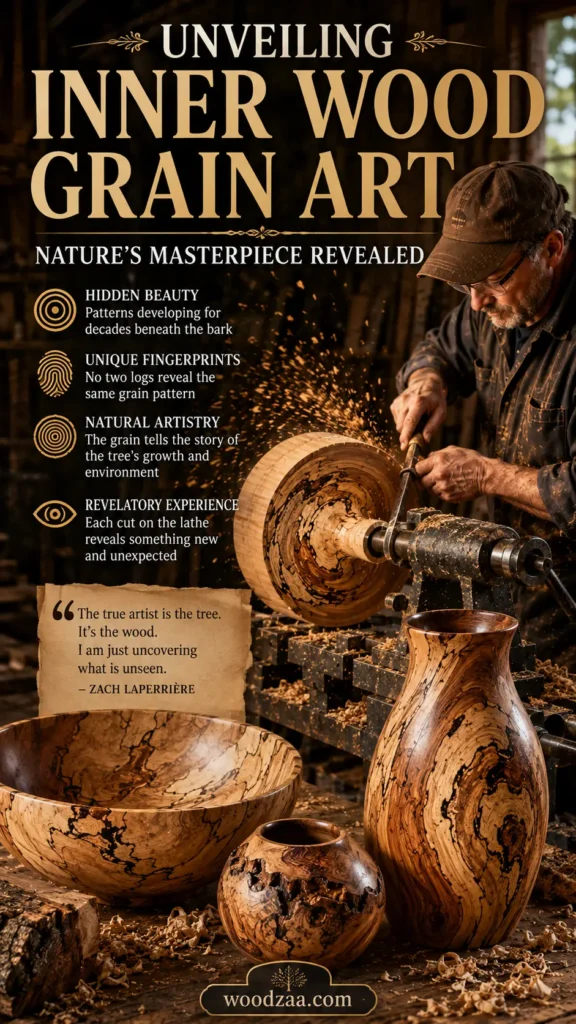
Unveiling inner wood grain art is the heart of the woodturning craft. Every log holds a secret – a unique pattern of grain, colour, and texture that no one has ever seen. The woodturner’s role is to reveal that secret, to bring nature’s hidden masterpiece into the light.
What makes inner wood grain so captivating:
- Hidden beauty: The patterns have been developing for decades, unseen beneath the bark
- Unique fingerprints: No two logs reveal the same grain pattern
- Natural artistry: The grain tells the story of the tree’s growth and environment
- Revelatory experience: Each cut on the lathe reveals something new and unexpected
Woodturner Robert Clague says it best: “There’s tremendous beauty inside our trees. I love revealing that.” He generally starts with a log and cuts it up into large chunks with a chainsaw, working to uncover what resides within.-
Similarly, artist Zach LaPerrière describes his philosophy: “The true artist is the tree. It’s the wood. I am just uncovering what is unseen.” For him, the hidden story might be “the remnant of a bear slash from decades ago buried under the bark or a spot where a branch fell off centuries ago.”
Worthy tip: “The most captivating woodturned pieces are those where the artist has let the wood’s natural grain guide the form. Look for pieces that celebrate the wood’s unique character.”
For more on the beauty of natural wood, check out our related article: Hand Carved Wood Pieces Inspired by Organic Forms (Mid to High Net Worth)
2. Discovery of Hidden Timber Patterns – The Thrill of the Reveal
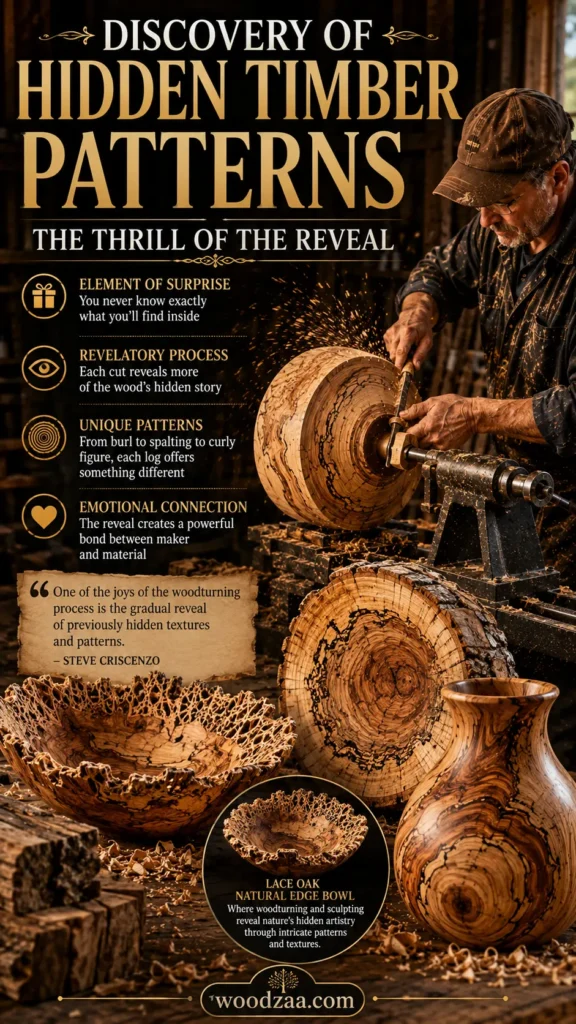
The discovery of hidden timber patterns is what keeps woodturners coming back to the lathe. Each log is a mystery waiting to be solved – a puzzle of grain, colour, and texture that reveals itself only as the wood is turned.
What makes the discovery so thrilling:
- Element of surprise: You never know exactly what you’ll find inside
- Revelatory process: Each cut reveals more of the wood’s hidden story
- Unique patterns: From burl to spalting to curly figure, each log offers something different
- Emotional connection: The reveal creates a powerful bond between maker and material
Steve Criscenzo, a woodturning artist, explains: “One of the joys of the woodturning process is the gradual reveal of previously hidden textures and patterns.” Once the bark is removed, the inner wood often reveals “fascinating patterns” that were completely invisible from the outside.-
The “Lace Oak Natural Edge Bowl” demonstrates this principle beautifully. Through a process combining woodturning and sculpting, the oak takes on “an intricate lace-like effect, seeming to fray at its natural edge.” Once dry, a sandblasting technique removes the soft spring growth “to reveal the inner structure of the material and its unique pattern of intersecting medullary rays and growth rings.”-
Worthy tip: “When choosing a woodturned piece, ask the artist about the log’s origin. Knowing where the wood came from adds depth to your appreciation of its hidden beauty.”
You Might Like : 15 Masterpieces: The Most Breathtaking Wood Sculpture Art of the Year
3. Bark-to-Beauty Turned Sculpture – The Transformation Begins
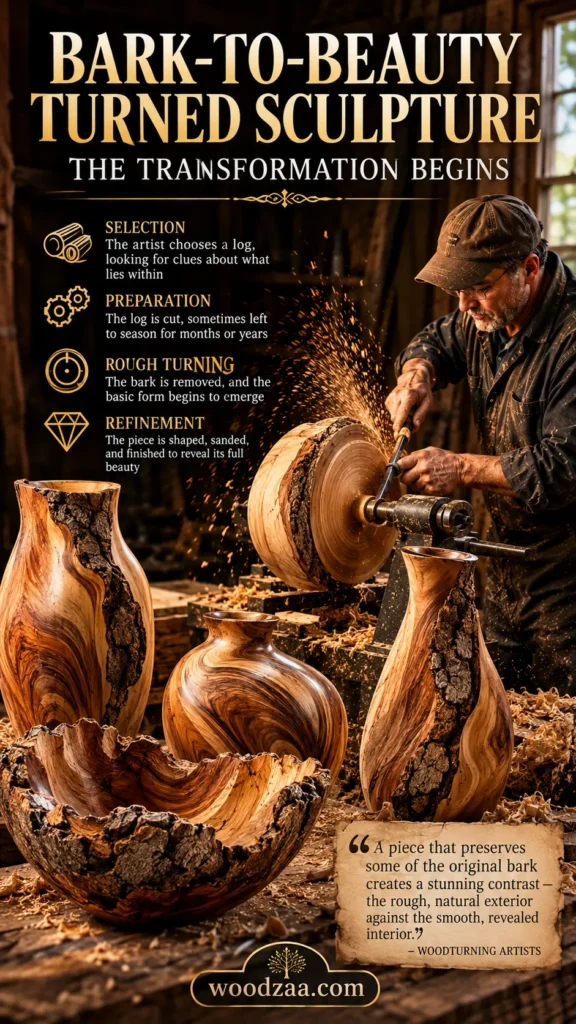
Bark-to-beauty turned sculpture is the journey from rough, unremarkable log to polished, breathtaking object. It’s a transformation that requires skill, patience, and a deep understanding of the material.
The stages of transformation:
- Selection: The artist chooses a log, looking for clues about what lies within
- Preparation: The log is cut, sometimes left to season for months or years
- Rough turning: The bark is removed, and the basic form begins to emerge
- Refinement: The piece is shaped, sanded, and finished to reveal its full beauty
Ray Asselin, a Massachusetts-based woodturner, describes his process as “gradually converting a raw chunk of log” into a finished piece.- His work, which features polished surfaces contrasted with weathered tree bark, exemplifies the bark-to-beauty transformation.-
Virgil Leih takes the transformation to an extreme, turning 2000-pound rescued tree trunks into enormous, carved sculptures.- His large-scale approach demonstrates that the bark-to-beauty journey can happen at any scale.
Worthy tip: “A piece that preserves some of the original bark creates a stunning contrast – the rough, natural exterior against the smooth, revealed interior.”
4. Revealing the Tree’s Secret Core – What Lies Beneath
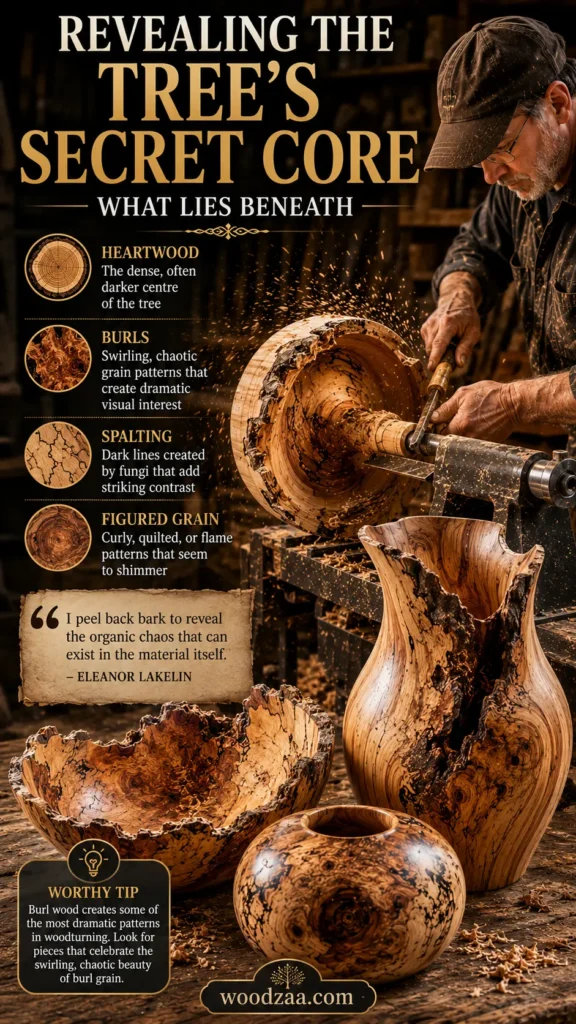
Revealing the tree’s secret core is the woodturner’s ultimate goal. The core of the tree holds the most dramatic patterns – the heartwood, the burl, the spalting that transforms ordinary wood into something extraordinary.
What the secret core can reveal:
- Heartwood: The dense, often darker centre of the tree
- Burls: Swirling, chaotic grain patterns that create dramatic visual interest
- Spalting: Dark lines created by fungi that add striking contrast
- Figured grain: Curly, quilted, or flame patterns that seem to shimmer
Eleanor Lakelin, a British sculptor, describes her approach: “I peel back bark to reveal the organic chaos that can exist in the material itself.” Her work exposes “the twisted configuration of the grain and the frequent bark inclusions and voids,” elements that many would consider flaws, but that she celebrates as part of the wood’s story.
Artist Ron Layport works directly from the log, using “fresh cut local hardwoods – trees felled as a result of storm damage or otherwise destined for landfill, firewood, or the chipper.” His sustainable approach ensures that the tree’s secret core is revealed before it’s lost forever.
Worthy tip: “Burl wood creates some of the most dramatic patterns in woodturning. Look for pieces that celebrate the swirling, chaotic beauty of burl grain.”
5. Transformative Woodturning Art – From Rough to Refined
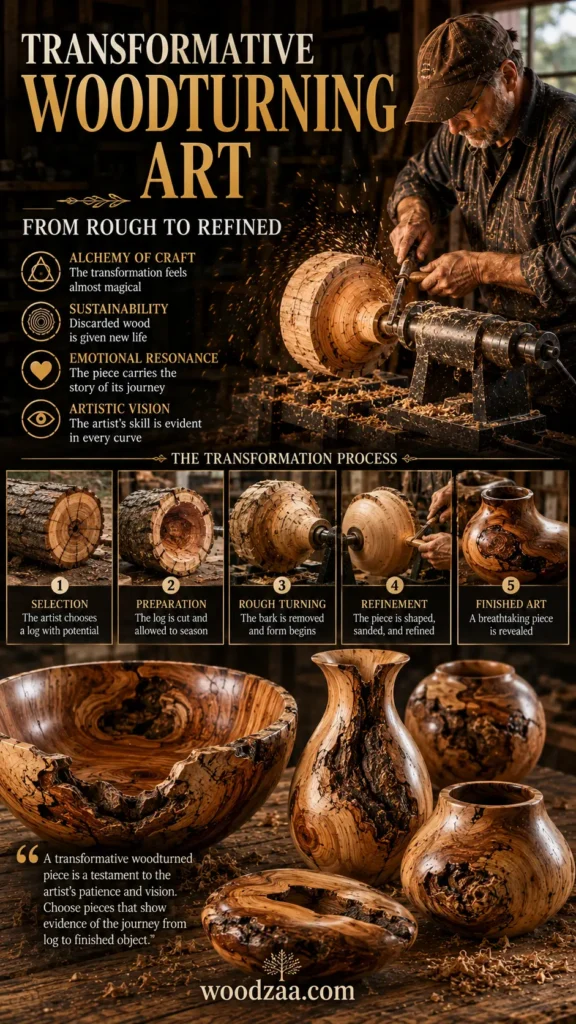
Transformative woodturning art is about more than just shaping wood – it’s about changing how we see the material itself. A rough, splintery log becomes a smooth, glowing vessel. A discarded tree becomes a treasured heirloom.
What makes transformative woodturning special:
- Alchemy of craft: The transformation feels almost magical
- Sustainability: Discarded wood is given new life
- Emotional resonance: The piece carries the story of its transformation
- Artistic vision: The artist’s skill is evident in every curve
Matthew Calder, a woodturner who was first attracted to ceramics, was drawn to woodturning “by the philosophy of leaving part” of the material’s natural character intact.- He works with “a freshly cut tree while the wood is still unseasoned,” creating pottery-like sculptures from hardwood logs.-
The transformation process can take months. Some woodturners soak the wood in solution for several months to prevent cracking, followed by a drying period before the final turning.- This patience is rewarded with pieces that will last for generations.
Worthy tip: “A transformative woodturned piece is a testament to the artist’s patience and vision. Choose pieces that show evidence of the journey from log to finished object.”
6. Exposing Wood’s Inner Landscape – The Topography of Timber
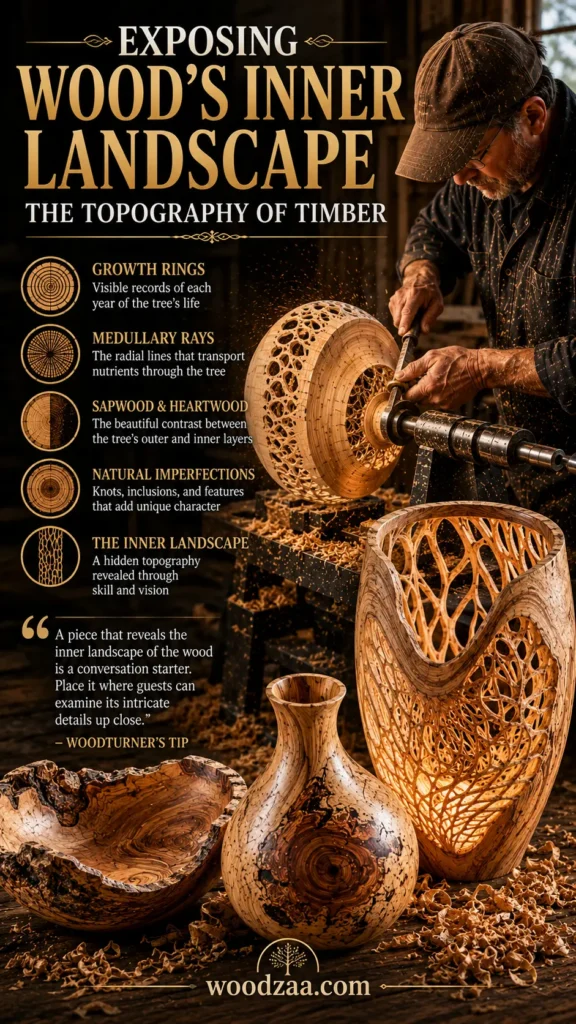
Exposing wood’s inner landscape reveals the hidden topography of the tree – the rings, the rays, the subtle variations in colour and texture that tell the story of decades of growth.
What the inner landscape reveals:
- Growth rings: Visible records of each year of the tree’s life
- Medullary rays: The radial lines that transport nutrients through the tree
- Sapwood and heartwood: The contrast between the tree’s outer and inner layers
- Natural imperfections: Knots, inclusions, and other features that add character
Pascal Oudet, a French woodturner and sculptor, takes this exposure to an extreme. Using the trunk of a 70-year-old oak tree, he meticulously carves away the wood “until he achieved a diaphanous sculpture of astonishing lightness.” When illuminated, “an organic lacework emerges, composed of alternating summer rings and the distinctive oak grain that binds them.”
Oudet’s work reveals “the inner structure of the material” through “meticulous woodturning and sandblasting processes to peel the wood down to skin-like thinness.” The result is a piece that seems to glow from within.
Worthy tip: “A piece that reveals the inner landscape of the wood is a conversation starter. Place it where guests can examine its intricate details up close.”
7. Lathe-Revealed Natural Patterns – The Art of the Spin
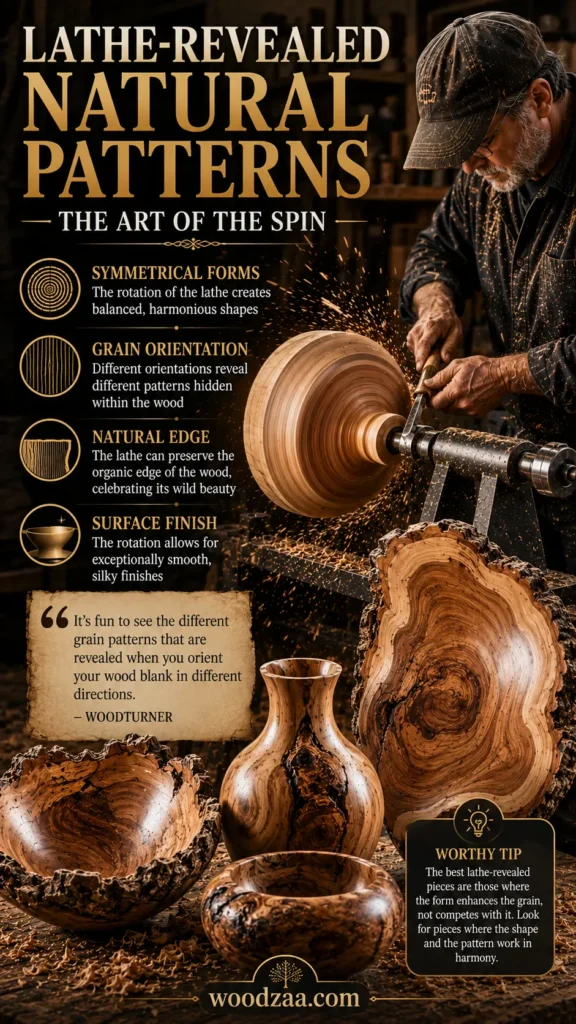
Lathe-revealed natural patterns are created through the unique interaction between the spinning wood and the artist’s tools. The rotation of the lathe allows the artist to create symmetrical forms that highlight the wood’s natural beauty.
How the lathe reveals patterns:
- Symmetrical forms: The rotation creates balanced, harmonious shapes
- Grain orientation: Different orientations reveal different patterns
- Natural edge: The lathe can preserve the organic edge of the wood
- Surface finish: The rotation allows for exceptionally smooth finishes
Brian Markham, a woodturner in the rugged Muskoka landscapes, “turns bark-covered burls on his lathe to reveal unique grain patterns, rich variations in colour and natural raw edge.” His work in his “workshop deep in the forest” connects the craft directly to its source.
The orientation of the wood on the lathe can dramatically affect the revealed pattern. As one woodturner notes, “It’s fun to see the different grain patterns that are revealed when you orient your wood blank in different directions.” This experimentation is part of what makes each piece unique.
Worthy tip: “The best lathe-revealed pieces are those where the form enhances the grain, not competes with it. Look for pieces where the shape and the pattern work in harmony.”
The Artists Behind the Art
Several remarkable artists are pushing the boundaries of woodturning:
Pascal Oudet (France): Creates diaphanous oak sculptures of astonishing lightness, using meticulous woodturning and sandblasting to reveal the inner structure of the material.
Ernst Gamperl (Germany): Has “radically revitalised the historical technique of woodturning” and “revolutionised woodturning by developing new methods that push the practice’s technical limits.” His work is celebrated in major exhibitions like “The Tree of Life Project” at the Museum für Kunst und Gewerbe Hamburg.
Zach LaPerrière: Believes “the true artist is the tree,” uncovering the hidden stories within each log – “the remnant of a bear slash from decades ago buried under the bark.”
Robert Clague: Finds inspiration in nature, saying, “There’s tremendous beauty inside our trees. I love revealing that.”
Ray Asselin: Gradually converts raw chunks of log into vases with polished surfaces and weathered tree bark.
Styling Your Woodturned Sculpture
You’ve chosen your perfect piece – now, how do you display it to make the most of its revealed beauty?
Placement ideas:
- Entryway console: Welcome guests with a piece that reveals nature’s hidden beauty
- Living room focal point: Make it the centrepiece of your space
- Home office: Bring natural inspiration to your workspace
- Bookshelf: Add a sculptural element that rewards close inspection
- Mantelpiece: Create a stunning focal point that captures the light
Styling tips:
- Let it breathe: Give the sculpture space to be the star
- Consider lighting: Directional light will highlight the wood’s grain and patterns
- Pair with natural materials: Linen, wool, and stone complement wood beautifully
- Rotate your pieces: Different lighting conditions reveal different aspects of the wood’s beauty
Worthy tip: “A woodturned piece is a journey of discovery. Place it where you can spend time with it – you’ll notice new details and patterns with every look.”
From Raw Log to Revealed Beauty – The Magic of Woodturning
You now have everything you need to appreciate woodturning art that reveals the hidden beauty inside the log. From the thrill of unveiling inner wood grain art to the excitement of discovery of hidden timber patterns, from the transformative journey of bark-to-beauty turned sculpture to the wonder of revealing the tree’s secret core, from the alchemy of transformative woodturning art to the patience of inside-out timber artistry, from the precision of lathe-revealed natural patterns to the revelation of exposing wood’s inner landscape, and the complete journey of raw to refined wood transformation – you’re ready to welcome these stunning works into your home.
A woodturned sculpture is more than just decor. It’s a revelation of nature’s hidden beauty, a testament to the artist’s skill and patience, and a reminder that the most extraordinary beauty often lies just beneath the surface, waiting to be discovered.
Table of Contents
Call to Action (CTA)
Ready to bring a woodturned masterpiece that reveals hidden beauty into your home? I’d love to help you find the perfect piece. Email me at admin@woodzaa.com with “Woodturning Art” in the subject line. Share your style – organic, sculptural, minimalist, or something in between – and the feeling you want to create. I’ll help you find or commission a piece that reveals the hidden beauty inside the log.
Let’s uncover nature’s secrets together.
– Sheila

