
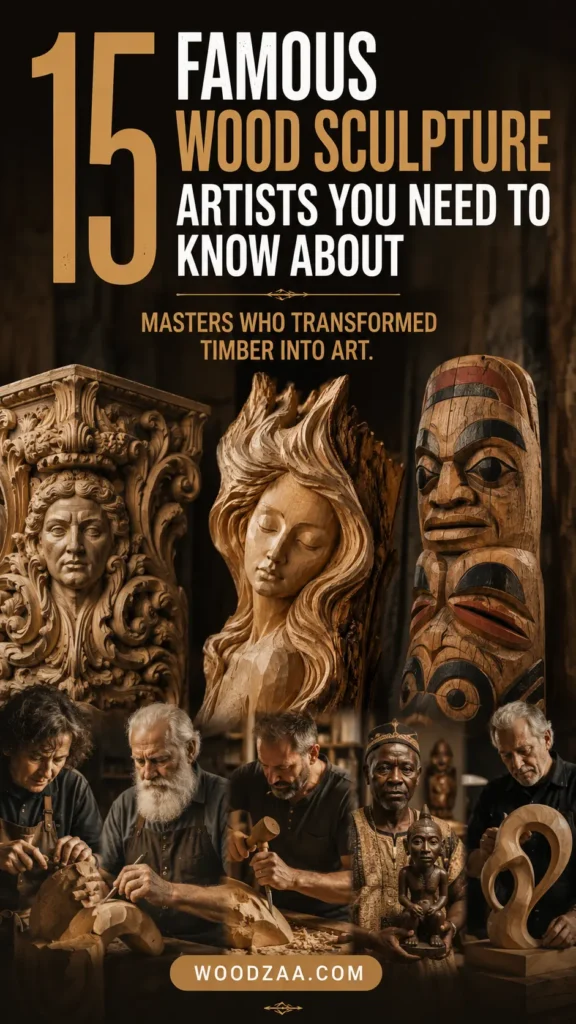
You’ve admired the beauty of carved wood – the intricate details, the flowing forms, the way a simple block of timber can be transformed into something extraordinary. But have you ever wondered about the artists behind these masterpieces? The visionaries who took an ancient craft and pushed it to new heights? From the ornate limewood carvings of 17th-century Britain to the monumental cedar sculptures of contemporary America, these are famous wood sculpture artists you need to know about.
In this guide, you’ll journey through four centuries of wood carving excellence. You’ll meet the masters who defined the craft – from the “Michelangelo of wood” to the axe-wielding giant of the Pacific Northwest, from the guardians of Yoruba tradition to the innovators of gravity-defying forms. Each of these artists brought something unique to the medium, transforming timber into art that continues to inspire and amaze.
1. Grinling Gibbons: The “Michelangelo of Wood”
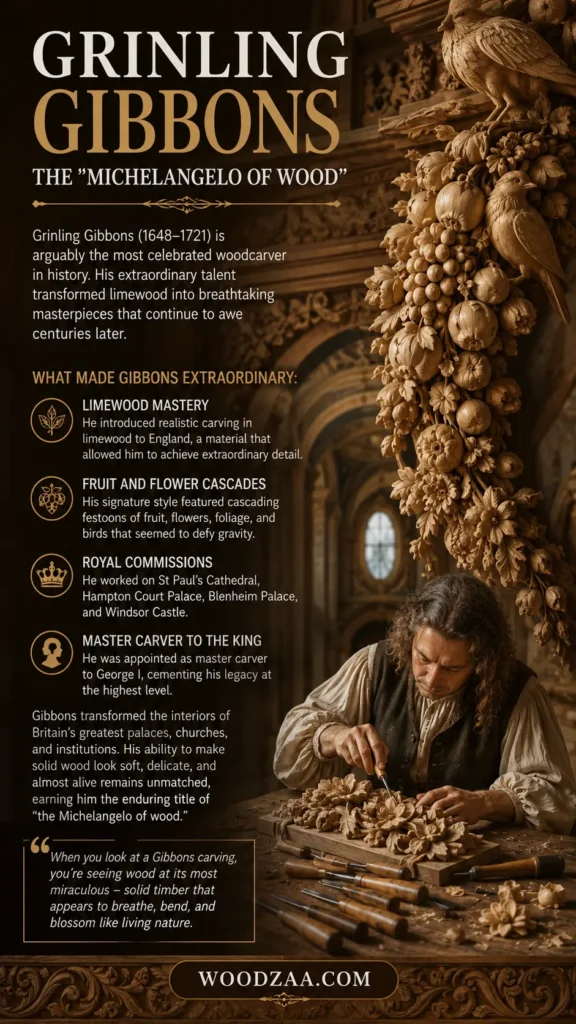
Grinling Gibbons (1648–1721) is arguably the most celebrated woodcarver in history. Born in Rotterdam to English parents, Gibbons moved to England in the 1660s and quickly established himself as the preeminent decorative carver of his era.
What made Gibbons extraordinary:
- Limewood mastery: He introduced realistic carving in limewood to England, a material that allowed him to achieve extraordinary detail.
- Fruit and flower cascades: His signature style featured cascading festoons of fruit, flowers, foliage, and birds that seemed to defy gravity.
- Royal commissions: He worked on St Paul’s Cathedral, Hampton Court Palace, Blenheim Palace, and Windsor Castle
- Master carver to the king: He was appointed as master carver to George I, cementing his legacy at the highest level
Gibbons transformed the interiors of many of Britain’s greatest palaces, churches, and institutions. His ability to make solid wood look soft, delicate, and almost alive remains unmatched, earning him the enduring title of “the Michelangelo of wood.”
Worthy tip: “When you look at a Gibbons carving, you’re seeing wood at its most miraculous – solid timber that appears to breathe, bend, and blossom like living nature.”
2. Dudley Carter: The Legendary Axe-Wielding Sculptor
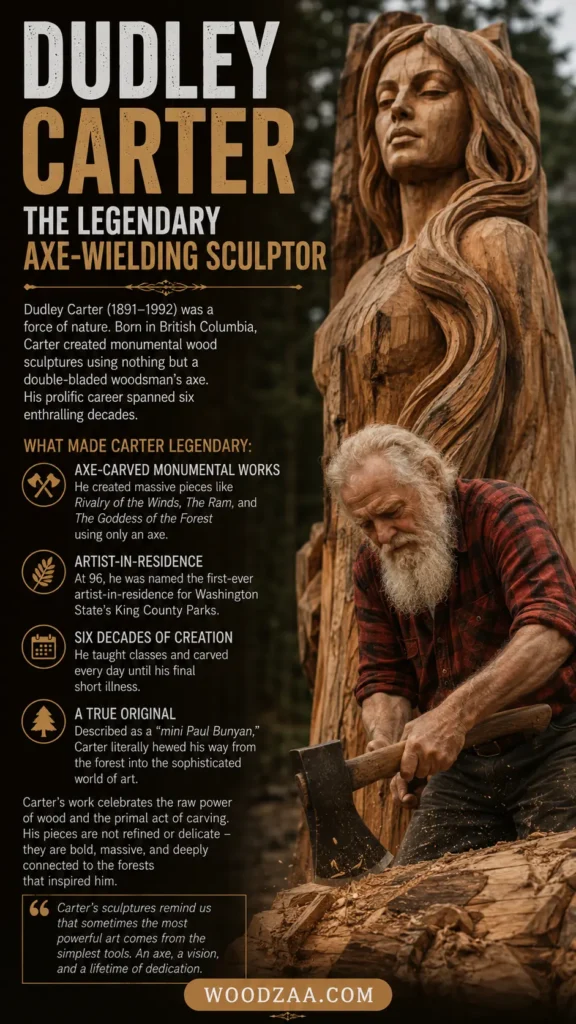
Dudley Carter (1891–1992) was a force of nature. Born in British Columbia, Carter created monumental wood sculptures using nothing but a double-bladed woodsman’s axe. His prolific career spanned six enthralling decades, ending in 1992 when he died at the age of 100 with dozens of works still in progress.
What made Carter legendary:
- Axe-carved monumental works: He created massive pieces like Rivalry of the Winds, The Ram, and The Goddess of the Forest using only an axe.
- Artist-in-residence: At 96, he was named the first-ever artist-in-residence for Washington State’s King County Parks.
- Six decades of creation: He taught classes and carved every day until his final short illness
- A true original: Described as a “mini Paul Bunyan,” Carter literally hewed his way from the forest into the sophisticated world of art
Carter’s work celebrates the raw power of wood and the primal act of carving. His pieces are not refined or delicate; they are bold, massive, and deeply connected to the forests that inspired him.
Worthy tip: “Carter’s sculptures remind us that sometimes the most powerful art comes from the simplest tools. An axe, a vision, and a lifetime of dedication.”
You Might Like : Glass Fish Sculpture on Wood for a Unique Display Piece
3. Hiragushi Denchū: Preserving Japanese Tradition
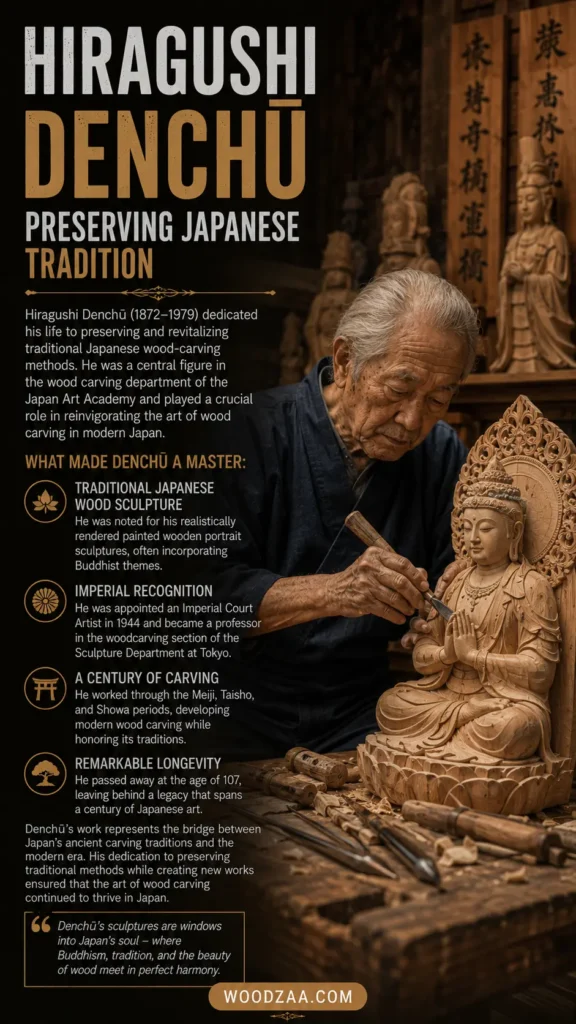
Hiragushi Denchū (1872–1979) dedicated his life to preserving and revitalizing traditional Japanese wood-carving methods. He was a central figure in the wood-carving department of the Japan Art Academy and played a crucial role in reinvigorating the art of wood carving in modern Japan.
What made Denchū a master:
- Traditional Japanese wood sculpture: He was noted for his realistically rendered painted wooden portrait sculptures, often incorporating Buddhist themes.
- Imperial recognition: He was appointed an Imperial Court Artist in 1944 and became a professor in the woodcarving section of the Sculpture Department at Tokyo.
- A century of carving: He worked through the Meiji, Taisho, and Showa periods, developing modern wood carving while honoring its traditions
- Remarkable longevity: He passed away at the age of 107, leaving behind a legacy that spans a century of Japanese art.
Denchū’s work represents the bridge between Japan’s ancient carving traditions and the modern era. His dedication to preserving traditional methods while creating new works ensured that the art of wood carving continued to thrive in Japan.
Worthy tip: “Denchū’s sculptures are windows into Japan’s soul – where Buddhism, tradition, and the beauty of wood meet in perfect harmony.”
4. Alexandre Noll: The Poet of Exotic Wood
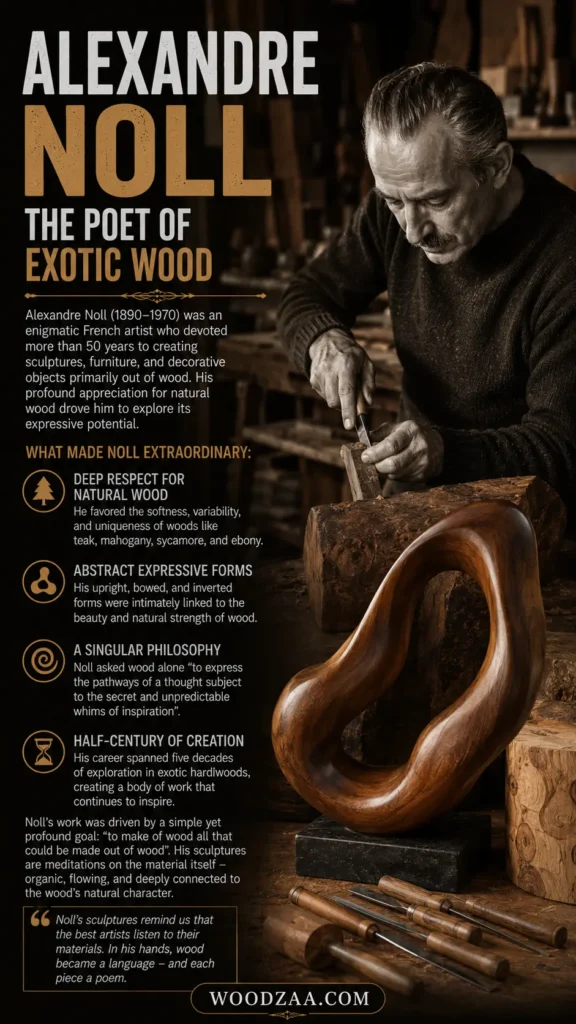
Alexandre Noll (1890–1970) was an enigmatic French artist who devoted more than 50 years to creating sculptures, furniture, and decorative objects primarily out of wood. His profound appreciation for natural wood drove him to explore its expressive potential.
What made Noll extraordinary:
- Deep respect for natural wood: He favored the softness, variability, and uniqueness of woods like teak, mahogany, sycamore, and ebony.
- Abstract expressive forms: His upright, bowed, and inverted forms were intimately linked to the beauty and natural strength of wood-
- A singular philosophy: Noll asked wood alone “to express the pathways of a thought subject to the secret and unpredictable whims of inspiration”
- Half-century of creation: His career spanned five decades of exploration in exotic hardwoods
Noll’s work was driven by a simple yet profound goal: “to make of wood all that could be made out of wood”. His sculptures are meditations on the material itself – organic, flowing, and deeply connected to the wood’s natural character.
Worthy tip: “Noll’s sculptures remind us that the best artists listen to their materials. In his hands, wood became a language – and each piece a poem.”
5. Lamidi Olonade Fakeye: The Guardian of Yoruba Tradition
Lamidi Olonade Fakeye (1928–2009) was a fifth-generation Yoruba wood carver from Nigeria, born into the prestigious “Fakeye Woodcarving Dynasty” – a family whose lineage has been traced to seven generations of woodcarvers. His name, Olonade, literally means “the carver has arrived.
What made Fakeye a master:
- Deep tradition: He received training in traditional Yoruba wood carving as a young boy and apprenticed under the renowned woodcarver George Arowoogun.
- Contemporary meets traditional: He merged contemporary influences with traditional Yoruba carving through intricate sculpting of religious and royal figures.
- One-block carving: From a single block of Iroko wood, he chiseled tall figures with highly detailed, geometric patterns and exaggerated, angled features
- Symbolism over representation: Due to the spiritual and ritualistic history of Yoruba wood carving, Fakeye emphasized symbolism over literal representation
Fakeye stands between traditional Yoruba artists and academically trained Nigerian artists who are part of the international contemporary art world. His work honors centuries of tradition while embracing new influences, making him one of Nigeria’s foremost traditional sculptors.
Worthy tip: “Fakeye’s carvings carry the weight of generations. Each piece is not just art – it’s a living connection to the Yoruba ancestors who came before.”
6. William Zorach: The Pioneer of Direct Carving
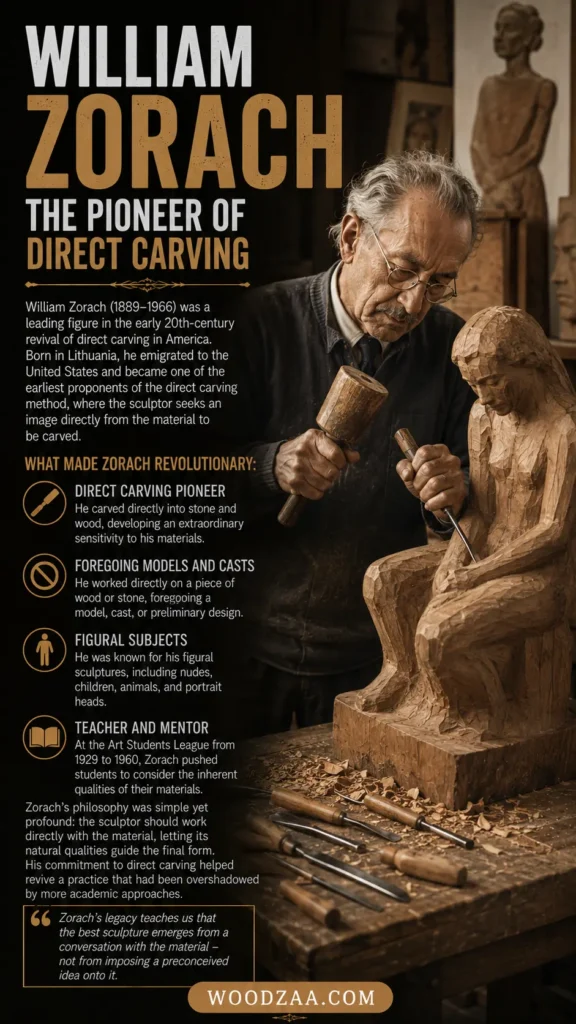
William Zorach (1889–1966) was a leading figure in the early 20th-century revival of direct carving in America. Born in Lithuania, he emigrated to the United States and became one of the earliest proponents of the direct carving method, where the sculptor seeks an image directly from the material to be carved.
What made Zorach revolutionary:
- Direct carving pioneer: He carved directly into stone and wood, developing an extraordinary sensitivity to his materials.
- Foregoing models and casts: He worked directly on a piece of wood or stone, foregoing a model, cast, or preliminary design
- Figural subjects: He was known for his figural sculptures, including nudes, children, animals, and portrait heads
- Teacher and mentor: At the Art Students League from 1929 to 1960, Zorach pushed students to consider the inherent qualities of their materials
Zorach’s philosophy was simple yet profound: the sculptor should work directly with the material, letting its natural qualities guide the final form. His commitment to direct carving helped revive a practice that had been overshadowed by more academic approaches.
Worthy tip: “Zorach’s legacy teaches us that the best sculpture emerges from a conversation with the material – not from imposing a preconceived idea onto it.”
7. Ursula von Rydingsvard: The Cedar Alchemist
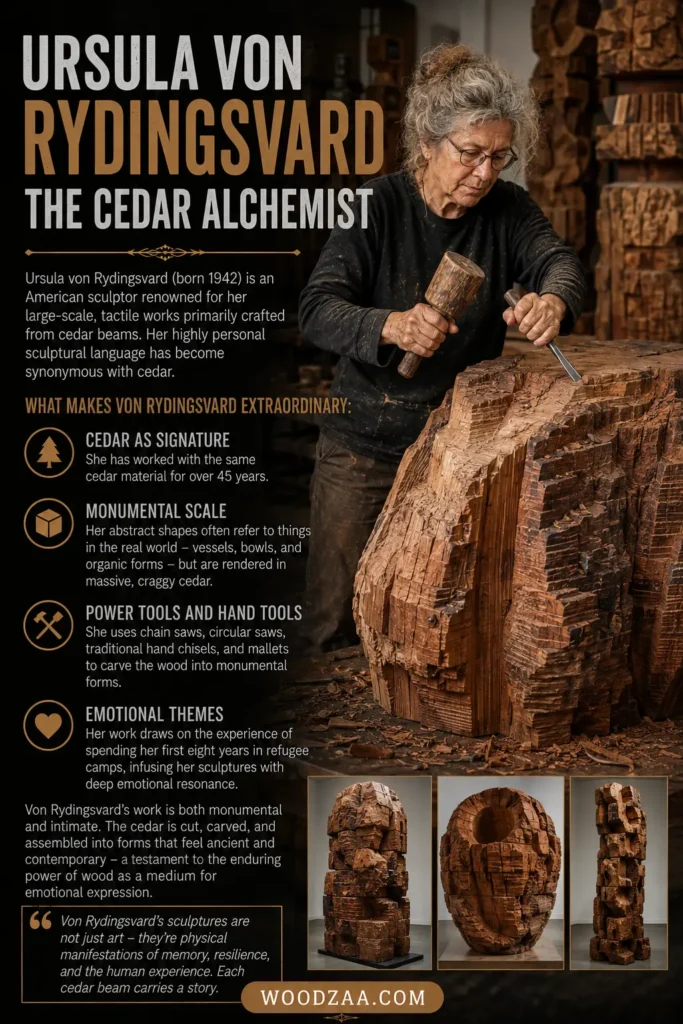
Ursula von Rydingsvard (born 1942) is an American sculptor renowned for her large-scale, tactile works primarily crafted from cedar beams. Her highly personal sculptural language has become synonymous with cedar.
What makes von Rydingsvard extraordinary:
- Cedar as signature: She has worked with the same cedar material for over 45 years.
- Monumental scale: Her abstract shapes often refer to things in the real world – vessels, bowls, and organic forms – but are rendered in massive, craggy cedar.
- Power tools and hand tools: She uses chain saws, circular saws, traditional hand chisels, and mallets to carve the wood into monumental forms.
- Emotional themes: Her work draws on the experience of spending her first eight years in refugee camps, infusing her sculptures with deep emotional resonance.
Von Rydingsvard’s work is both monumental and intimate. The cedar is cut, carved, and assembled into forms that feel ancient and contemporary – a testament to the enduring power of wood as a medium for emotional expression.
Worthy tip: “Von Rydingsvard’s sculptures are not just art – they’re physical manifestations of memory, resilience, and the human experience. Each cedar beam carries a story.”
8. David Nash: The Sculptor Who Grows His Art
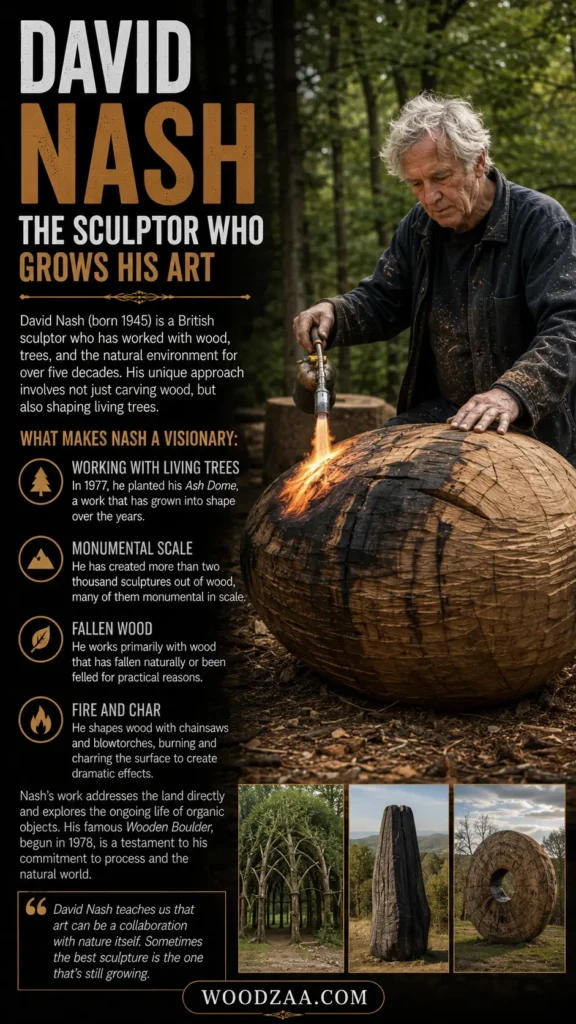
David Nash (born 1945) is a British sculptor who has worked with wood, trees, and the natural environment for over five decades. His unique approach involves not just carving wood, but also shaping living trees.
What makes Nash a visionary:
- Working with living trees: In 1977, he planted his Ash Dome, a work that has grown into shape over the years.
- Monumental scale: He has created more than two thousand sculptures out of wood, many of them monumental in scale.
- Fallen wood: He works primarily with wood that has fallen naturally or been felled for practical reasons.
- Fire and char: He shapes wood with chainsaws and blowtorches, burning and charring the surface to create dramatic effects
Nash’s work addresses the land directly and explores the ongoing life of organic objects. His famous Wooden Boulder, begun in 1978, is a testament to his commitment to process and the natural world.
Worthy tip: “David Nash teaches us that art can be a collaboration with nature itself. Sometimes the best sculpture is the one that’s still growing.”
9. Joseph Walsh: The Master of Gravity-Defying Wood
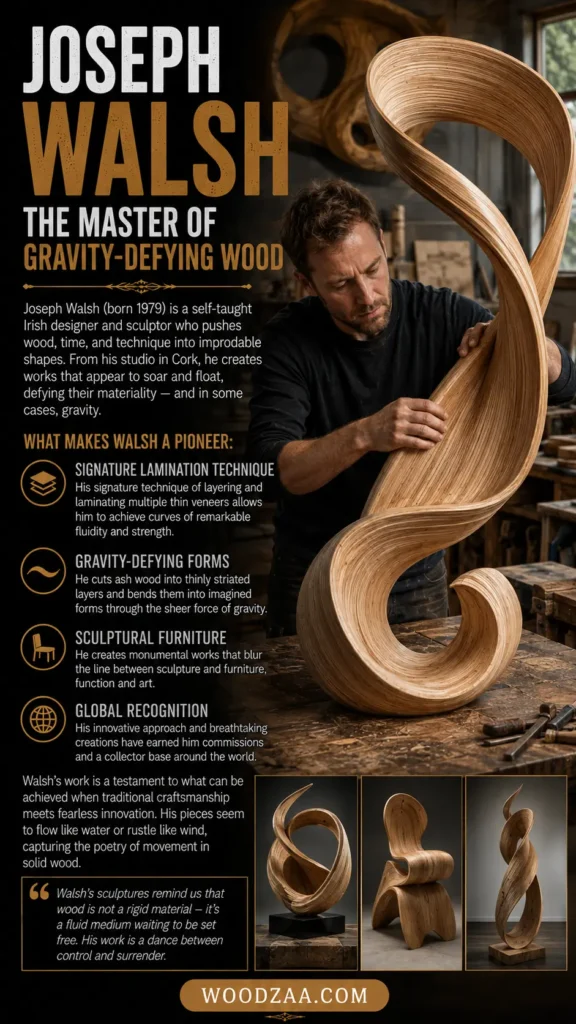
Joseph Walsh (born 1979) is a self-taught Irish designer and sculptor who pushes wood, time, and technique into improbable shapes. From his studio in Cork, he creates works that appear to soar and float, defying their materiality – and in some cases, gravity.
What makes Walsh a pioneer:
- Signature lamination technique: His signature technique of layering and laminating multiple thin veneers allows him to achieve curves of remarkable fluidity and strength.
- Gravity-defying forms: He cuts ash wood into thinly striated layers and bends them into imagined forms through the sheer force of gravity.
- Sculptural furniture: He creates monumental works that blur the line between sculpture and furniture
- Global recognition: His works are now commissioned and collected around the world.
Walsh’s work is a testament to what can be achieved when traditional craftsmanship meets fearless innovation. His pieces seem to flow like water or rustle like wind, capturing the poetry of movement in solid wood.
Worthy tip: “Walsh’s sculptures remind us that wood is not a rigid material – it’s a fluid medium waiting to be set free. His work is a dance between control and surrender.”
10. Raul De Lara: Storytelling Through Woodworking
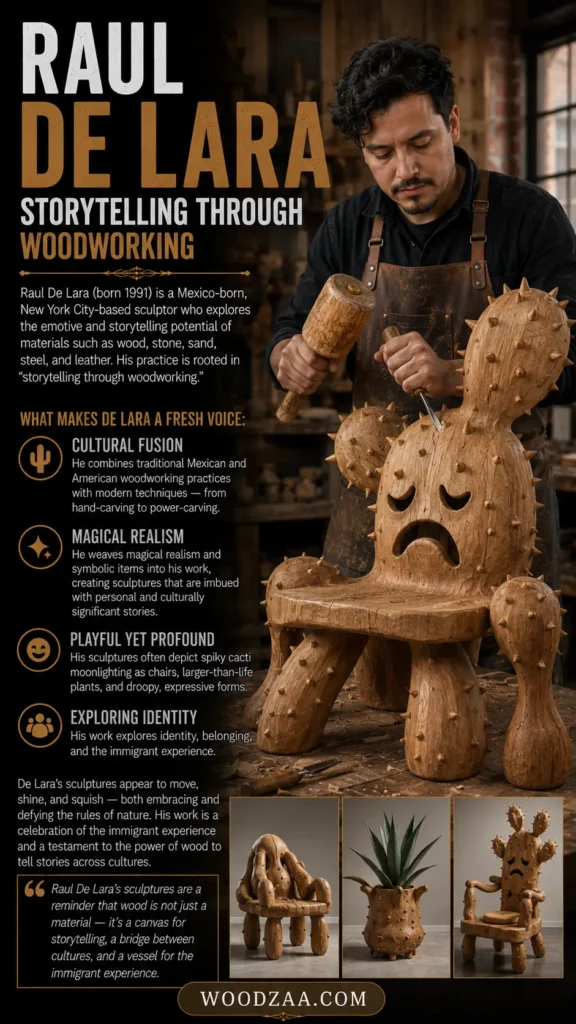
Raul De Lara (born 1991) is a Mexico-born, New York City–based sculptor who explores the emotive and storytelling potential of materials such as wood, stone, sand, steel, and leather. His practice is rooted in “storytelling through woodworking.
What makes De Lara a fresh voice:
- Cultural fusion: He combines traditional Mexican and American woodworking practices with modern techniques – from hand-carving to power-carving.
- Magical realism: He weaves magical realism and symbolic items into his work, creating sculptures that are imbued with personal and culturally significant stories.
- Playful yet profound: His sculptures often depict spiky cacti moonlighting as chairs, larger-than-life plants, and droopy, expressive forms
- Exploring identity: His work explores identity, belonging, and the immigrant experience.
De Lara’s sculptures appear to move, shine, and squish – both embracing and defying the rules of nature. His work is a celebration of the immigrant experience and a testament to the power of wood to tell stories across cultures.
Worthy tip: “Raul De Lara’s sculptures are a reminder that wood is not just a material – it’s a canvas for storytelling, a bridge between cultures, and a vessel for the immigrant experience.”
The Yoruba Wood Carving Tradition: A Living Legacy
Beyond individual artists, the Yoruba wood carving tradition represents one of the most significant and enduring sculptural traditions in the world. Spanning seven generations, the “Fakeye Woodcarving Dynasty” has produced master carvers who have shaped the course of Nigerian art.
Key figures include:
- Lamidi Olonade Fakeye: The fifth-generation master who merged contemporary influences with traditional Yoruba carving.
- Kasali Akangbe Ogun: A renowned Nigerian master wood carver, famous for his “unique artistic style, characterised by lean, elongated faces and dynamic, flowing forms”
- Bámigbóyè of Odo-Owa: A renowned Yoruba woodcarver who established his own workshop in the 1920s and was particularly known for carvings of Epa-style masks.
The Yoruba tradition emphasizes symbolism over literal representation, with figures often carrying deep spiritual and ritualistic meaning. It is a living tradition that continues to inspire new generations of artists worldwide.
Worthy tip: “The Yoruba carving tradition is a testament to the enduring power of wood as a medium for spiritual expression. Each carving carries the weight of centuries.”
From Timber to Treasure – Celebrating the Masters
You now have a comprehensive guide to famous wood sculpture artists you need to know about. From the intricate limewood carvings of Grinling Gibbons to the monumental ax-hewn sculptures of Dudley Carter, from the traditional mastery of Hiragushi Denchū to the poetic abstractions of Alexandre Noll, from the cultural legacy of Lamidi Olonade Fakeye to the direct carving philosophy of William Zorach, from the monumental cedar forms of Ursula von Rydingsvard to the growing art of David Nash, from the gravity-defying forms of Joseph Walsh to the storytelling woodwork of Raul De Lara – these artists represent the extraordinary range of what is possible in wood.
Each of these masters brought something unique to the medium – a new technique, a fresh perspective, or a deeper connection to culture and tradition. Their work reminds us that wood is not just a material; it’s a living medium with endless possibilities.
Table of Contents
Call to Action (CTA)
Which of these master wood sculptors inspires you most? I’d love to hear which artist’s work speaks to your soul. Email me at admin@woodzaa.com with “Wood Artists” in the subject line. Share your favourite artist – whether it’s Gibbons’ intricate detail, von Rydingsvard’s monumental cedar, or Walsh’s gravity-defying forms – and what draws you to their work. I’ll help you discover more about their art and how you can bring the spirit of their craftsmanship into your own space.
Let’s celebrate the masters who turned timber into treasure.
– Sheila

